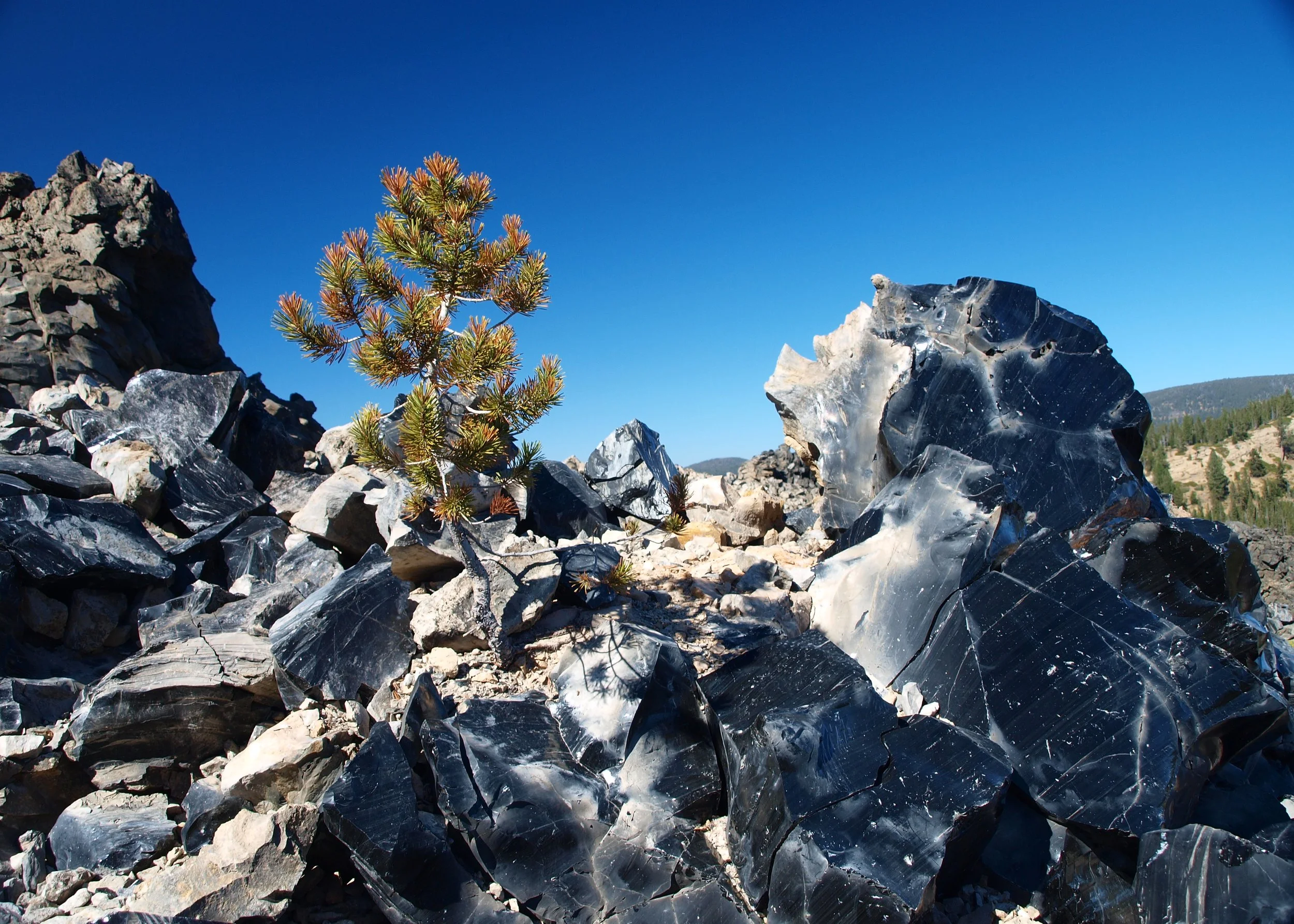
Obsidian is natural glass that has cooled rapidly from magma: melted, liquid rock. What then is glass, and how is it special? Technically, it is a material cooled from a liquid into a solid, and lacks a regular atomic structure. When a magma rises in the Earth, the atoms in the liquid arrange themselves to be in balance with the new, cooler condition at the surface, resulting in crystallization. But if cooling happens too fast for the atoms to get themselves organized, then a glass will form.
Glass has an atomic structure somewhere between the long-range order of crystals and the disorder of liquids. What little structure it has is at the cubic nanometer scale, and is homogenous in all directions. The absence of a preferred breaking direction is why glass “spalls” – one can cleave thin flakes from the surface, leaving a shiny fresh surface and very sharp edges. The broken surface is ridged and rounded, giving a shell-like appearance called “conchoidal fracture.” A spalled edge can be only a few atoms thick (a few ten millionths of a centimeter), sharper than can be achieved by grinding. Such edges have served humankind as knives, axes, arrows, scrapers, and spearpoints in the past, and are used in specialty scalpels for very fine surgery today.
Obsidian is quenched mainly from rhyolite magma and so occurs only in plate tectonic environments where such volcanoes occur, namely continental rifts, subduction zones (where one geological plate dives under another), and intraplate continental hotspots. Rhyolite is 70 to 78% silica (SiO2), by weight: silicon and oxygen, in the atomic proportion 1:2. Thin glassy margins are also common on fresh basalt flows, particularly underwater ones like those on Hawaii, where water quickly carries away the heat. Extensive glass deposits are comparatively uncommon in basalts, however; their melts have lower viscosity (that is, less resistance to flow) and greater tendency to arrange themselves into microcrystals during cooling. Other magma types with intermediate temperatures and silica content may also form glass upon cooling. But the high silica content of rhyolites, and its relatively cool magma state (with pre-eruption temperatures near 700 °C) make it the signature obsidian.
Another important attribute of rhyolite is that it commonly has high concentrations of elements that prefer to remain in melt, rather than crystallize. As a magma ascends in the Earth it may leave behind early crystallizing minerals, while still carrying melt-loving components like rubidium, niobium, zirconium, and thorium. The end point is a material highly enriched with these trace elements. Each rhyolite has its own unique proportion of these “impurities,” which in turn means that obsidians can be readily chemically fingerprinted. In some instances, rhyolite eruption occurred during human occupation. Precise dating of the resulting obsidian allows us to track the development of ancient trade routes.
Rhyolites are also noted for erupting explosively, owing to the overpressure of gasses trapped in the viscous melt. After explosive venting, an effusive lava-producing stage can lead to thick stubby flows or domes with thick glassy margins. Movement of the sticky lava causes abundant shear, which leads to flow layering: trapped gas bubbles or small crystals are segregated into different layers, resulting in a visible banding in the rock. If the lava moves too fast for the magma to respond in a fluid way, then it may break into chunks, particularly at the flow surface where the lava is cool, and so more brittle. The interior cools more slowly, and glass is replaced by micro-crystals. Hot gases may rise near the vent and cause oxidation - essentially rusting - of trace iron in the rhyolite, causing the obsidian to be red. Cannibalistic entrainment of fragments of lava by successive episodes of flow can give complex and beautiful textures. While most obsidian occurs in lavas, rhyolite deposits from explosive eruptions may weld together under their own heat and weight, fusing the pumice fragments, and produce thick glassy obsidian zones at their base.
Fresh obsidian is typically black (owing to very tiny needles of the iron oxide mineral magnetite) and has a shiny luster, which becomes more resinous, and dull in appearance, as the glass absorbs water from the atmosphere. In scientific parlance, we say that the absorption of water causes a “hydration rind” on the obsidian. The thickness of this rind can be used to estimate the age of a flow, or even of a complete artifact, if one knows the water diffusion rate into the glass, which in turn depends on the climate and the composition of the obsidian.
The physical properties of obsidian, a hardness greater than that of ordinary steel and the ability to cleave to a fine edge, have made obsidian a prized material for millennia. The sheer beauty of this shiny, glassy material also draws us in. It may be black, red, orange, green, gray, clear and even rainbow; partly crystallized obsidian can be speckled with white, yielding a “snow-flake” obsidian. A special kind of natural glass can be also formed without volcanic processes, by meteorite impact. The resulting spray of melt freezes to make blobs and beads of glass called tektites, colloquially known as “cosmic obsidian.” Every rock shop will feature an array of these various obsidians, in all colors and textures, speaking eloquently to our continued fascination with this ancient material.