Recreations of the mind
Shawkat M. Toorawa
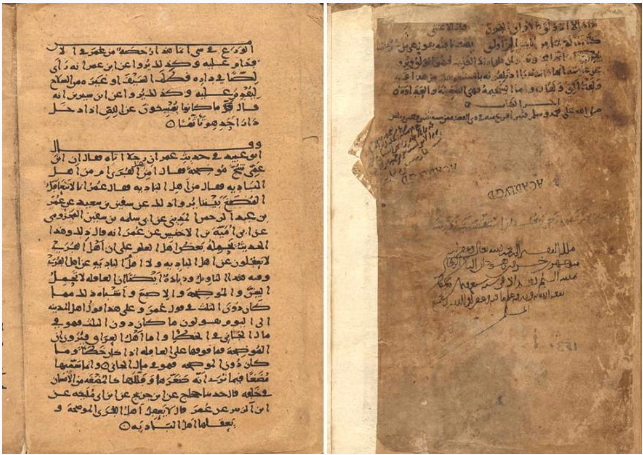
Abū ʿUbayd al-Qāsim Ibn Sallām (late 867 AD), Gharīb al-Ḥadīth (incomplete), Manuscript Or. 298, Legatum Warnerianum, Leiden University.
According to the eleventh-century author al-Thaʿalibi, paper and papermaking was introduced to lands under Muslim rule when forces of the Abbasid and Tang dynasties met at the Battle of Talas, in present-day Kyrgyzstan, in 751. The Abbasids took Chinese prisoners. One of them, the travel writer Du Huan, mentions weavers and metalsmiths among his fellow captives; it is possible papermakers were among them as well.
Al-Thaʿalibi’s story of the advent of papermaking in the heartland is likely romanticized, as happens when wondrous events are recounted. His statement that paper passed into general use in Muslim lands, however, is clearly accurate. Papermaking would already have been known in Central Asia, where it was made principally from rags of flax and cotton (not hemp or mulberry, as in southern China), as we know from a stash of 20,000 documents discovered in Egypt in the late 19th century. But the impact of paper made from linen and cotton rags, first in Baghdad, and thence on Islamic societies, was extensive, far-reaching, transformative, and irrevocable.
Paper was here to stay, and it didn’t just stay in Baghdad. The Muslims carried it to the west, from Iraq into Syria, Egypt, North Africa, Sicily, and Spain. One piece of linguistic evidence of this westward movement of paper is the English word “ream,” from Old French rayme, Spanish resma, and ultimately Arabic rizmah, bundle.
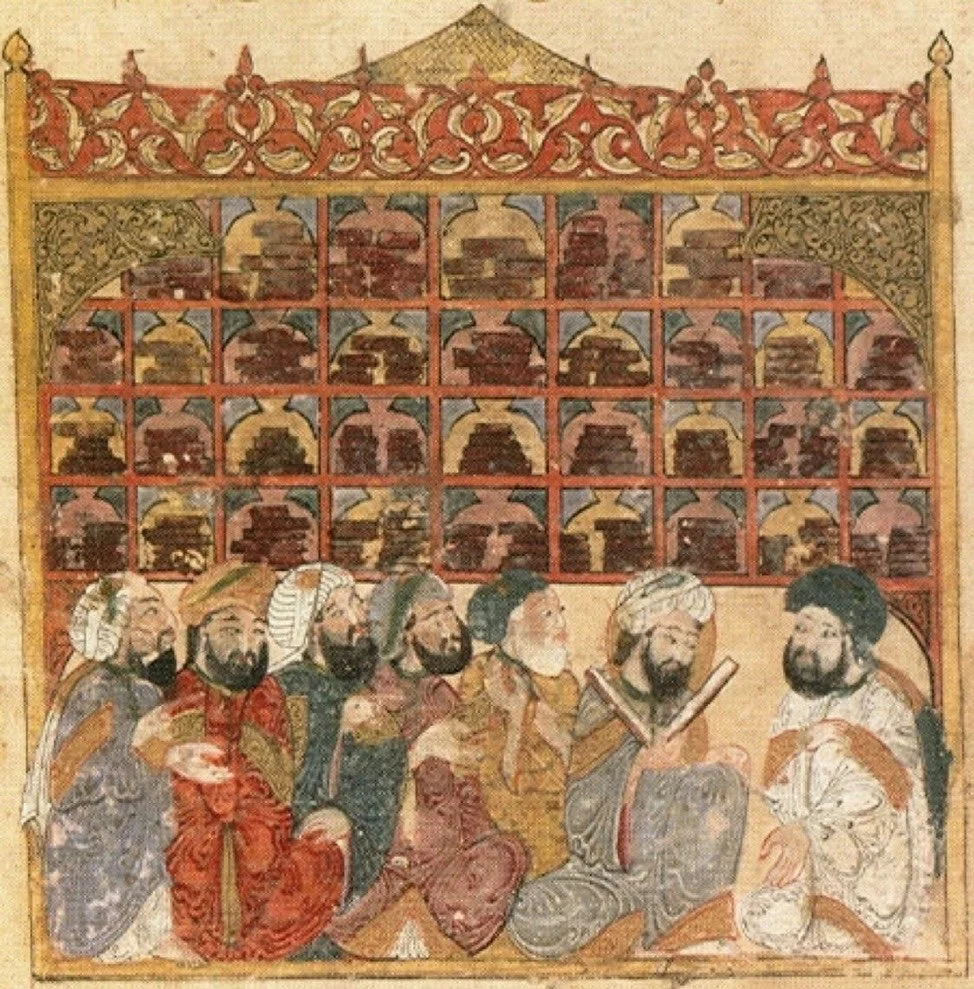
Illustration by Yaḥyā ibn Maḥmd al-Wāsiṭī in a manuscript of the Maqāmāt of al-Ḥarīrī (13th century AD), Bibliotheque Nationale de France, MS Arabe 5847.
The use and dissemination of paper in Europe was limited until the invention of the printing press. In societies under Muslim rule, paper reached far and wide without it – mechanical printing was not introduced there until the early 18th century. The first printed Qur’an was consequently produced in Europe, in Venice in 1538, not in Arabic-speaking lands. But already in the 7th century, we find in the Qur’an the word qirṭās, meaning “sheaf of parchment,” from the ancient Greek khártēs (parchment, or writing paper). The celebrated 10th century poet al-Mutanabbī uses qirṭās in one of his most quoted lines:
al-laylu wal-khaylu wal-bayḍāʾu taʿrifunī
was-sayfu war-rumḥu wal-qirṭāsu wal-qalamū
I am well-known to the night, to horses and the desert,
to swords and lances, and to parchment and pen
The availability of paper - less expensive than parchment derived from animal skin - led to an increase in the number of books and that increase in turn led the establishment of new venues for learning and study: the private homes of munificent patrons and fellow-scholars, colleges of law, and public and private libraries. The astromancer, courtier, and bookman Ibn al-Munajjim (d. 889) collected a large personal library which he called the Khizānat al-Ḥikmah, The Treasury of Wisdom, where he provided stipends of free paper and other materials to all callers. The scholar, courtier, chess master, and bookman al-Ṣūlī (d. 946) also collected an outstanding personal library, which he allowed others to use. Of his library, one of his students said: “I saw a large room of al-Ṣūlī’s filled with books, stacked on shelves, their bindings in different colors. Each bookshelf was one color; one shelf was red, another green, another yellow, and so on...”
The common Arabic word for paper was waraq, literally “leaf” or “sheet.” From this term came another, warrāq, literally “papermaker,” which was initially applied only to craftsmen but soon was broadened to refer to stationers, copyists, and booksellers. By the ninth century, there were as many as one hundred bookshops in the Bookmen’s Market (sūq al-warrāqīn) of Baghdad. One could not only buy texts there, but also consult them: the bibliographer Ibn al-Nadim (d. 998) reports that the great essayist al-Jāḥiẓ (d. 868) would rent the shops of the warrāqs and spend his nights there, poring over the books.
Paper also meant permanence, as it enshrined the literary, scholarly, scientific, and storytelling output in a physical artifact. The lexicographer Ibn Durayd (d. 933) is reported to have pointed out at a literary gathering:
Let others see their recreation
In beautiful songstresses and wine,
What we offer are literary gatherings and books
As recreations of the mind.
To this day, even after the ravages of war and occupation, Baghdad’s al-Mutanabbi Street (named after the poet cited above) teems with books. The potential that flax, cotton, and woodpulp unleashed have been as limitless as the imagination of the Muslim writers who, for over a millennium, have been putting pen to paper.
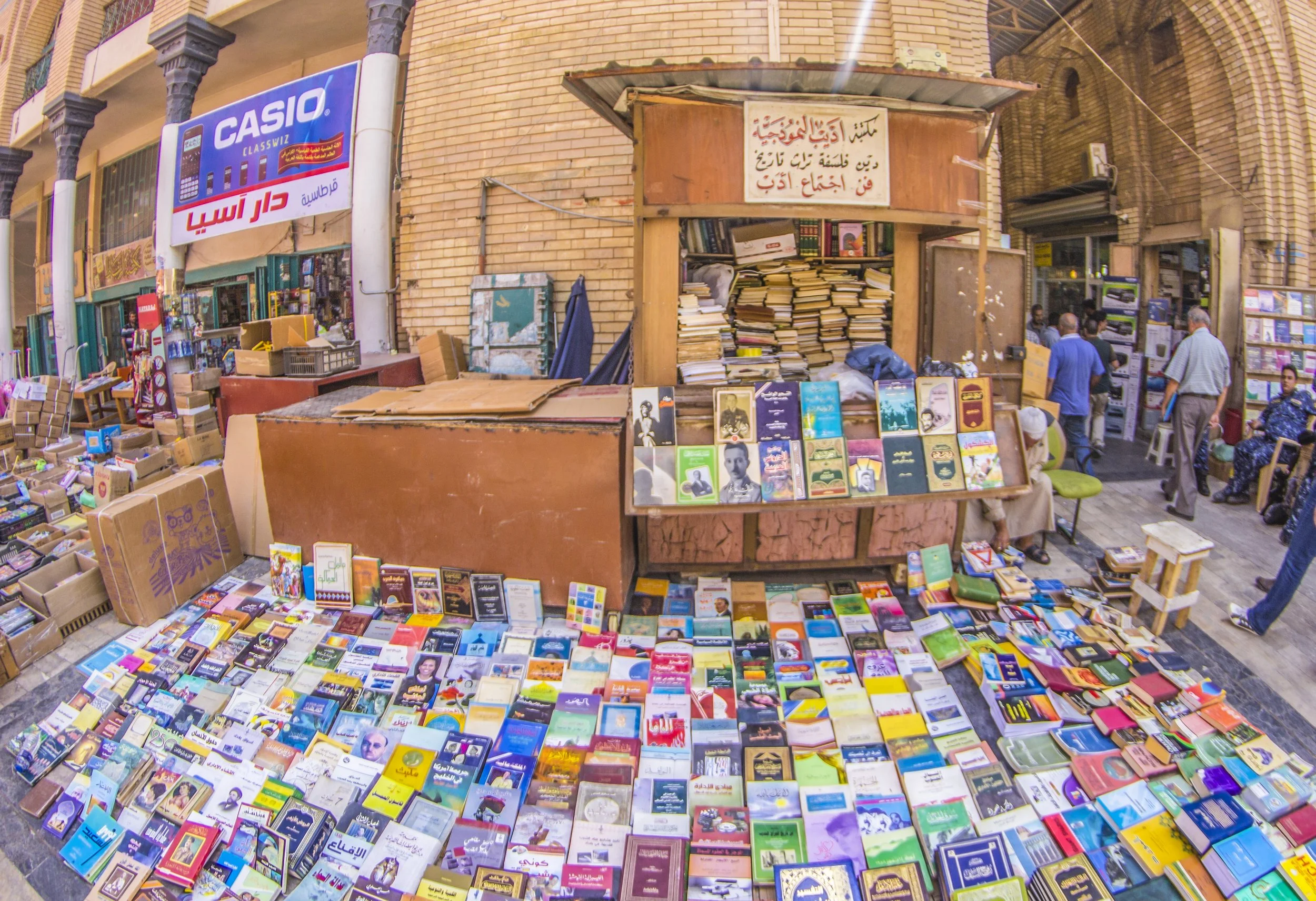
A typical scene of books on display at bookshops on Al-Mutanabbī Street in Baghdad, 2015.