The materiality of math
Alexander Mann
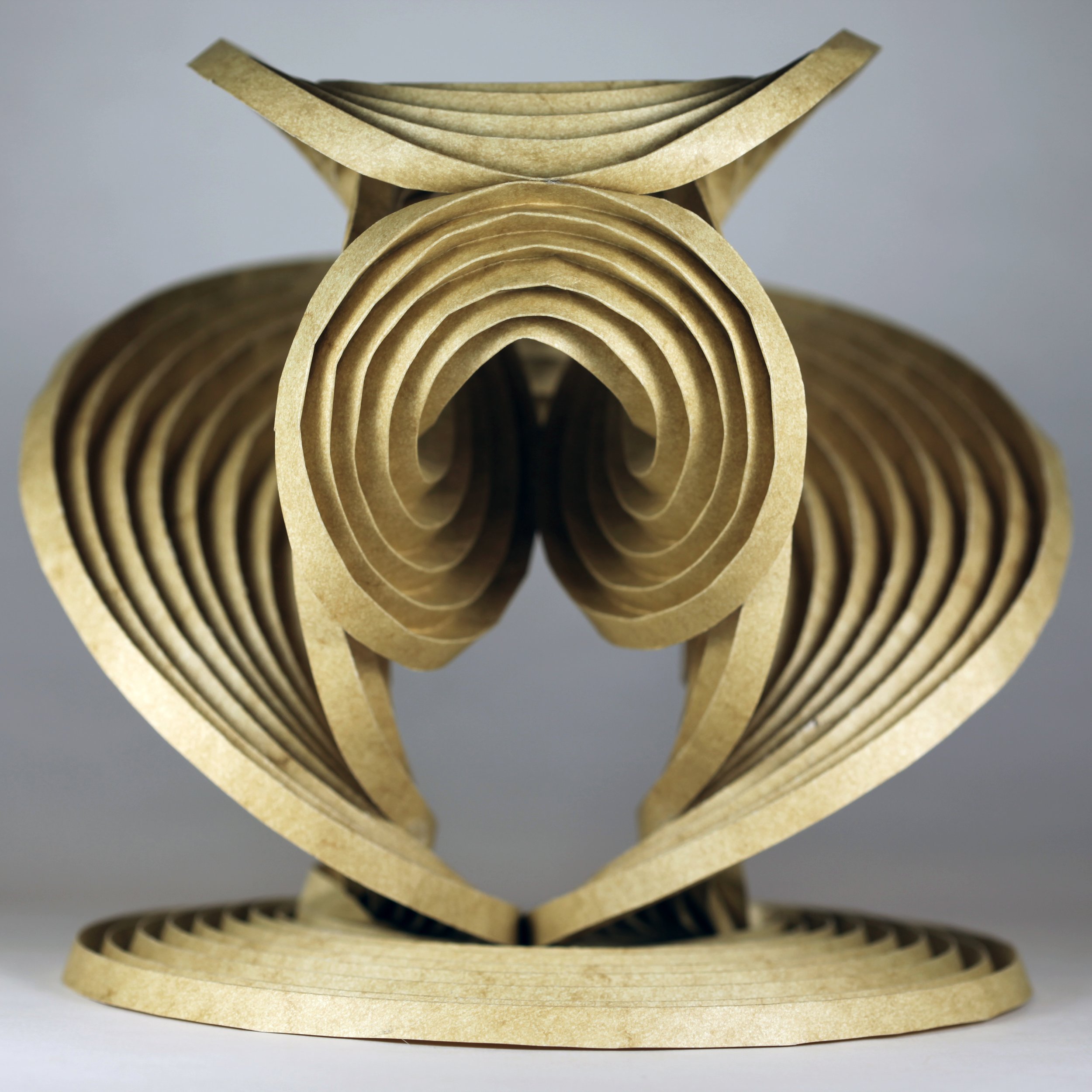
Erik Demaine (American, born Canada 1981– ), Martin Demaine (American, 1942– ), Natural Cycles, 2009, Zanders Elefantenhaut paper (elephant hide paper), 9 x 9 x 9 in. (22.9 x 22.9 x 22.9 cm), Smithsonian American Art Museum, 2011.54.1 © 2009, Erik and Martin Demaine.
A common sheet of paper can only be folded about seven times. This has little to do with the folder’s strength or dexterity. It is, rather, a matter of mathematics. Folding paper once gets you the thickness of two sheets. Fold it twice, four sheets. Three times, eight. Once you reach seven folds, that is one hundred and twenty-eight sheets of paper. The radius of the fold simply cannot encompass the exponential increase.
Paper offers us a very tactile experience of math. As an art form, we know this as origami. But while something like geometry or trigonometry exists in a pure idealized state, paper has imperfections, tears, and depth. A digital model of origami is an example of pure math: it typically assumes that the paper has no depth, and therefore no fold radius. The real world is messier. Even some very simple shapes, such as pentagons, can only be approximated. The problem is that when you fold something, you are inherently dividing or multiplying by two. Getting to five edges is therefore a difficult task. One can achieve what looks like a pentagon in seven folds, but its sides will actually have lengths in a ratio of 1 x 1 x 1 x 1.04 x 1.04. Imperceptibly different to the human eye… but nevertheless, different.
Unlike other forms of making, which are either additive or subtractive, in origami there is typically no cutting or gluing. Just folding. Styles range from the interpretive to the realistic, with some simply approximating a form, and others aiming to be scale models. The greater the detail, the more folds and layers are required. As layers increase, the radius problem crops up, and the bulk of the paper prevents edges from lining up nicely. In other words, there is a gap.
There are clever ways around this problem. One is to “cheat” some folds, using less paper, so as to leave a little more material for the finishing exterior surfaces. Another is to actually stretch the paper. A technique developed by Akira Yoshizawa involves wetting a series of angular polygon folds and smoothing them into curves and volumes. The resulting dried paper will actually be stiffer because the pulp and fibers have realigned. In this same fashion, makers use this technique to stretch the edges of folds to render the radius more pliable. Of course, not all papers like being treated this way. If the material is too loosely bound, it may dissolve. If it is too thick or starchy, it may just rip.
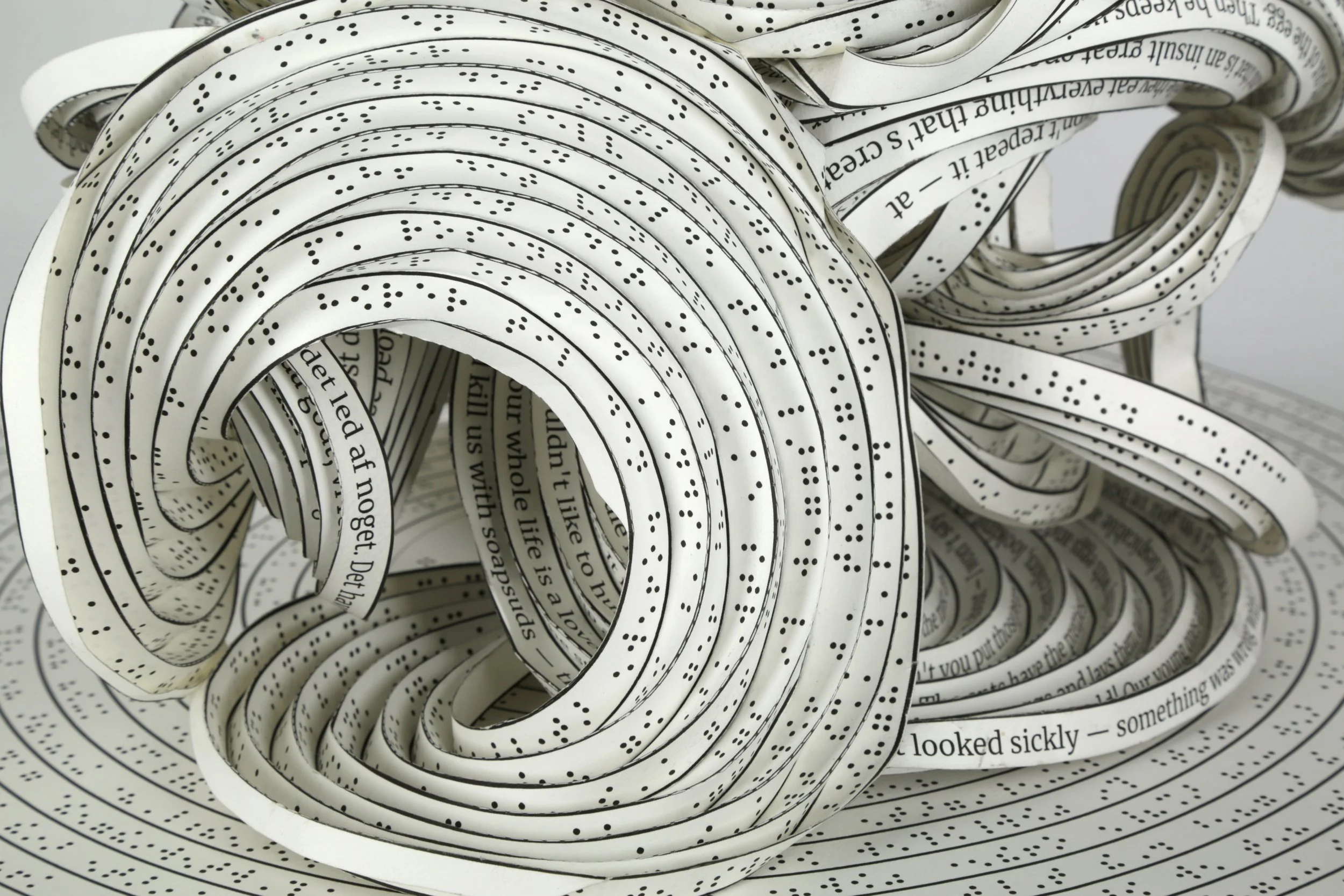
Erik Demaine (American, born Canada 1981– ), Martin Demaine (American, 1942– ), Aphid Spirals / ⠁⠏⠓⠊⠙⠀⠎⠏⠊⠗⠁⠇⠎ , 2023, Mi-Teintes paper, 12 × 15 × 15 in. (30.5 x 30.5 x 38.1 cm) © 2023, Erik and Martin Demaine.
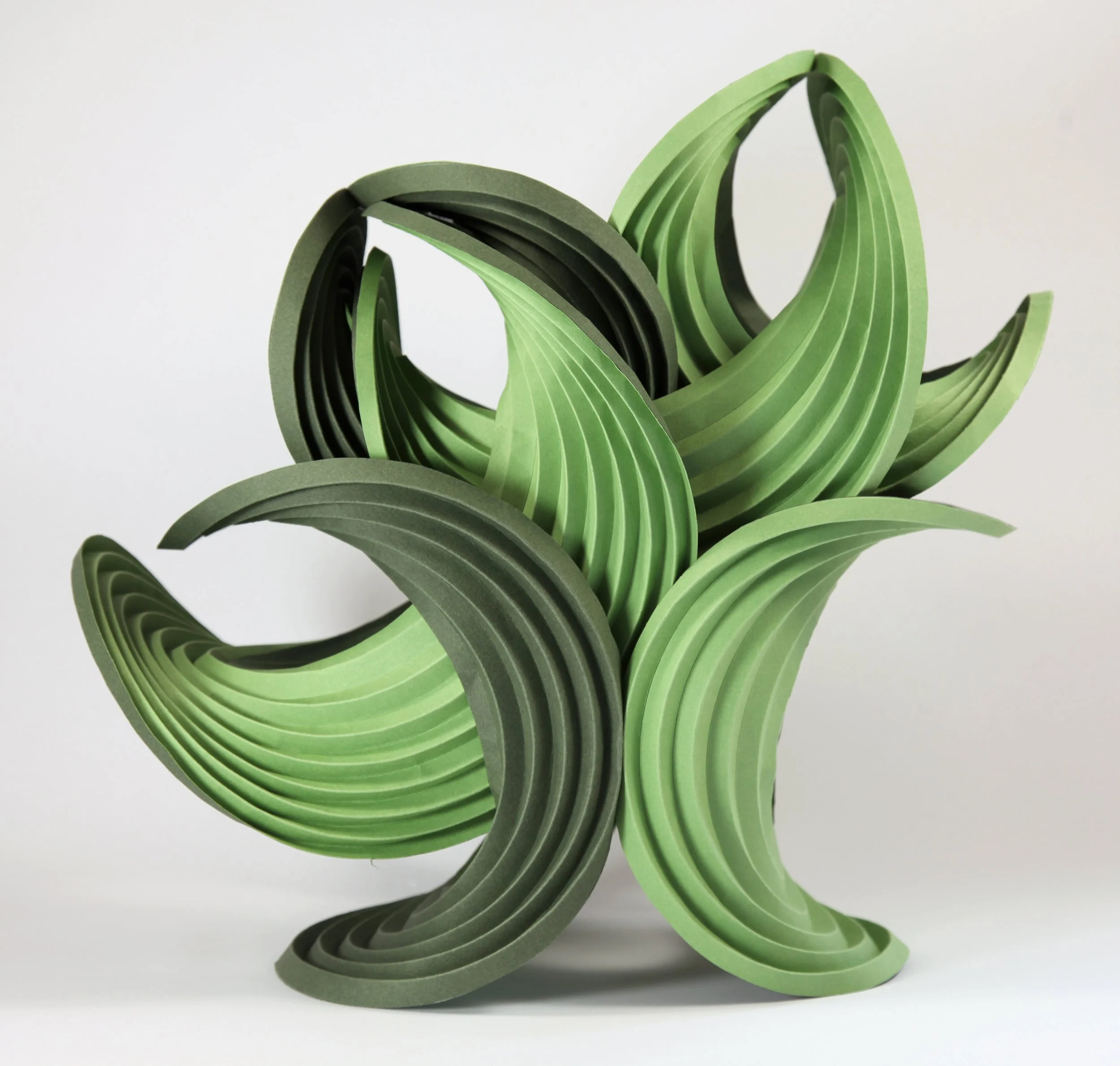
Erik Demaine (American, born Canada 1981– ), Martin Demaine (American, 1942– ), Green Balance, 2011, Mi-Teintes watercolor paper, 15 x 10 x 16 in. (38.1 x 25.4 x 40.6 cm), Smithsonian American Art Museum, 2011.54.3 © 2011, Erik and Martin Demaine.
While many different kinds of paper can be used to fold origami–dollar bills happen to be a good choice–the most desirable quality is the ability to hold an edge. Traditional Japanese origami paper is defined by this characteristic, as well as its combination of thinness and strength. These qualities are always in tension with one another. The Japanese company Hidaka Washi makes tengujo, the thinnest paper in the world, at 0.02 millimeters. Its long fibers made of mulberry make it useful for stabilizing works on paper in conservation. One might think that its extreme thinness would make it equally ideal for origami, as it approaches the pure math zero depth paper plane. But when origamist Kevin Hutson used it to create a daddy longlegs spider, he found it to be too soft and delicate to hold an edge. He therefore had to treat it with methyl cellulose in order for it to be “crisp.”
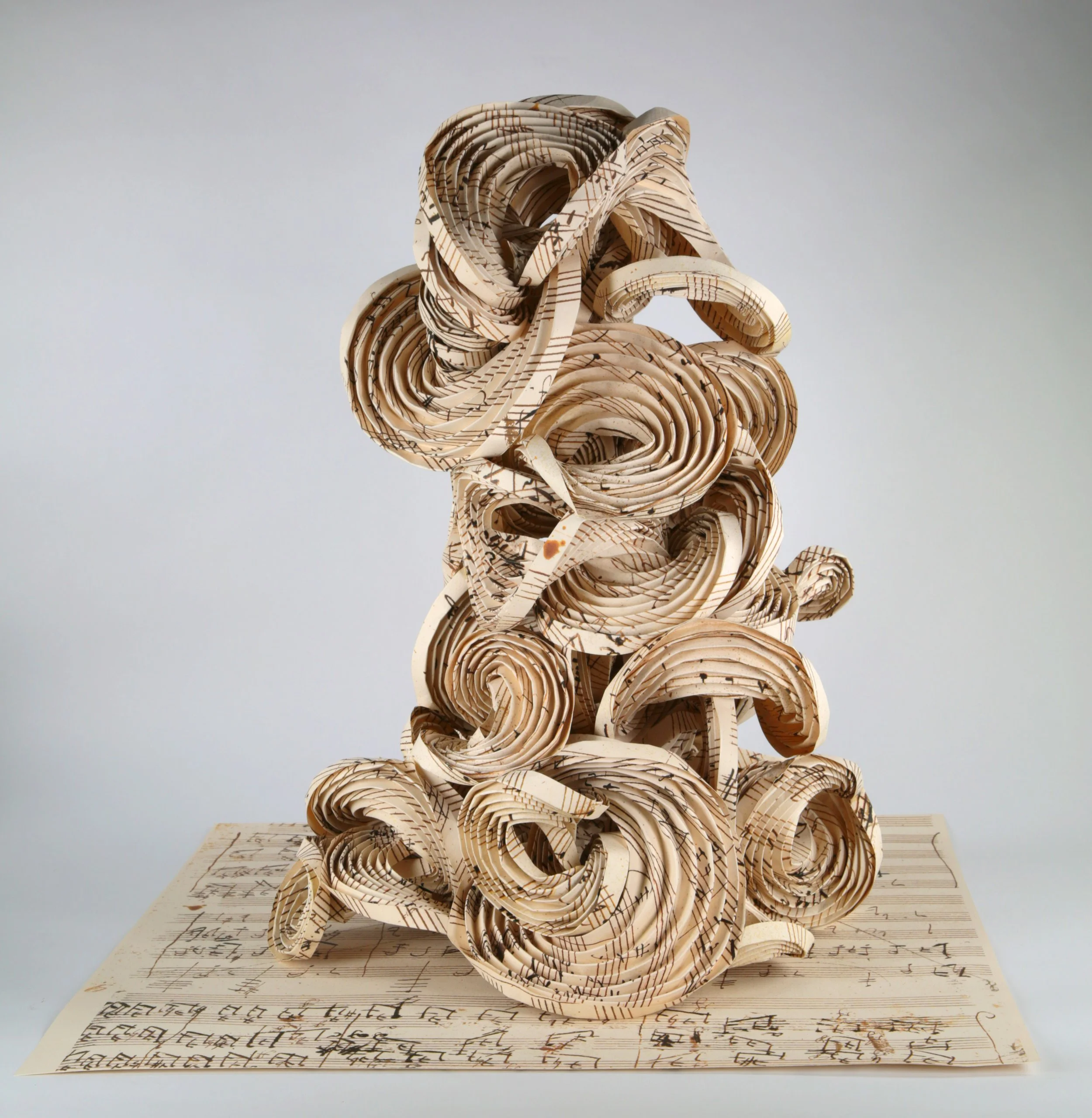
Erik Demaine (American, born Canada 1981– ), Martin Demaine (American, 1942– ), Grosse Fugal Form, 2021, Mi-Teintes paper, 12 × 12 × 17 in. (30.5 x 30.5 x 43.2 cm) © 2021, Erik and Martin Demaine.
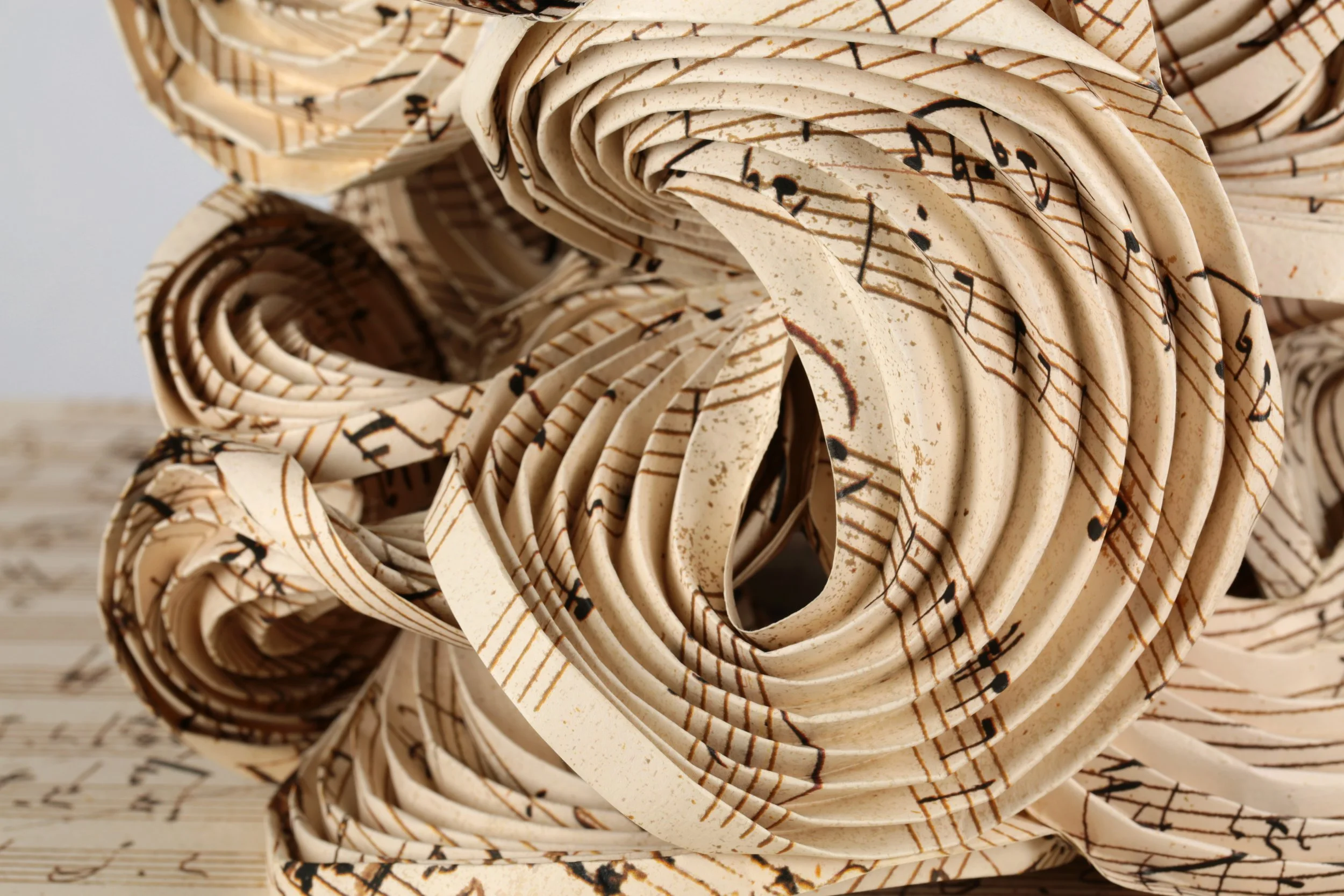
Erik Demaine (American, born Canada 1981– ), Martin Demaine (American, 1942– ), Grosse Fugal Form (Detail), 2021, Mi-Teintes paper, 12 × 12 × 17 in. (30.5 x 30.5 x 43.2 cm) © 2021, Erik and Martin Demaine.