Ficus elastica beyond the plantation
Aparajita Majumdar
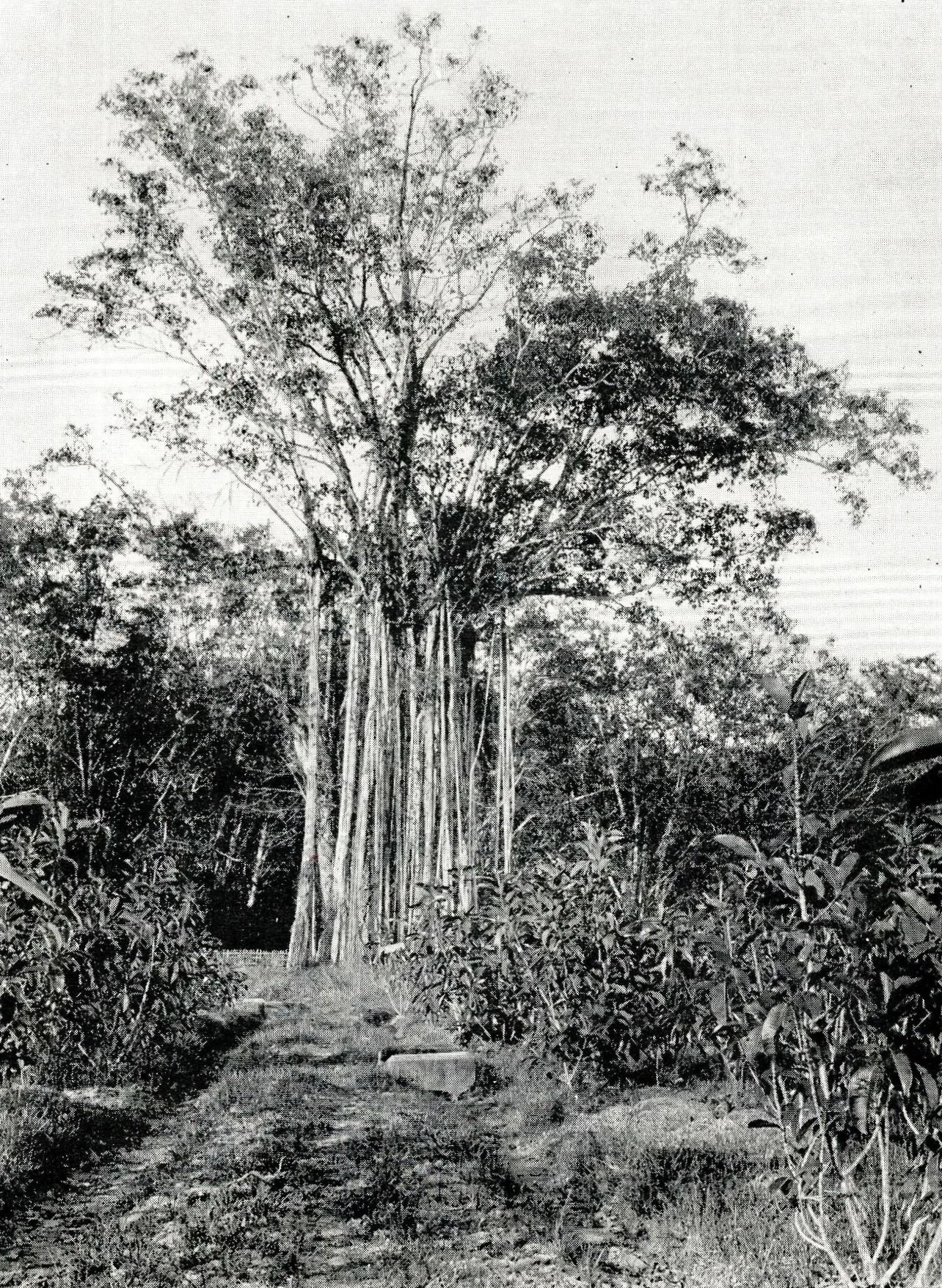
A wild Ficus elastica tree about of 120 feet high. Photo, Ficus Elastica: Its Natural Growth and Artificial Propagation, 1906, E. M. Coventry.
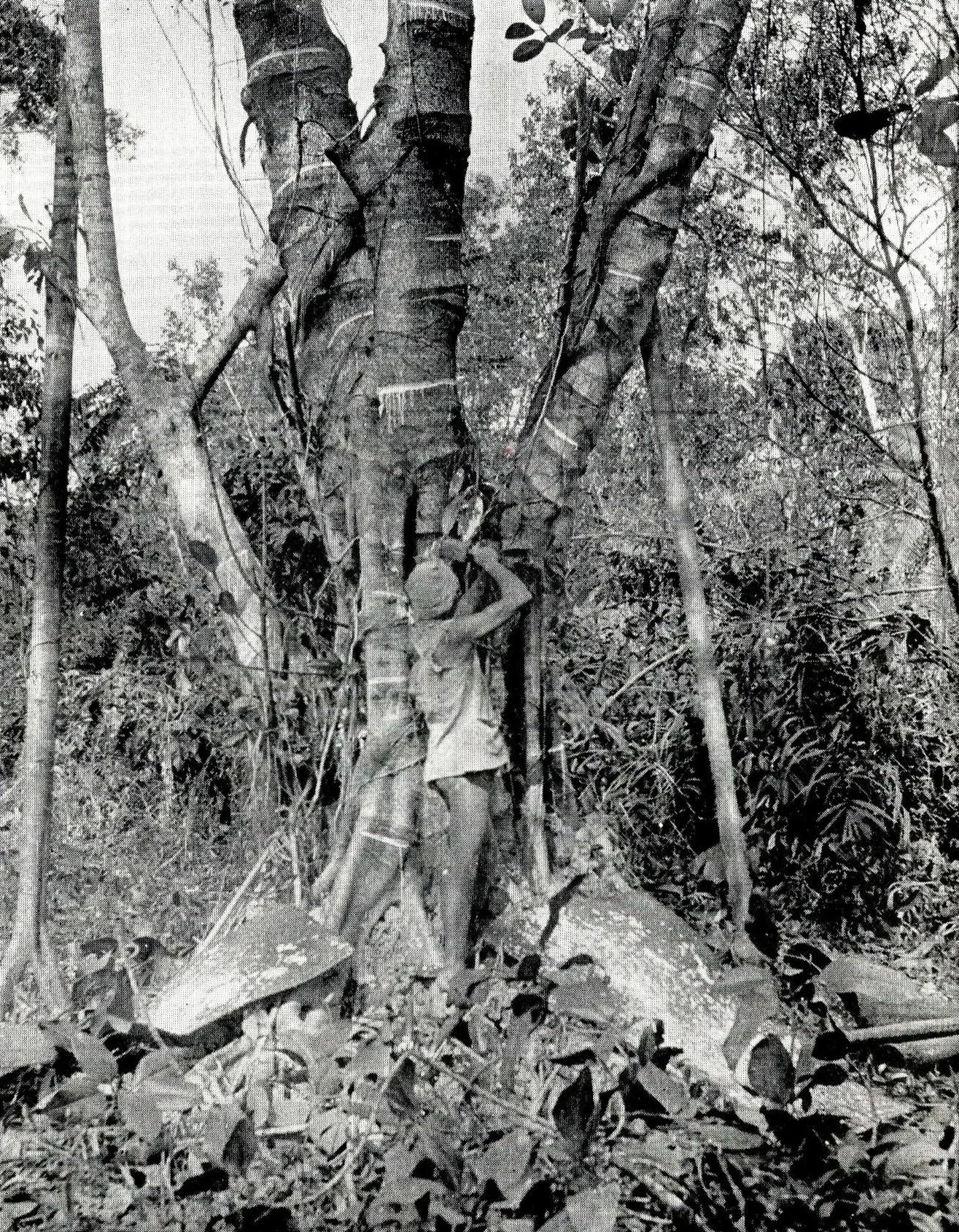
An indigenous rubber tapper collecting latex from a wild Ficus elastica in colonial Assam. Photo, Ficus Elastica: Its Natural Growth and Artificial Propagation, 1906, E. M. Coventry.
Ficus elastica—an Asian species of the rubber tree—is often ignored by the historians of rubber, because it failed to make a mark in the plantation economy. Its untold story, however, reveals a complex tale about resource extraction at the frontiers of the British Empire, which displaced earlier, environmentally-sustainable, indigenous ways of being, forgotten by postcolonial regimes.
In the Khasi and Jaintia hills of Meghalaya in northeast India, close to the borders of Bangladesh, Ficus elastica has many names. In the village of Rangthylliang, the tree is called Jri Bamon, suggesting a wilful, moody tree that grows only where it wishes (mostly on steep, wet terrains like the edges of rocky waterfalls and the brinks of flowing streams). Morningstar Khongthaw, an indigenous activist from Rangthylliang, describes how their ancestors guided the Jri Bamon to make the jing kieng jri: the living root bridge. Jri Bamon’s pliable aerial roots were woven around dead wood like bamboo and betel nut trunks, and then placed across a river. Once woven, the roots continuously renew and regenerate themselves, making the bridge an animated, durable structure that can survive for several centuries.
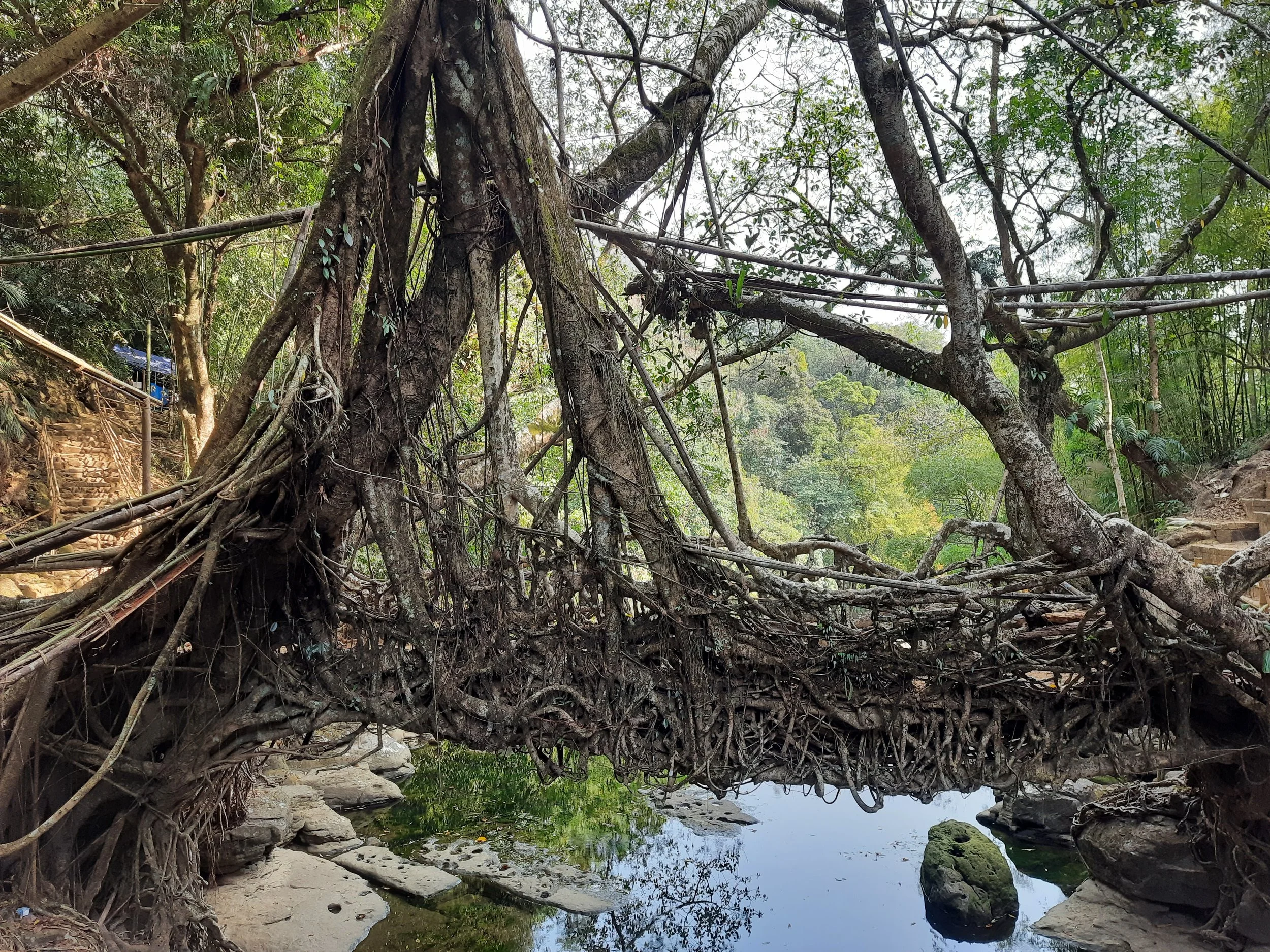
A several centuries-old living root bridge located in the East Khasi Hills District, Meghalaya, Northeast India. Photo, Aparajita Majumdar.
Historically, living root bridges allowed people and goods to traverse the deep gorges of the Khasi hills, and down into the floodplains of Bangladesh. With the drawing of new borders between northeast India and Bangladesh, however, many of these pathways were obstructed and the old root bridges were lost in the jungle, forgotten. Morningstar’s grassroots organization—the Living Bridge Foundation—is now campaigning to revive the indigenous culture of ‘growing’ root bridges in Meghalaya. The region, in the past decades, has seen intense environmental degradation due to a proliferation of government and big corporation-led limestone extraction and cement plants in its hills. Countering this extractive culture, the Foundation is disseminating the knowledge of older indigenous experts to a younger generation for the purpose of growing new, living infrastructures in the region.
Morningstar’s work inspires a reimagining of humanity’s relationship with technology and growth. A Jri Bamon takes, on average, several decades to span a gorge and become a bridge. Once established, however, its roots hold fast, even in slippery soil. The root bridge is an antithesis of the fast growth-oriented “plantationocene era” — a term proposed by scholars like Donna Haraway and Anna Tsing for a historical epoch dominated by extractive logics and monoculture-cropping for the quick production of commodities in bulk.
In the nineteenth century, British botanists categorized Jri Bamon as the rubber tree—Ficus elastica—and unleashed a colonizing extractive logic in the north-eastern frontiers of British India. Forests in Assam were leased by the colonial government to the highest bidder, who within a short time extracted maximum latex from the wild trees to feed the rapidly-growing rubber industries. For several decades this system worked profitably for the government and the bidders, but in the 1870s, reports about the trees dying from over-extraction emerged. Around the same time, the colonial government also worried about what it called the ‘contraband’ rubber trade between indigenous peoples and independent speculators who entered the frontier market.
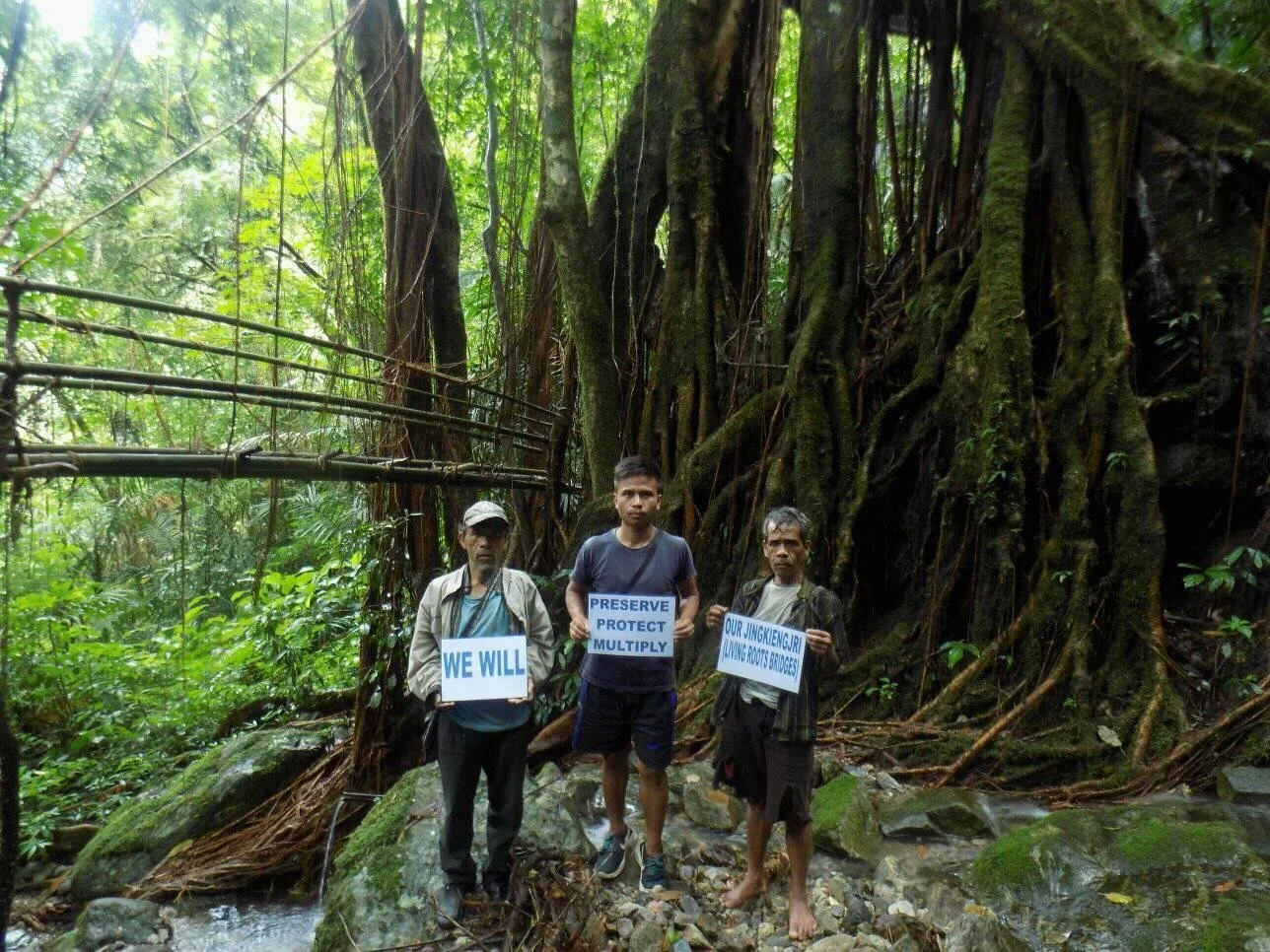
Morningstar Khongthaw (in the middle) with his friends, standing in the backdrop of a 200 to 300-year-old Jri Bamon, to campaign for the ‘preservation,’ ‘protection’ and ‘multiplication’ of living root bridges. Photo, Morningstar Khongthaw.