Chakaia Booker: “Art has no season”
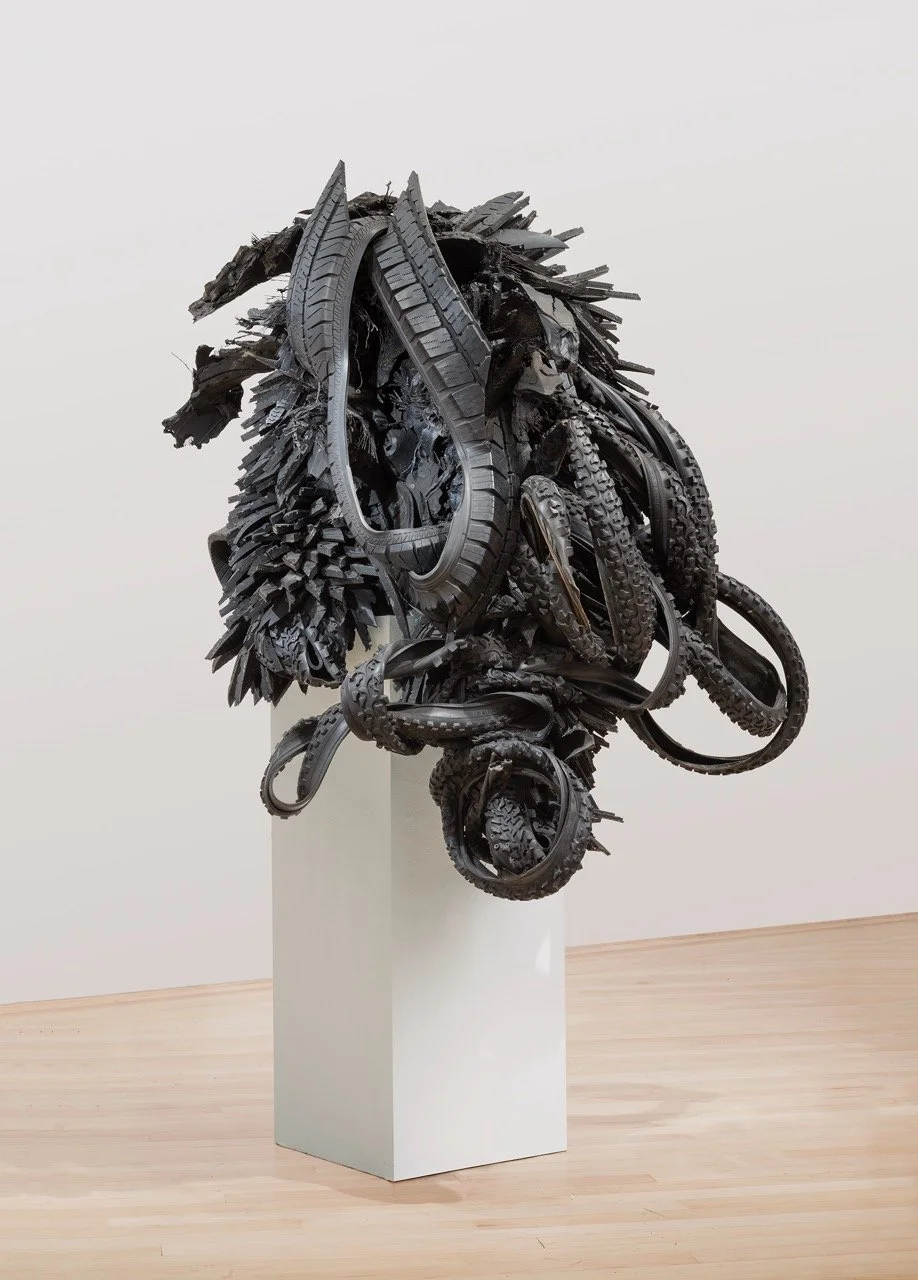
Chakaia Booker (American, born 1953), El Gato, 2001, Rubber tires, and wood, 48 x 42 x 42 in. Collection of the Kemper Museum of Contemporary Art, Kansas City, Missouri, Bebe and Crosby Kemper Collection, Museum purchase, Enid and Crosby Kemper and William T Kemper Acquisition Fund, 2004.12.01 © Chakaia Booker. Photo: E. G. Schempf, 2017.
Phil Sanders & Sara Sanders
“Everything matters, every detail, every thought, every touch,
every smell, because we carry it all with us, and when we
need these experiences, they are there for us, to help us solve the
problem at hand.”
–Chakaia Booker
Chakaia Booker’s abstract sculpture embodies urgency, grace, and allure that belie its materiality. Her novel use of cast-off rubber tires as a primary art material over the last thirty years, has claimed for her a singular place in the artistic canon. The evolution of Booker’s work mirrors the evolution of rubber tires themselves and the politics surrounding them, as driving habits have changed and laws have been enacted to govern manufacture, wear, and disposal. The material, fraught with a troubling origin story, is both ecologically destructive and vexingly durable. Booker has tackled all of these challenges head-on through her evolving material literacy with rubber to create one of the most recognizable and significant bodies of work by a living artist.
Booker first began using rubber tires in the late 1980s as a young artist living in New York City. Still deeply mired in the fallout from the recessions of the preceding decade, Booker’s East Village neighborhood was a burned out landscape with rampant crime, which nonetheless attracted artists because of the availability of cheap space to live and work. Discarded tires were in abundant supply on the streets: exploded truck retreads, abandoned (sometimes melted) car tires, and flat bicycle tubes. Booker had grown up in nearby Newark, New Jersey, during a time when things were fixed rather than thrown away; she spent much of her early life repairing, altering, and constructing clothing. This way of life, in which you made do and made good, provided Booker with the formative lens through which she viewed the potential harvest of New York City’s streets.

Courtesy, Chakaia Booker.
Booker had earlier worked in the mediums of ceramics, fibers, and basketry where elements became wearable sculpture and jewelry, evolving into standalone abstract scupltures. Over time, being restricted to the dimensions of available kilns and flexibility of fabric was too limiting in terms of scale and construction, however, these early experiences instilled in her a foundation for sculptural fabrication that utilized modular thinking. Booker’s diverse skills taught her to manipulate multiple materials to achieve complex surface variations and treatments. She also had an acumen for jewelry and fashion, a refined approach to adornment in both conceptual and aesthetic terms. The diversified material history of Booker’s work guided her through initial experiments with breaking down tires into usable parts, which could not only hold themselves up, but also elevate the outsized ideas she had for their use. Cutting, tiling, fastening, and reorienting parts and patterns to construct larger compositions became Booker’s hallmark. When entering graduate school at the City University of New York in the early 1990s, she began building big, and she has never looked back.
Booker arrived in New York at a formative time for the city and the local art scene. Many artists around her were starting to work with found and alternative materials. Much of this work, however, was intended as a commentary on art-making in the traditions of the Dada and Neo-Dada art movements. For Booker, found tires were a means rather than an end. Through her inventiveness, resourcefulness, and physical strength, Booker could manipulate tires as expressively as she could any other raw material, such as wood, steel, fabric, clay, or marble. This approach separated Booker from her contemporaries, placing her work in the traditions of artists such as Louise Nevelson and Eva Hesse. Booker is as much an inventor as she is an artist; she experimented and discovered the limitations and advantages of a unique material that she saw as abundant, flexible, and often free.
Witnessing her contemporaries shoulder the burden of the history of their own chosen materials, Booker was emboldened by the tire’s minimal presence in art history. Her sculptures were entirely her own, with little to get in the way of her own ideas and intentions. “It has to get past you first, it starts with you,” Booker says. “Your life and where your body and mind are at, means something. You are where you are now, and won’t be there again. That’s why you can see something, or feel something that wasn’t there before.”
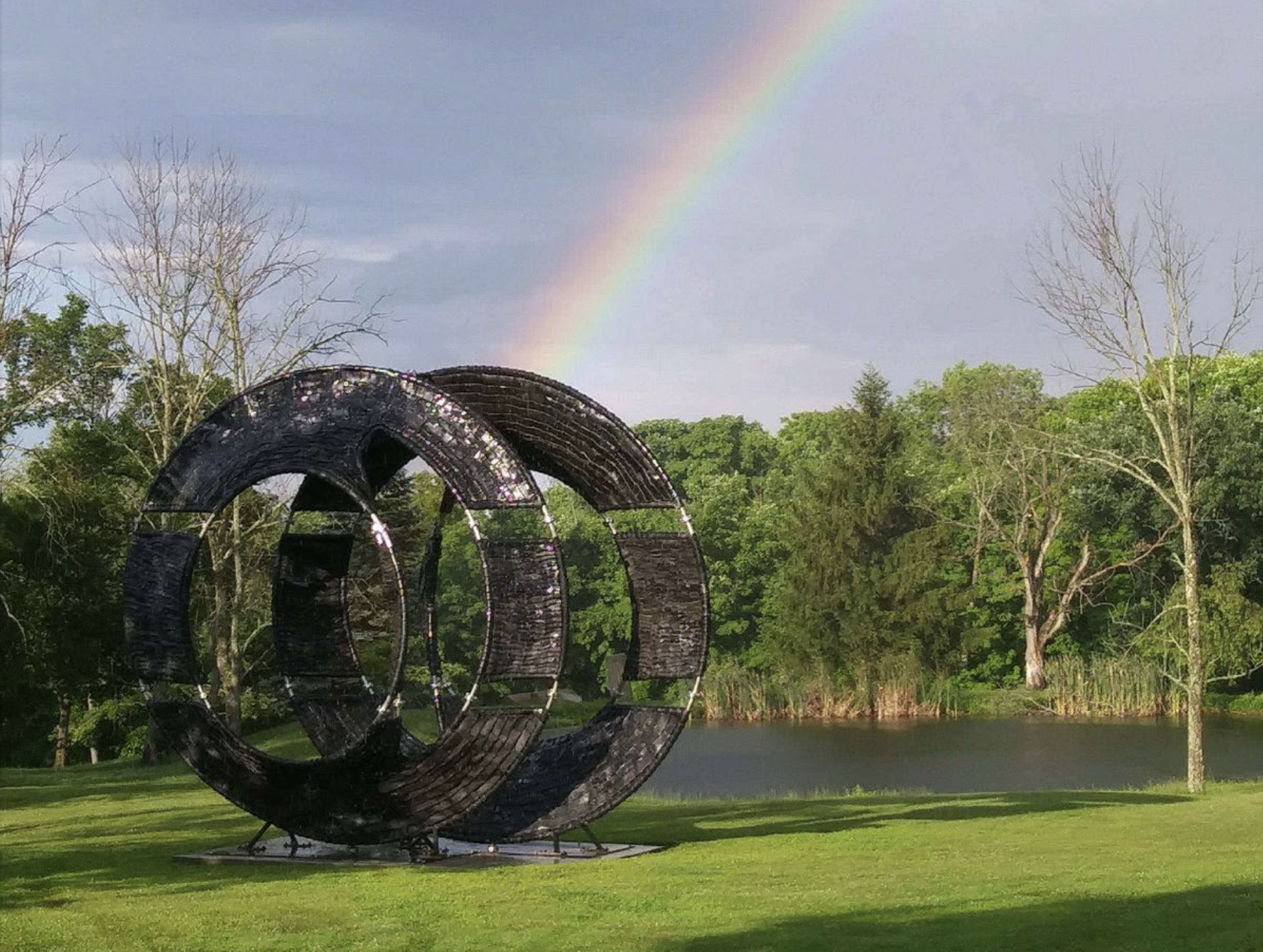
Déjà Vu by Chakaia Booker, 2016, Rubber tires and stainless steel, 21 x 26 x 17 ft. Photographed at Pyramid Hill Sculpture Park, Hamilton, OH. Exhibited in Millennium Park, Chicago, IL. Courtesy of Chakaia Booker.