The Ulama ballgame: past, present, and future
Manuel Aguilar-Moreno

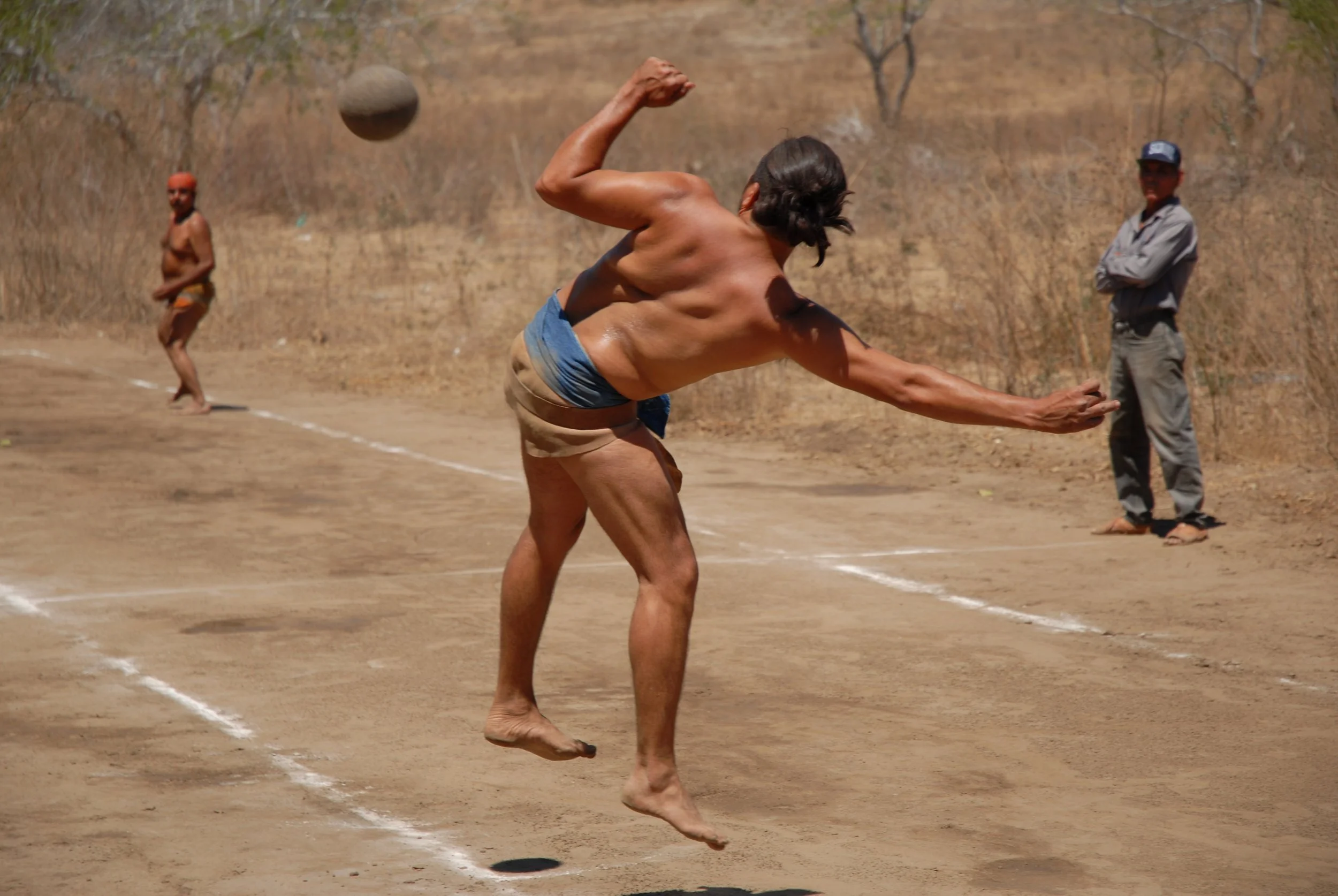
Jose Lizarraga Hitting a High Ball. Photo, Manuel Aguilar-Moreno.
The Mesoamerican ballgame known as ulama has been played for 3,500 years and is thought to be the oldest team sport in existence, and certainly, the oldest game using a rubber ball. Played in various versions by the Olmec (Nahuatl for “rubber people”), Maya, and Aztecs, today is played in just four towns of the State of Sinaloa, Mexico.
Ulama is played on a field called the taste, approximately 60 meters long and 4 meters wide, divided into two halves by a line, the analco – a term that appears in colonial chronicles. In the town of Los Llanitos, this is marked by two stones set into the ground on each side. The end lines are known as chichis. The size of teams can vary but is generally between three and five. Play begins with one side serving by throwing the ball high across the analco (male por arriba) or by rolling the ball across the same line(male por abajo). Points or rayas are scored when one team fails to return the ball past the analco, or when the ball is driven past the opponent’s end line. The first team to reach eight rayas wins. In the distinctive version known as ulama de cadera, the players are only allowed to pass and volley the ball with their hips. This requires them to propel their entire bodies with great force and skill in the air, and also sliding down to the ground, swiveling their bodies into the ball to keep it in motion.
The rules of ulama are complex and take a good amount of time to understand. Rather than a linear cumulative scoring system, as is used in most Western games, the score oscillates from one team to another, with the rayas going up and down. This aspect of the game is consistent with Mesoamerican ideology, for it originated as a ritual practice in which there was a representation of the dynamics of the cosmos. The Mesoamericans believed that life is held by the balancing action of contrary and complementary forces, which are in perpetual movement: light and darkness, day and night, high and low, hot and cold, fertility and drought, masculine and feminine, and life and death. The scoring oscillation in ulama embodies that duality.
One of the most serious challenges to ulama today is the scarcity of rubber balls, which need to be custom made and typically are about a foot in diameter, weighing approximately nine pounds. The rubber trees that once grew along the west coast of Mexico have been wiped out, forcing ball makers to undertake dangerous and arduous trips to the eastern sierra of Sinaloa and Durango to find trees that can be milked. This situation has made the balls extremely expensive, often costing as much as 20,000 pesos (approximately 1000 dollars). This has meant that, generally, there are only one or two balls in a town for either play or practice. It has also changed power relations within communities, so that the owner of the ball is the “owner of the game.”
Lichi Lizarraga Playing as Cerrador. Photo, David Mallin.
Between 2003 and 2013, I undertook a research project on the history and current practice of ulama at California State University, Los Angeles, in which Dr. Jim Brady and eight of our graduate students participated. One of our efforts was to produce a rubber ball using industrial latex, that would be similar in size and characteristics to those used by modern Ulameros. The coagulation of the latex to make a solid and elastic ball is achieved by combining it with an extract from the root of machacuana (Operculina rhodocalyx), a variety of Morning Glory. In Veracruz and Chiapas, the juice of a vine in the same botanical family is used. These plants contain sulfur, which helps to coagulate or cure the latex – the same effect obtained by Charles Goodyear in 1839, when he accidentally mixed latex with sulfur, creating the modern process known as vulcanization. Mesoamericans discovered the same principle three millennia earlier.
The making of our experimental ulama ball was a surprisingly difficult and time-consuming task, even without having to gather and process the latex. The experience gave us a new appreciation of the passage in the Codex Mendoza, a sixteenth-century colonial document, which records the fact that the province of Tochtepec, Oaxaca, paid an annual tribute of 16,000 rubber balls to the Aztec empire. (400 “human statues” made of rubber were also delivered.) If this is accurate, it has far-reaching implications for our understanding of the scale of Pre-Columbian rubber production.
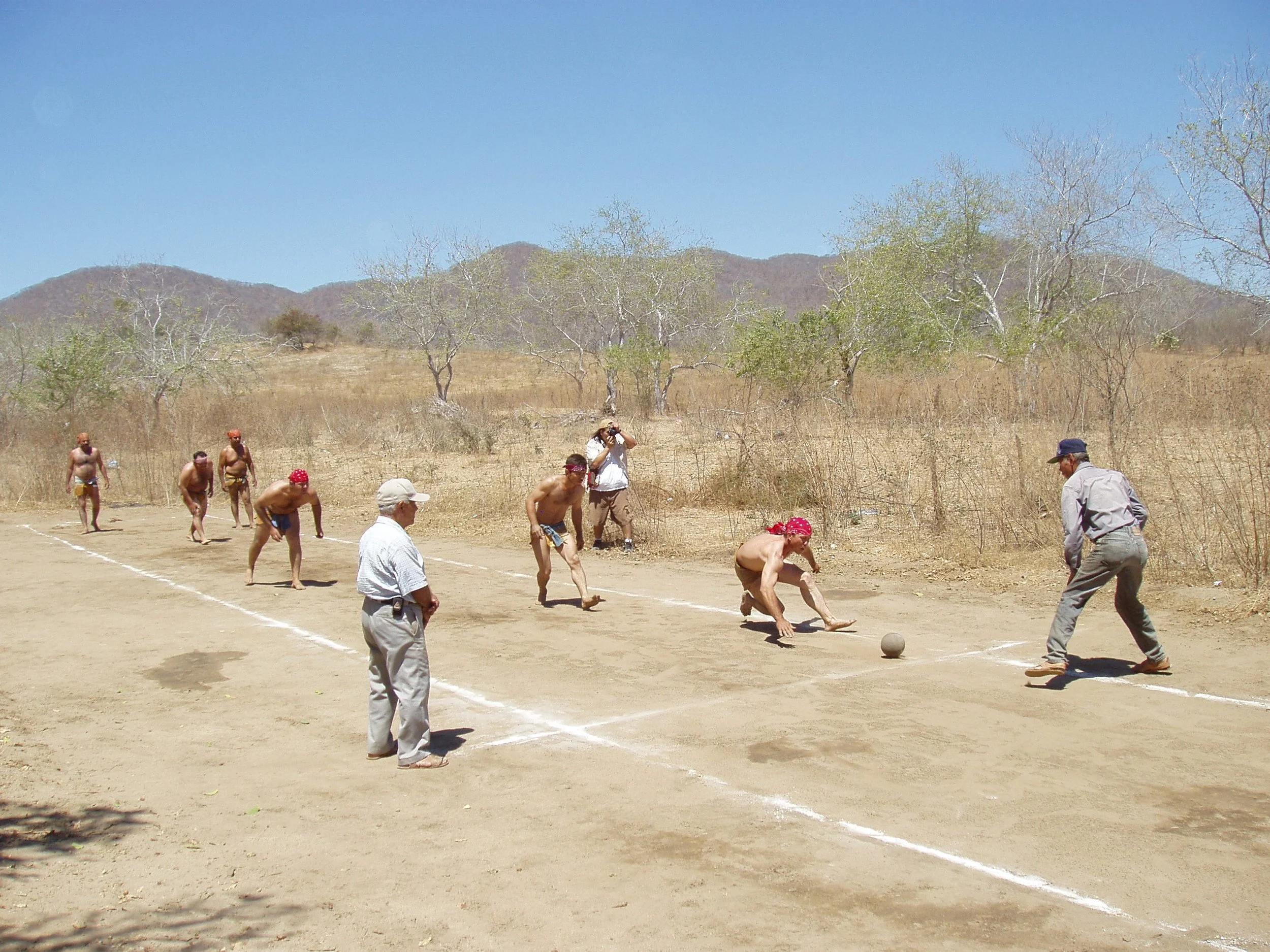
Veedor Lorenzo Covarrubias Rolling the Ball to Start the Game. Photo, Manuel Aguilar-Moreno.
Our initial experiments in ball making began in 2003. After stirring the latex well, when the mixture started taking on a more solid or pasty consistency, we shaped it into a small ball, which becomes the core. We bounced the ball to eliminate excess of water and bubbles, and added layers until reaching the desired size, texture and weight. Periodically, we bounced the ball to give it compactness, elasticity and roundness. When applying the last layer, we held the ball under running water to give it its final shape. Finally, we dried and bounced it as vigorously as possible for a few minutes.
After several failures in the manufacture of a functional rubber ball, we finally achieved our objective. We learned that industrial latex normally has ammonia as an additive, to stop solidification; it is necessary to neutralize the ammonia with an acid, such as vinegar, in order to coagulate the latex with a good level of elasticity. The ball was ready and seemed to have the elasticity and bounce required by ulama players. At a later time, 2010, the ball was tested by some players of the town of La Sábila and they said that although not identical to the balls made with the ancient technique, they confirmed that it could be used effectively.
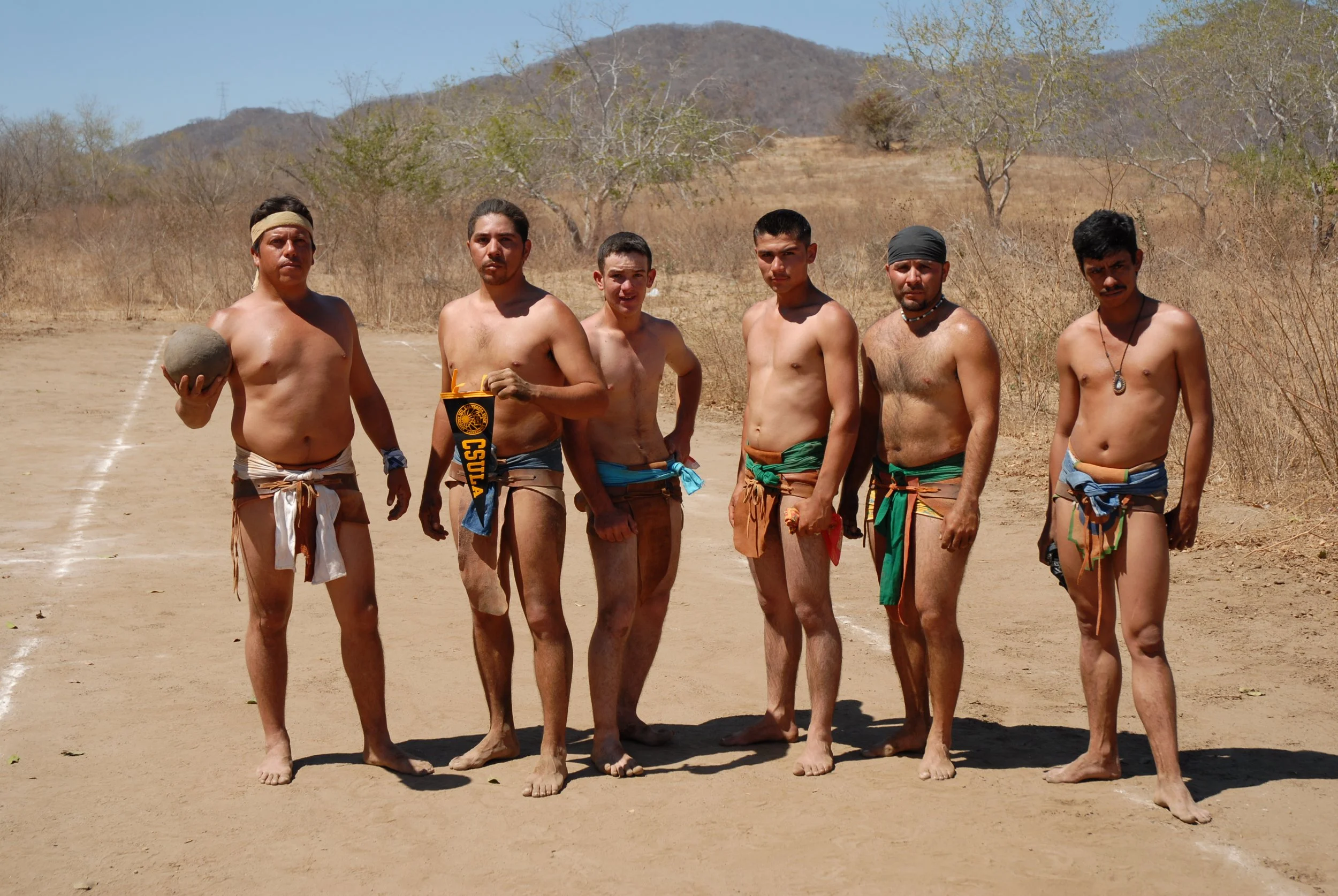
Team of La Sabila in Ulama Outfit. Photo, Manuel Aguilar-Moreno.