NEULEATHER

David Raful

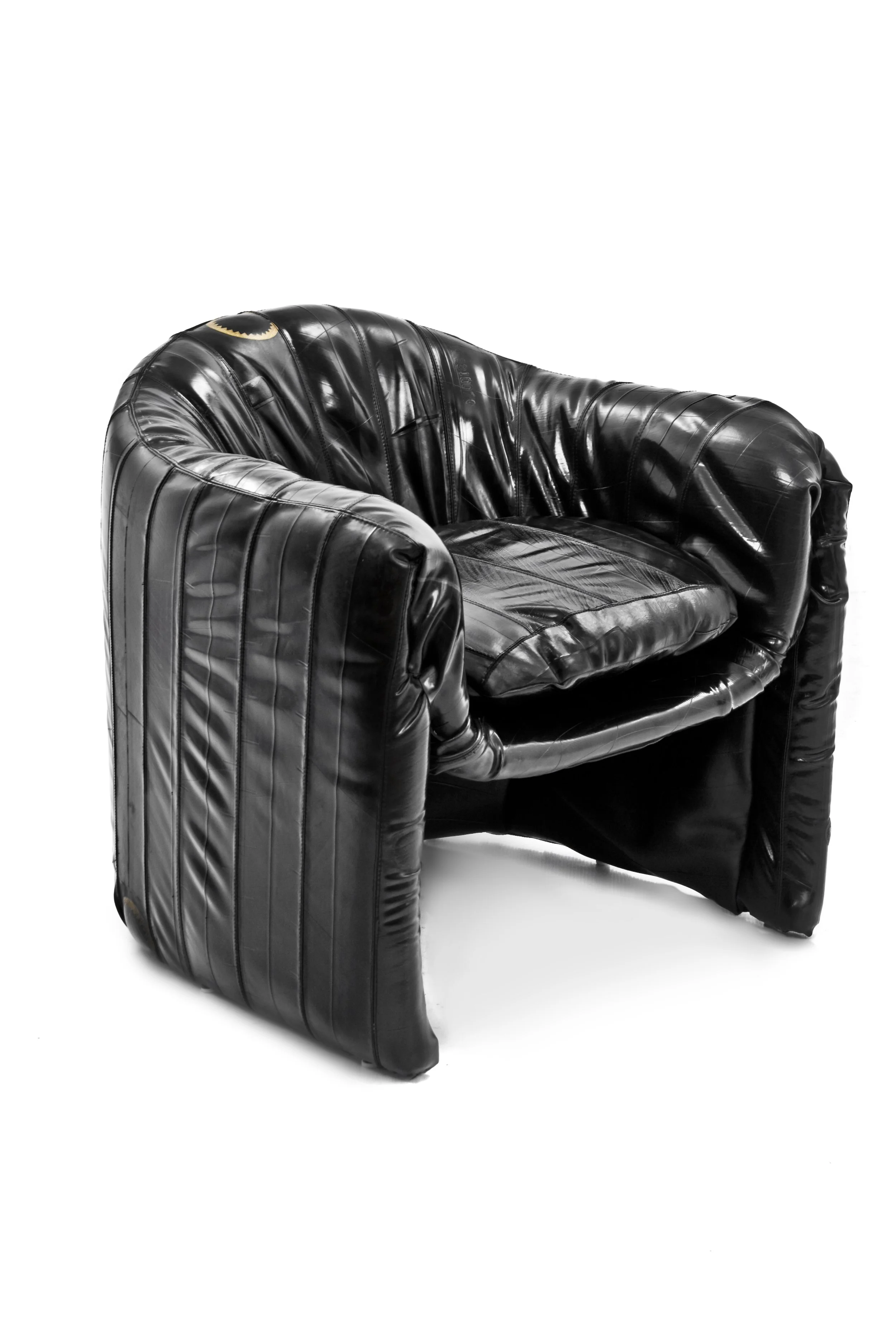
The Gum Chair, 2009, icff’09 highlight. The Future Perfect. New York. Photo, Joe Escobar, El Salvador.

The vestiges of the past are all around us, both above and below ground. What is our own civilization leaving behind? Some good things, to be sure, but we are leaving behind lots of detritus, including all manner of plastic in the form or bottles, containers, toys and kitchen implements, and billions of pieces of discarded technology: TVs, computers, cell phones. In this continuing age of oil and its derivatives, there is one other material that is emerging as an essential part of our problematic archaeological legacy: rubber, which is particularly destructive to the environment. 

Historically, the term “rubber” has described a natural polymer, developed originally by indigenous people in Mexico and Brazil. Today, it refers to a much wider range of not only natural compounds but also a high percentage of plastic polymers. In our kitchens, for example, silicone rubber (actually an elastomer, without any natural latex) is used for bakery tins, spatulas, handles of all sorts, colanders and insulators. Useful, yes, but we pay a silent price for this abundance. Each and every rubber product in our lives—shoe soles, tires and inner tubes, pneumatics, doormats, and rubber bands—is likely to end up in the ground. Synthetic rubber is considered one of the most environmentally damaging plastics, due to its chemical density and variability. It is cheap to produce, but difficult to dispose of. 
In an effort to deal with this vast environmental problem, I came up with the idea of using discarded mass-produced rubber in a socially productive way. The led to my creation of NEULEATHER, which started as a line of furniture, then became a brand, and is now my main undertaking in life. In the square meters I occupy, NEULEATHER is an expression of what I can do for my tiny country, which is oversaturated with trash. 

I am from El Salvador, where the poverty of the vast majority encourages all of us to come up with ingenious ideas to survive day by day. It is very common to see the lives of bicycle and car tires extended with industrial plastic patches, but there is a limit. Inner tubes can only be repaired so many times before they lose their function. At that point, burning or burying them can be more dangerous and difficult; as a result, you find discarded synthetic rubber inner tubes of all sizes all around our everyday landscape.
Occasionally the material has been made into bags and other items, and this inspired NEULEATHER. When I first saw an example of these vernacular crafts, I thought I was looking at black polished leather, but then recognized the repair patches. It occurred to me that this supple, durable material could be used as a replacement for leather in other applications as well. From the start, my goal was to create a well-designed and highly functional final product that would look impressive, with a professional finish, and not look like just any upcycled trash. 
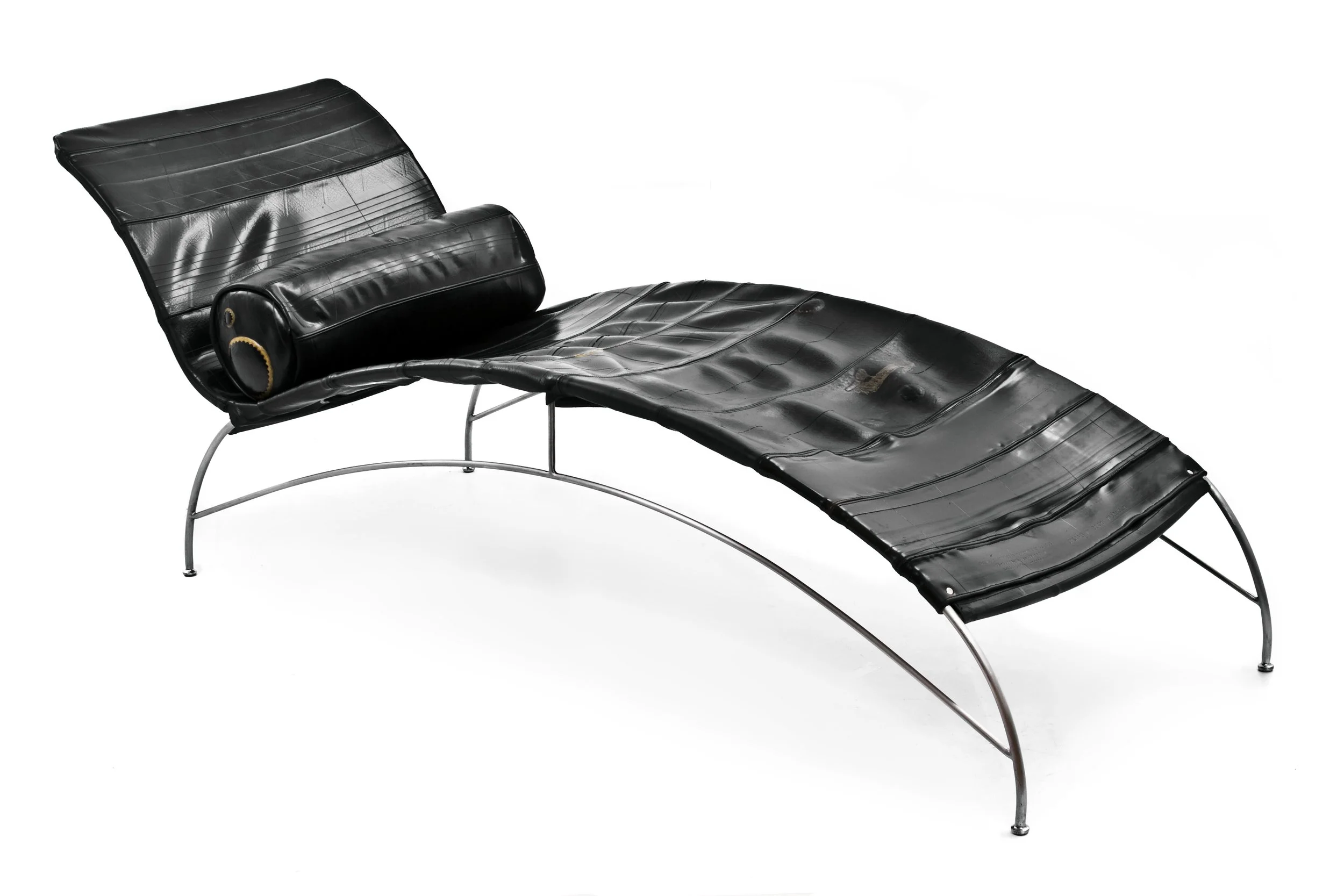
Chaise Lounge, 2009, New York. Photo, Joe Escobar, El Salvador.

Discarded inner tubes, primarily from car and truck tires, are the central material in the NEULEATHER furniture line. I re-use the frames of discarded pieces of furniture, cushion them with used blankets and comforters, and then use the inner tubes for upholstery. To assist in this process, I have made a novel craft alliance with the best leather workshop in the country, whose talented artisans cut the rubber into countless strips and form them into upholstery covers that are custom made to measure for each piece. 
At the beginning I planned to use rubber just as a kind of cover that would slip over the frame of the chairs that I was working on. But then I realized the design potential of the material’s elasticity. As with traditional furniture upholstery techniques, it became immediately evident that I could pull the rubber “fabric” either over a rigid stainless-steel frame, or over the existing under-upholstery on a found chair, to create a taut and aesthetically pleasing contoured surface. The same qualities that make rubber ideal for inflatable pneumatic tires also make it a perfect upholstery material: resilient, comfortable, pliant under the sitter’s weight. Moreover, the synthetic rubber used for inner tubes is nonabsorbent, relatively non-staining and easy to clean, and can even be polished to a high-gloss finish that looks almost like patent leather. In fact, I take advantage of these surface treatment in other NEULEATHER product lines like bags, wallets, and clothing accessories. Rubber’s characteristics are also ideal for outdoor use, as its water resistance leaves it unaffected by rough weather conditions like rain or snow; the inner elements of the furniture or fashion accesories are protected by the rubber exterior. 

My NEULEATHER upholstery does have that characteristic rubber smell, which we, of course, associate with shoe soles or car tires. There are challenges to its use in furniture design. For example, it can leave dark traces when dragged across a hard surface, and can be punctured. But as with an inflated rubber inner tube, tears or holes on my furniture can simply be patched and put right back into use. And in my opinion, the challenges are worth it for sheer wow-factor of these highly distinctive furniture forms. Today, I’m an ambassador of eco-design, exploring other materials to upcycle: from denim and leather to cans, fur, and neckties – anything that sparks my creative need to help the world. For all of the negatives surrounding the stuff we are leaving behind, trash never looked so good.

As a personal note, I would like to dedicate this essay to Ucca Ruffatti, her husband and her workshop staff, who have worked with me over ten years making my designs to come alive. Due to coronavirus crisis, the workshop stopped working and has permanently closed.  “Thank you Señora Ucca” is a small phrase, but it means so much.


David Raful is head designer of NEULEATHER, a design workshop based in El Salvador that makes stylish goods out of discarded rubber, one of the most environmentally damaging industrial materials. Raful and his team are dedicated to reclaiming the material as they rework it into functional and refined products, from handbags to furniture.

Brilliant Move

Brilliant Move is the Brooklyn-based creative studio of Marci Hunt LeBrun specializing in building websites on the Squarespace platform – among many other things.

I love working with small businesses, nonprofits, and other creatives to help them organize their ideas, hone their vision, and make their web presence the best it can be. And I'm committed to keeping the process as simple, transparent, and affordable as possible.

https://brilliantmove.nyc
Previous
Previous

“Extremely clever and ingenious”

Next
Next

The Ulama ballgame: past, present, and future