“Extremely clever and ingenious”
Sarah Pickman
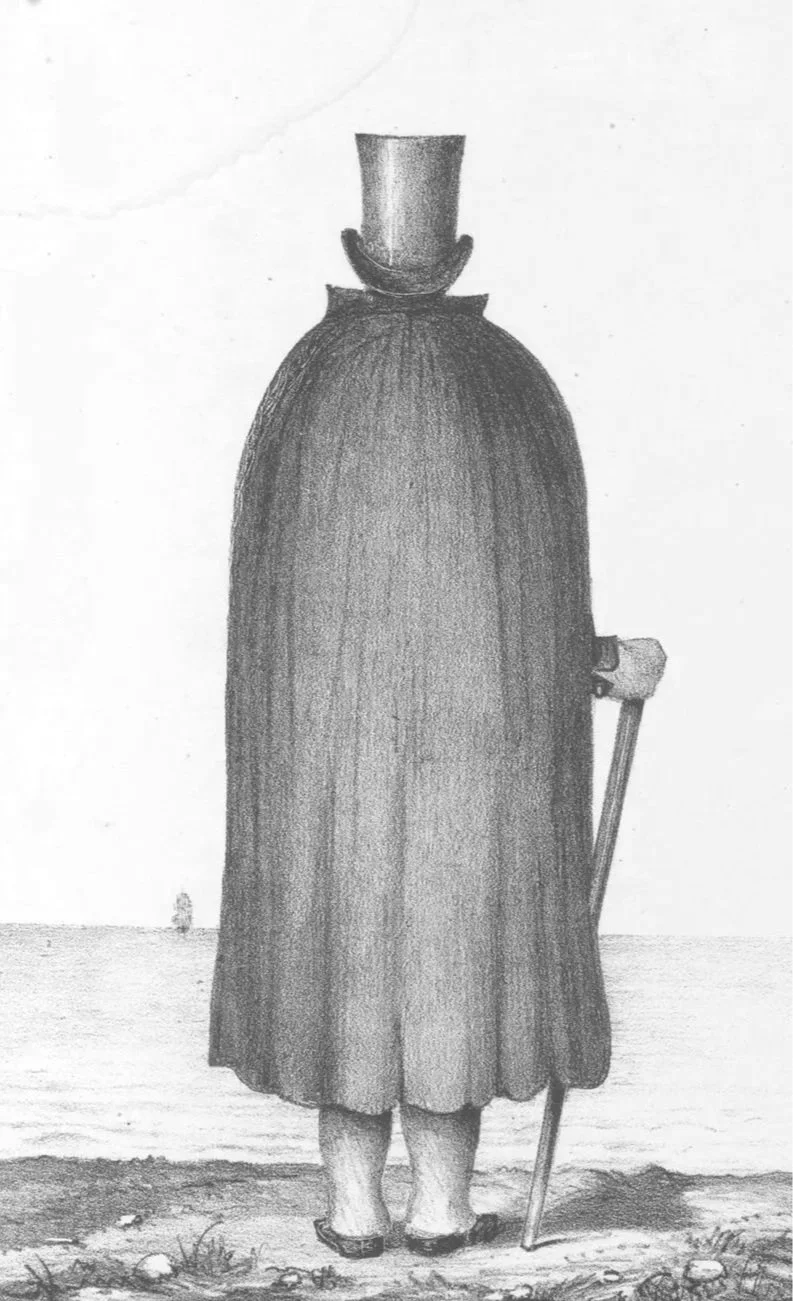
The Boat-cloak or cloak boat invented by Peter Halkett, 1848. ©National Maritime Museum, Greenwich, London.
Let’s say you’re a mid- nineteenth-century British explorer in the Arctic. You and your companions have been walking across rocky ground for days, doing some surveying and trying to stay alive on dried meat and hard biscuits. Suddenly, there’s a river blocking your path; too wide and deep to wade through. How will you cross?
Well, hopefully you’re wearing a cape that can turn into a boat. Yes: a “boat-cloak or cloak-boat,” designed by a Royal Navy lieutenant named Peter Halkett, and fabricated from a marvelous new rubberized textile churned out by the factory of Charles Macintosh in Manchester, England.
Since its earliest arrival in Europe, rubber has been intertwined with colonialism. Indigenous Amazonians had tapped the raw, milky sap from rubber trees, especially the Pará rubber tree (Hevea brasiliensis) since at least the first millennium C.E., and explorers and Spanish colonial officials returning from South America introduced the substance to European scientific circles by the mid-eighteenth century. Not long after, designs for possible uses for rubber were circulating in western Europe. But it was Charles Macintosh who obtained the first British patent, in 1823, for using rubber to produce a waterproof textile. He dissolved hunks of solid rubber using naptha, a derivative of coal tar that was a by-product of coal gas production. He then spread layers of this viscous substance between two layers of cotton cloth, producing a completely impermeable textile.
While the appeal of such a material might seem obvious to modern wearers (especially in a nation known for damp weather), Victorian British consumers took some time to warm up to garments made with rubber layers. Early rubberized fabrics were prone to cracking, and grew brittle in cold temperatures and sticky in hot. Clothes made from the material gave off a foul odor. These issues (apart from the smell) were solved with vulcanization, a process of treating rubber with sulfur that was introduced in the mid-1840s. But even as Macintosh and his competitors worked to serve the average consumer shopping for a raincoat, there were some who saw more expansive possibilities for a flexible, impermeable textile that could be made up in any shape or form. One of these individuals was Peter Halkett.
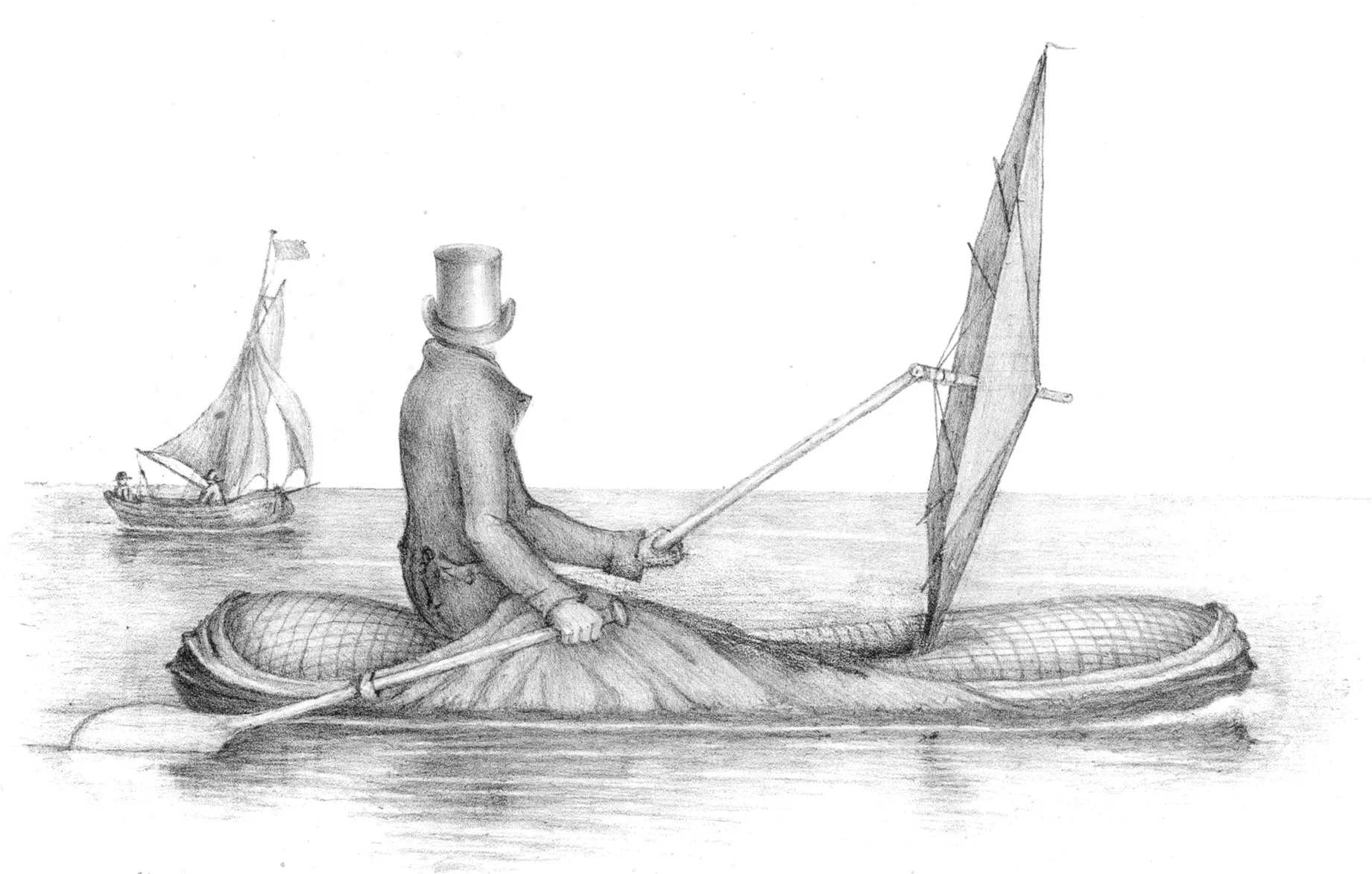
The Boat-cloak or cloak boat invented by Peter Halkett, 1848. ©National Maritime Museum, Greenwich, London.
Halkett had read recent reports of British Arctic expeditions with great interest, and surmised that overland explorers would have much use for a lightweight boat for crossing rivers and lakes. He believed that the solution lay in Macintosh’s new material. Halkett ordered sheets with rubber on one side and fabric on the other, and experimented with stitching them to create a series a series of inflatable chambers on the rubber side. The resulting item could be worn as a waterproof cloak, fabric side inwards. With a small set of bellows the chambers could be inflated, turning the garment into a dinghy. Halkett also designed a version that, when inflated, was large enough to carry two passengers, and when deflated could be carried in a rucksack and used as a blanket.
In 1848 Halkett published his designs in a pamphlet, where he reported the positive results of tests he’d undertaken with the single-person boat on the Thames and in the Bay of Biscay. These boats, he asserted, would not only be useful for “Exploring Parties, and Expeditions of Discovery,” but as lifeboats on ships large and small. The figures in his illustrations could be gentlemen from contemporary fashion plates: clad in cloaks with windowpane-check linings and sporting top hats and canes, the latter of which Halkett suggested using to rig paddles for the boats. (Similarly, an umbrella could be repurposed as a sail.) His boat was a shape-shifter, like rubber itself, and his sketches positioned rubberized textiles as comfortably situated between cosmopolitan fashion and functional expeditionary garb. However, Halkett was attentive to the problems of keeping rubber goods in working order, and cautioned readers against drying the boat-cloak near a fire, or inflating it too much in hot weather, lest the heat “burst the material of which these Boats are constructed.”
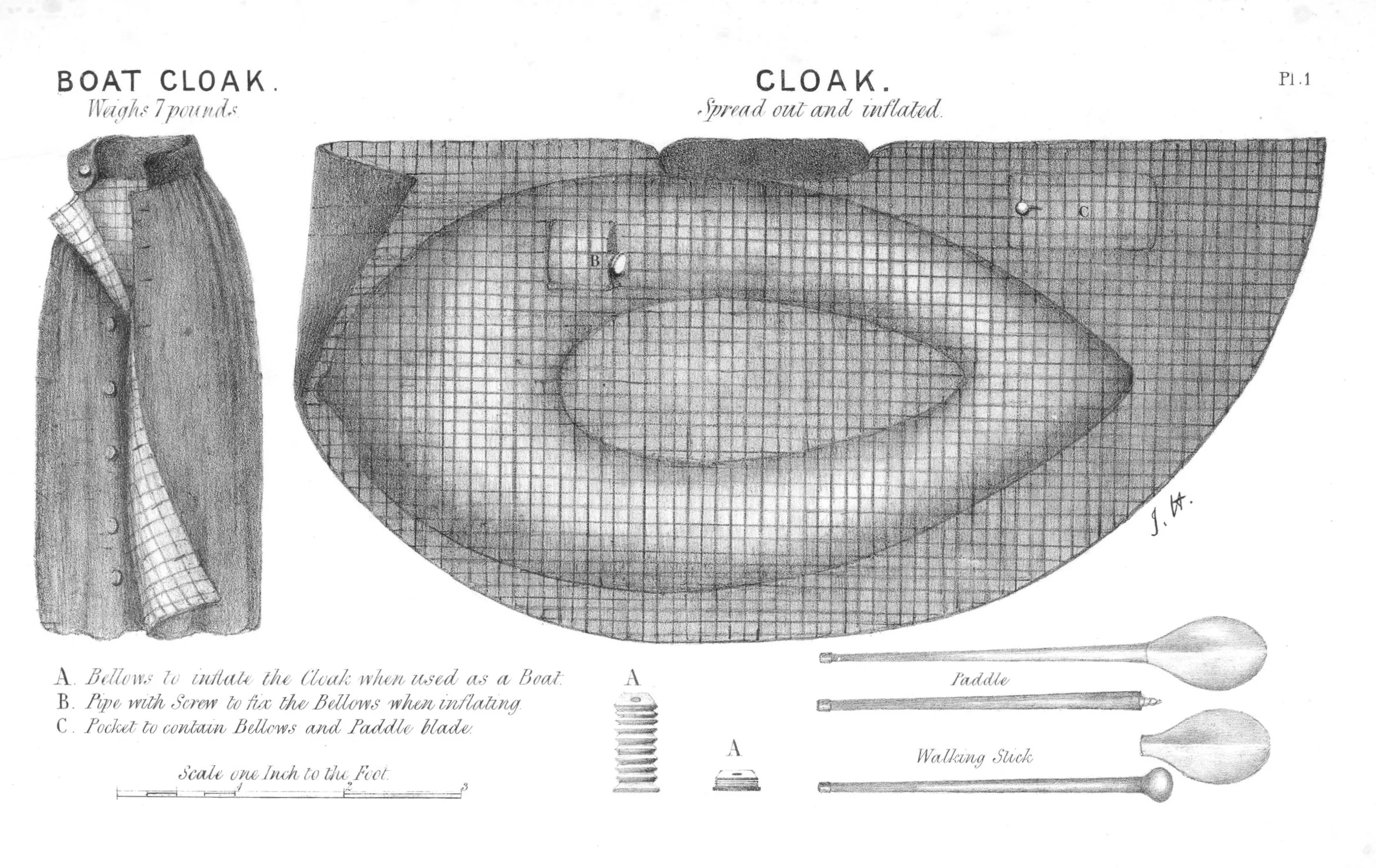
The Boat-cloak or cloak boat invented by Peter Halkett, 1848. ©National Maritime Museum, Greenwich, London.
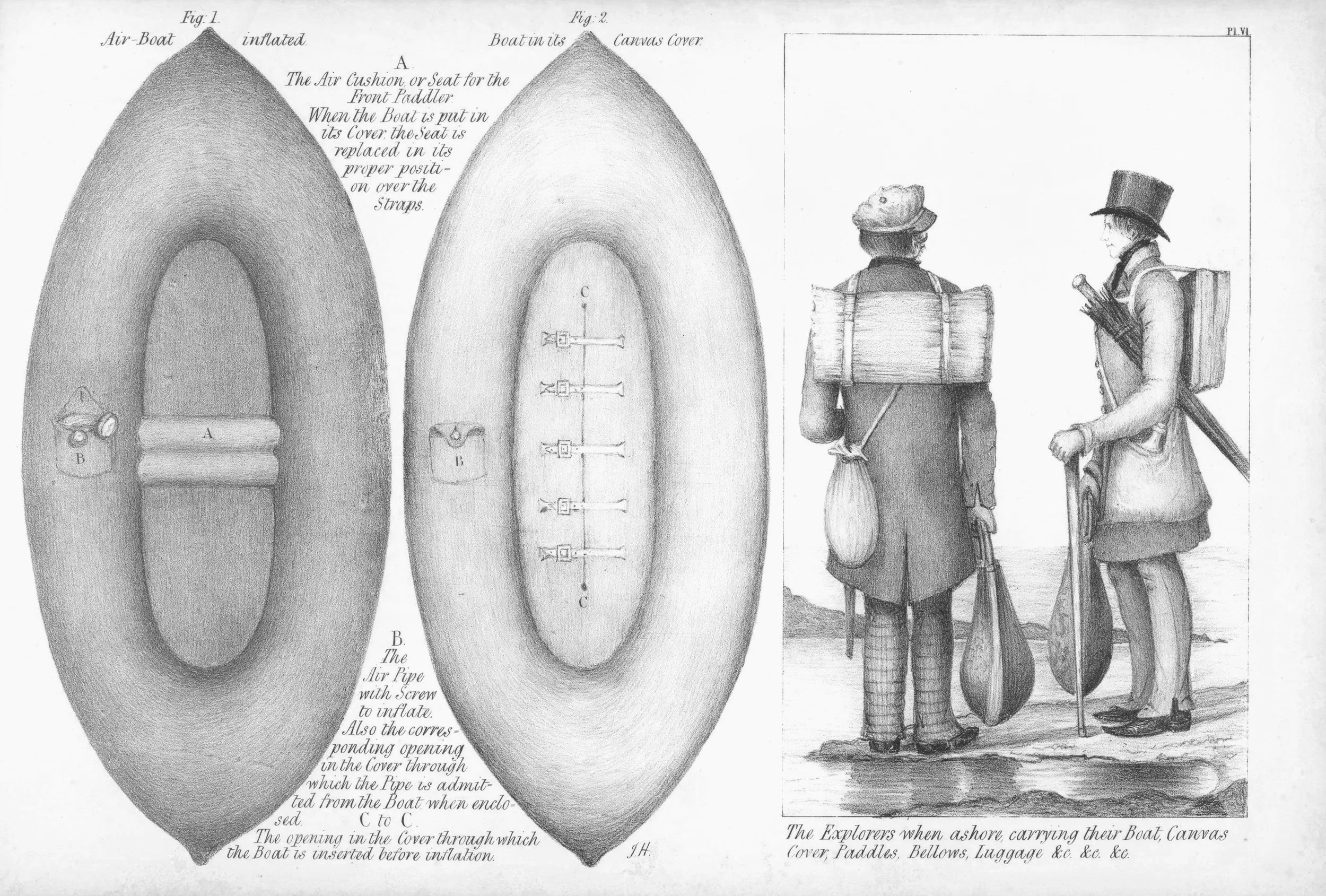
The Boat-cloak or cloak boat invented by Peter Halkett, 1848. ©National Maritime Museum, Greenwich, London.