Catching the waves
Jonathan Prown
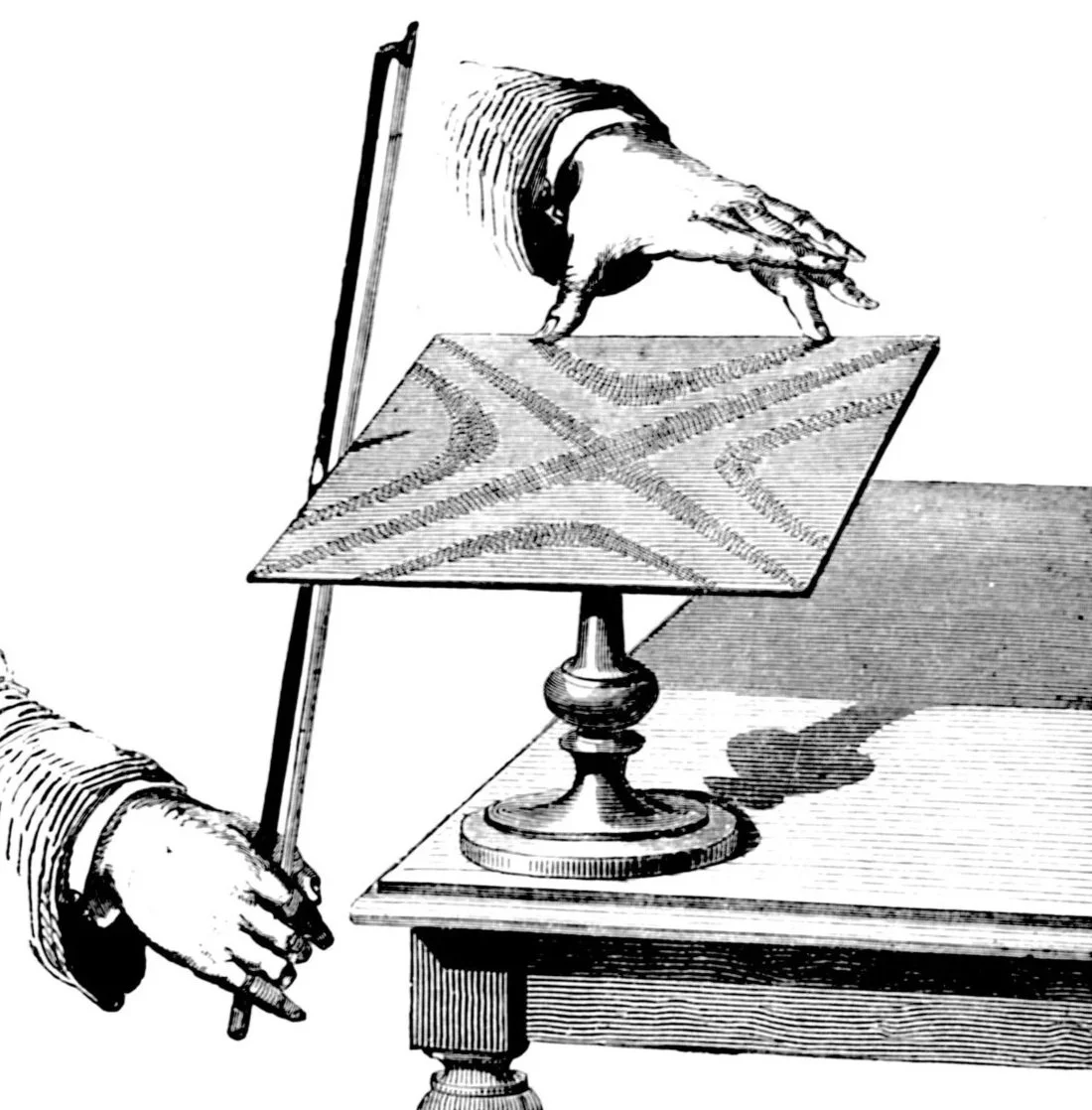
“Vibrations of a Plate,” in W. H. Stone, Elementary Lessons on Sound (London: Macmillan and Co., 1879), 25.
Sand may seem profoundly unmusical. Blow on it like a trumpet, hit with a drumstick, strum it like a guitar, and it simply turns into a messier pile of sand. True, you can put it in maracas and shake it. For true beauty, though, sand must be invited to dance.
Human beings discovered thousands of years ago that sound not only moves across time and space but also through materials. In ancient Greece, Pythagoras studied vibrating strings as part of his pioneering mathematical investigations; well before that, variable musical scales were widely known in ancient China. What they were discovering was the travel of vibrational energy across a musical instrument, originating from a plucked string or a struck drumhead, then passing through the body of the instrument, and finally emerging from it in complex and non-linear ways, with an infinite number of harmonic variations that were fractional divisions of the main or “fundamental” frequency. This tonal complexity is what explains the deep human fascination with all different types of music and instrumentation.
We actually feel sound—the incoming tone vibrates our eardrums, and that kick-starts an amazing journey through cells, membranes, even hairs, ultimately giving our brain the electronic signals to “hear” the sound in a certain way. The more resonant and responsive the material, the better the balance of the frequencies and the louder the volume. No matter how expert the player, a guitar body made from a cardboard box or a large pumpkin will just never sound like one made from tone woods such as mahogany, maple, and rosewood (all hardwoods), or cedar, redwood and spruce (softwoods).
Sand, being completely non-resonant at the particulate level, enters the story of music and materiality fairly late, in the work of the British experimentalist Robert Hooke (1635-1703). Intrigued by the work of Marin Mersenne, a Jesuit whose mathematical inquiries into music were published as Harmonie Universelle (1636), Hooke discovered a way to make vibrational patterns visible, activating a thin layer of sand or flour in a shallow glass dish using a violin bow. Rather than bouncing around chaotically, the particles unexpectedly and rapidly formed into geometrically ordered shapes on the plate.
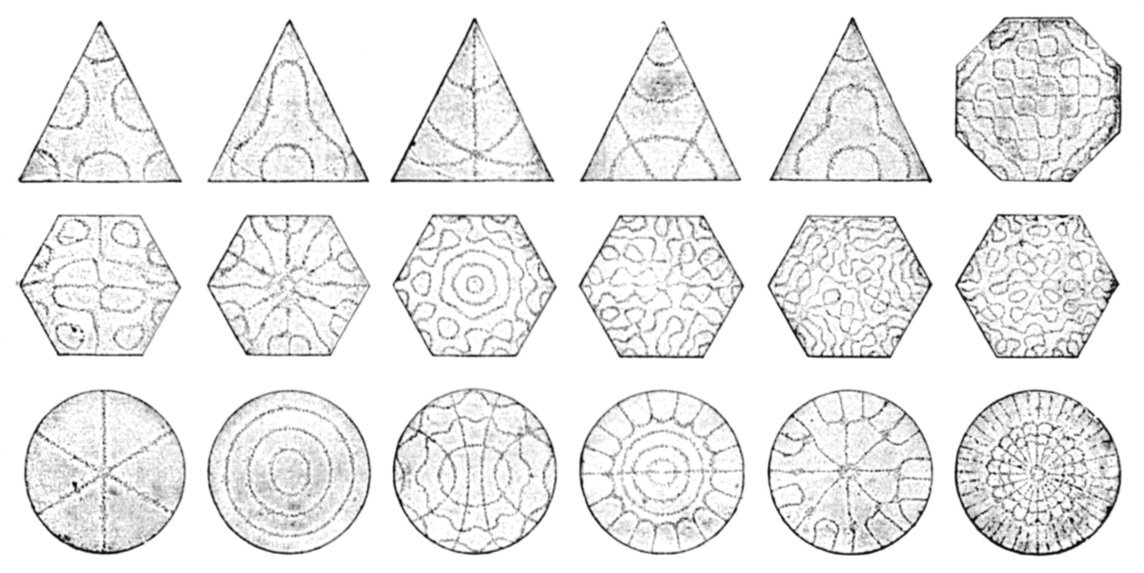
“Nodal lines of vibrating plates, according to chladni and Savart Stone,” in W. H. Stone, Elementary Lessons on Sound (London: Macmillan and Co., 1879), 26.

Image by Chris Smith.
This phenomenon – later called “cymatics” – remained little more than a curiosity until a century later, when German scientist Ernst Chladni (1756-1827; pronounced kla-dni) dove more deeply into the matter of visible sound. His methodical approach documented repeatable patterns of sand that could be created by running a bow along the edge of a flat plate. He proved that the material of the plate—whether metal, glass, or wood—did not vibrate randomly but rather regularly, and beautifully.
Chladni played his plates somewhat as a violinist would, moving one or more of his fingers along their sides and bowing in different places along their edges. By changed the timbre or note, he altered the basic harmonics. The sand, he realized, was forming a negative image of the soundwaves: the grains migrated towards discernible “nodal” spots where the soundwave—and therefore the plate itself—was vibrating less quickly, or not at all.
Although Chladni discovered countless nodal configurations that could be easily replicated, he did not fully understand the mathematical logic that could explain his observations. That further insight was primarily due to the work of Sophie Germain (1776-1831), a remarkable mathematician and physicist whose independent research on the elasticity of surfaces led to her becoming the first woman to win a prize from the French Academy of Sciences, in 1816 (though as a woman she was excluded from formal membership).
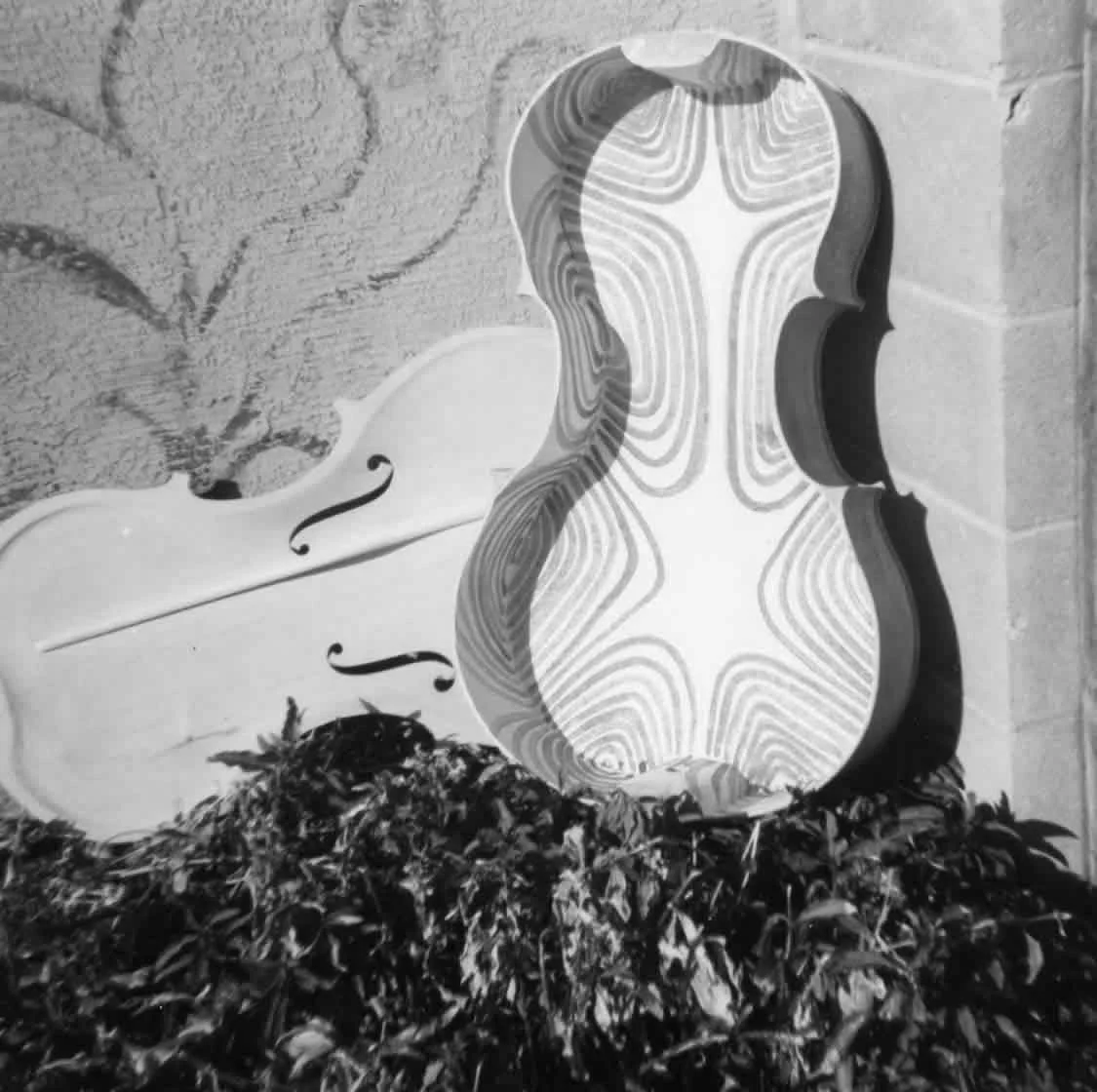
Anne Cole (American, 1945– ), Chladni Violin, 1976. Courtesy of the artist.