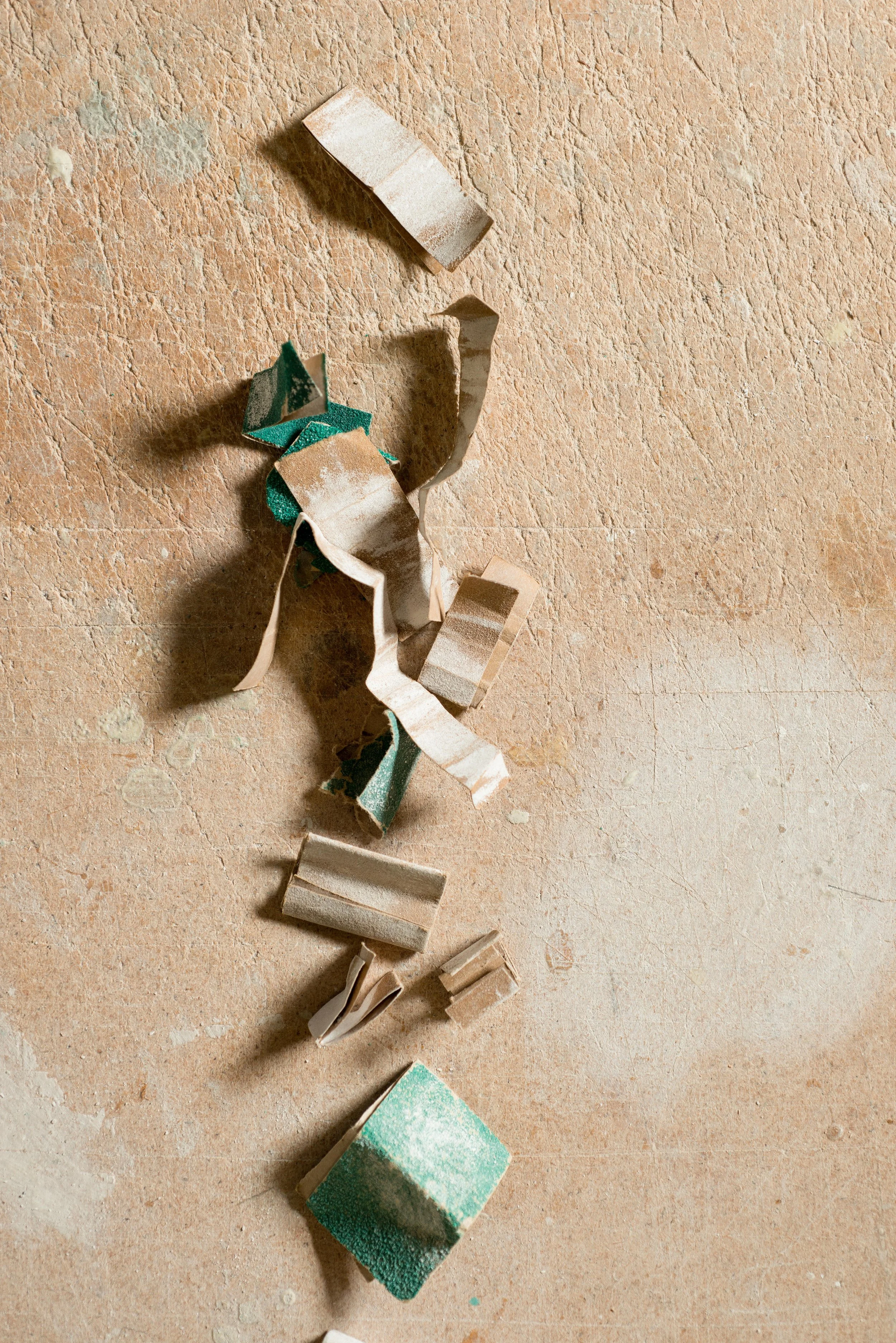
Grit and gleam

Shannon Mattern

Photo by Andrew Perris.

Just before my senior year of college, our family moved into a new house. My dad did most of the work himself — framing, plumbing, wiring, and so forth — but he saved a few jobs for us. Mine was sanding all the doors with 220-grit sandpaper. My abrasive apparatus were procured from the family hardware store, where Dad and his brothers sold Gator, 3M, and Norton sheets, discs, and belts, in grits ranging from a coarse 36 (well suited for sanding floors) to a fine 1200 (good for polishing metal). 

Since then, Dad has developed into an exceptionally talented fine woodworker. When he’s making a desk or a highboy, he treats all the components with 120 grit Klingspor, then incrementally progresses up to 320, paying particularly close attention to intricate parts, before gluing everything together. “Sanding’s tedious,” Dad admits. “Most people want to rush through it.” But it’s important to do it right: “If you don’t sand enough, scratches show up when you finish the wood. If you sand too much, you burnish the wood, which makes it impervious to stain.” You also have to be mindful of the particular qualities of different wood varieties: teak has oils that can easily gum up a belt sander, while yellow pine has a lot of sap. Cherry has tannic acids that can react to the heat of a power sander, creating black streaks. Hand-sanding minimizes all these risks. 
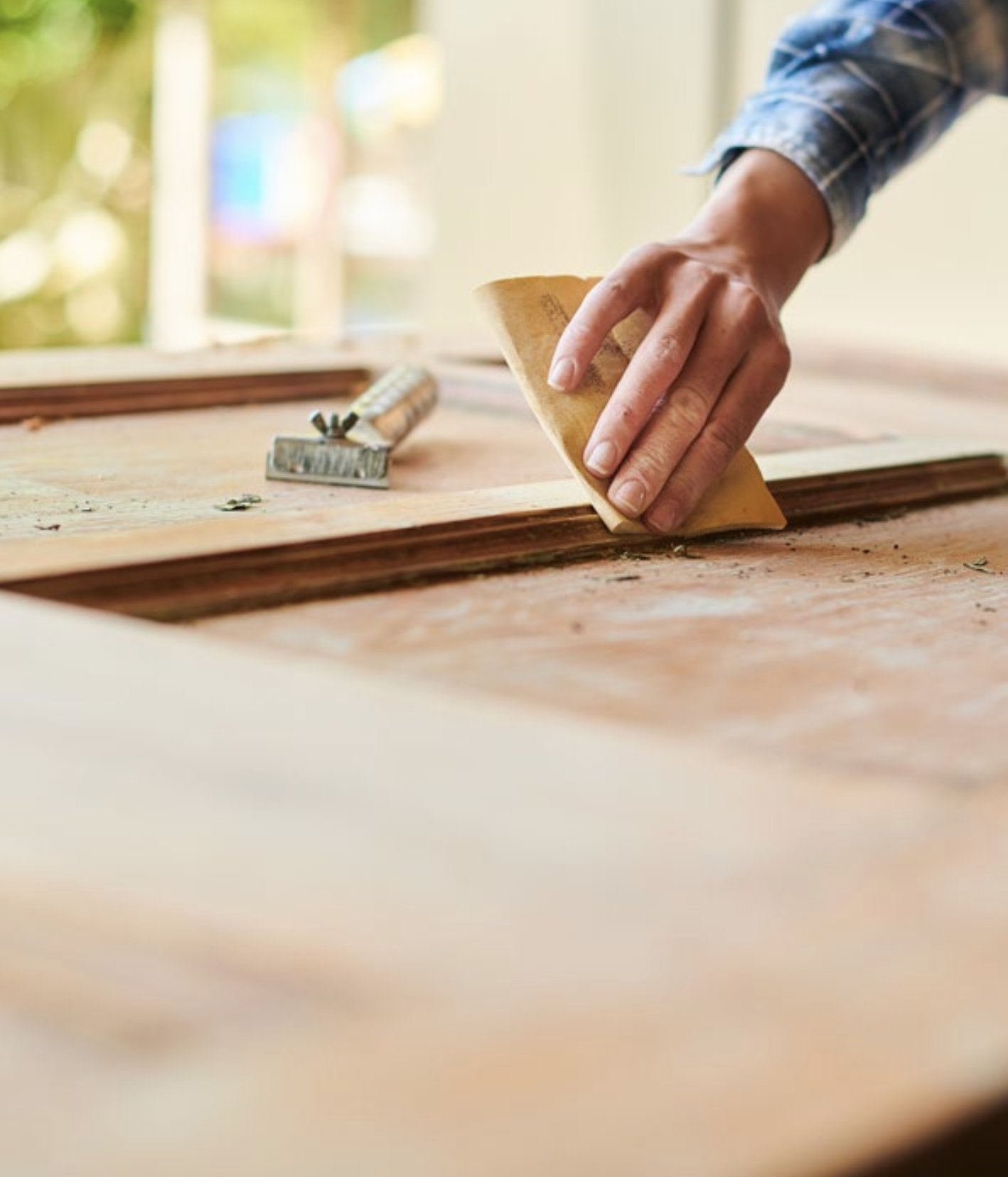
Photo by Sturti.

Itself the product of weathering and erosion, sand has long been used to smooth, abrade, texture, and shape the materials with which it comes into contact — and to erase the traces of time’s passage. When mixed with air and blasted at high pressure, it strips away the grime that’s accumulated on building facades, sloughs dead cells from aging skin, and distresses denim. Blended into slurries, it’s marshalled to cut and carve stone. Adhered to pliable substrates, it buffs metal, wood, and ceramic surfaces. At the dentist’s office, abrasive discs are used to grind and polish away the stains of daily living. 

Sandpaper roughs up drawer fronts to prepare them for veneering. It removes the finish from furnishings queued for refurbishment. Installed in a planer, it trims exotic hardwoods without leaving tool marks. It polishes wood cross-sections so dendrochronologists can distinguish the tree rings. Affixed to rectangular blocks, sandpaper turns preschoolers into percussionists and textures the rhythm of vaudevillian “soft shoe” choreography.

Ancient Egyptian masons likely used wet and dry abrasives – quartz, emery, corundum, perhaps even diamond — with their saws and drill bits. Pliny the Elder noted in his first-century CE Naturae Historiae that, while metal tools are used in cutting marble, it’s actually sand that does the work — “for the saw merely presses the sand upon a very thinly traced line, and then the passage of the instrument, owing to the rapid movement to and fro, is enough to cut the stone.” Ethiopian sand, he says, is the best suited for masonry, because it’s fine and “cuts without leaving any roughness.”
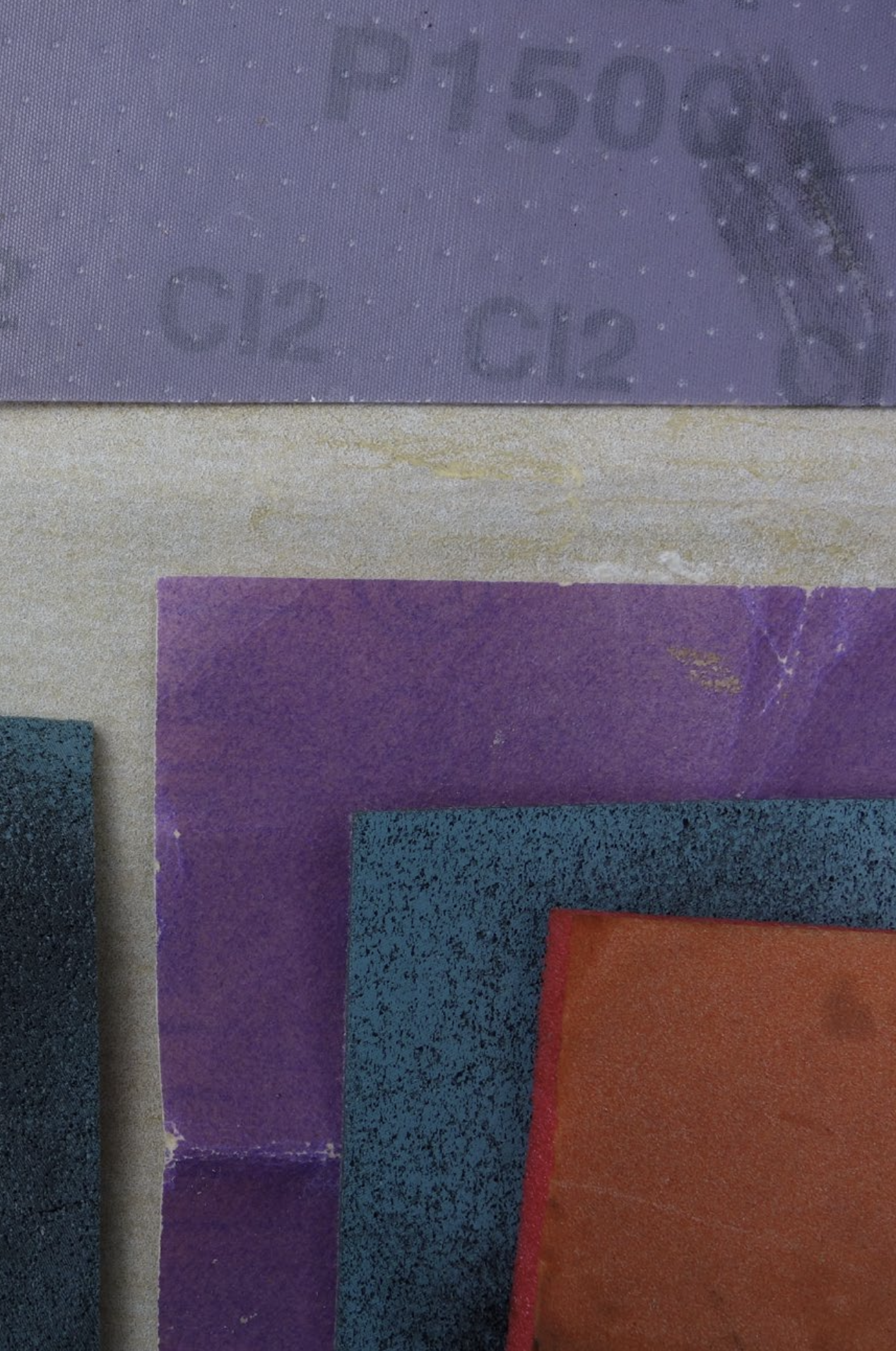
Photo by Wynne Patterson.

Woodworkers have used fish skins and reeds, planes and metal scrapers to smooth their materials, but sand-coated papers make up an especially long chapter in the history of woodcraft, and in humankind’s relationship to its tools and their biological, geologic, or industrial origins. As early as the 13th century, the Chinese created abrasives by gluing sand and crushed shells to parchment. During the Industrial Revolution in England, John Oakey’s Wellington Works experimented with abrasives made of glass, corundum, flint, quartz, garnet, carborundum, aluminum oxide, emery, and pumice. Around the same time, in the 1830s, Isaac Fischer of Springfield, VT, patented his own sandpaper-making process. A century later, responding to the needs of their new automotive clients, the Minnesota Mining and Manufacturing Company — now known as 3M — developed waterproof abrasives that would prevent scratches on polished metal and, simultaneously, minimize the creation of toxic lead-infused dust. 
Today, sandpaper’s substrate might consist of actual paper, but it could also be cloth, latex, or plastic film; its adhesive could be hide-based glue, urea formaldehyde, or resin; and its abrasive might include garnet, emery, diamond, ceramic, or a synthetic material like aluminum oxide, chromium oxide, alumina zirconia, or silicon carbide – all still technically “sand,” which is defined by its grain size. That sand might then be coated with stearate, a metallic soap, that keeps dust from clogging the areas between the grains.

Sand and dust are sibling particulates. Each is created though the undoing, the atomization, of long accumulation: arboreal growth, sedimentation, rust. What was once solid — tree or rock, floorboard or car hood— becomes aerosol. If that dust is inhaled, it settles into the lungs, potentially causing respiratory illnesses or even cancer, expediting the flow of grains through life’s hourglass. For decades, my dad has refused to wear a mask in the shop because it fogs up his glasses. “I could either inhale some dust or cut off my fingers,” he’s always joked. Consequently, a deep, wet, clearing cough has long been his sonic signature.

Sandpaper requires patient, full-body engagement. It can graze the knuckles and make them bleed; it can also change the way light filters through the room. Working with it requires attention through the fingertips, ears, and eyes. I did rush the job, thirty years ago, when I was charged with sanding all those doors. Today they feel a little rough, and their stain is uneven. But they’ve kept on weathering, thanks to we who’ve passed repeatedly through those portals.


Shannon Mattern is the Penn Presidential Compact Professor of Media Studies at the University of Pennsylvania. From 2004 to 2022, she served in the Department of Anthropology and the School of Media Studies at The New School in New York. Her writing and teaching focus on media architectures and information infrastructures. She has written books about libraries, maps, and urban intelligence; she serves as president of the board of the Metropolitan New York Library Council; and she contributes a column about urban data and mediated spaces to Places Journal.

Brilliant Move

Brilliant Move is the Brooklyn-based creative studio of Marci Hunt LeBrun specializing in building websites on the Squarespace platform – among many other things.

I love working with small businesses, nonprofits, and other creatives to help them organize their ideas, hone their vision, and make their web presence the best it can be. And I'm committed to keeping the process as simple, transparent, and affordable as possible.

https://brilliantmove.nyc
Previous
Previous

Land marks