The sands of war
Matthew Kirschenbaum
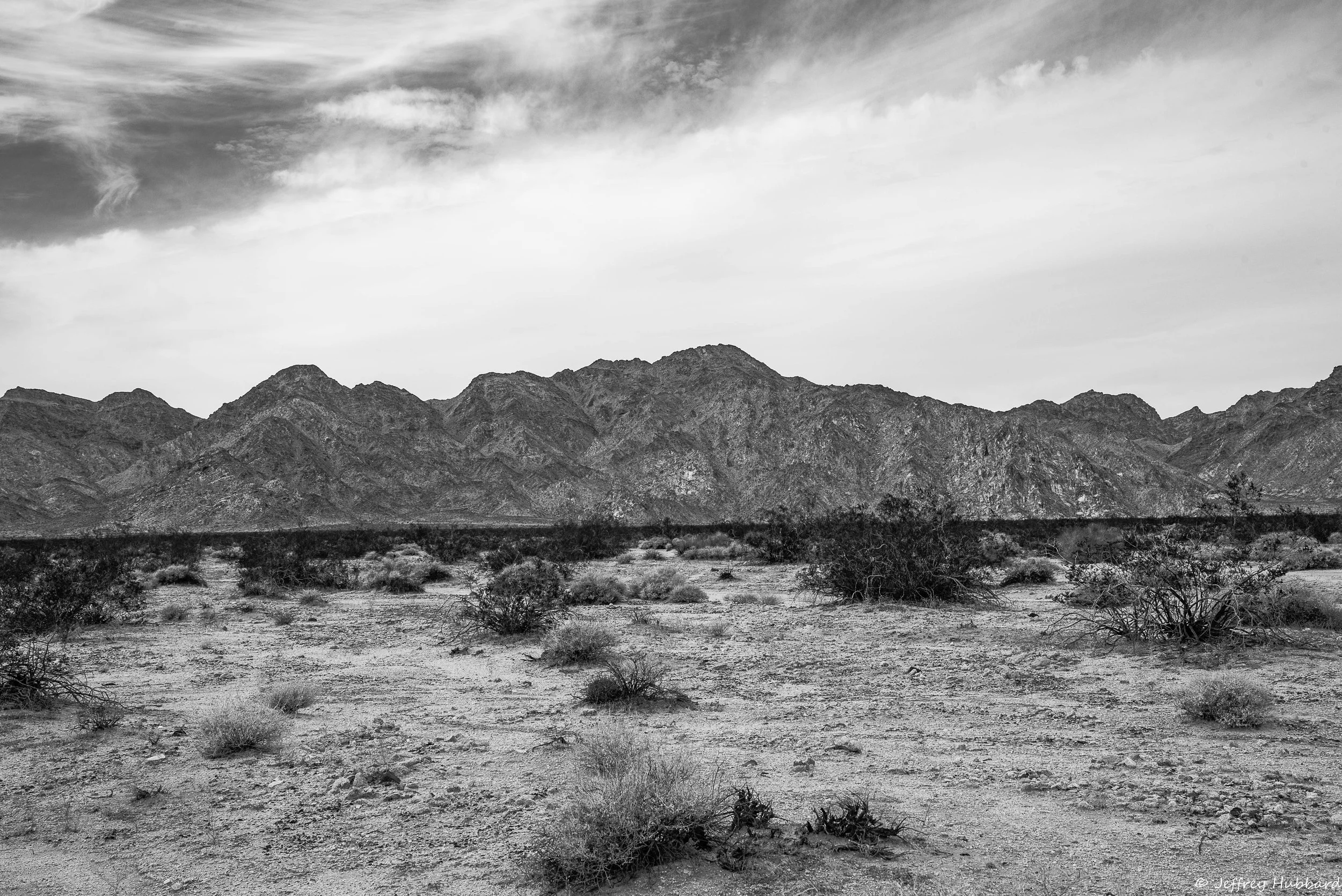
Photo by Jeffrey Hubbard.
Not for nothing was the desert the site of that most notorious fusing of simulation and the real, Jean Baudrillard’s knowingly outrageous La Guerre du Golfe n’ a pas eu lieu (The Gulf War Did Not Take Place, 1991). Baudrillard’s Arabian desert was a purely projective space, blank like a screen, a hyperreal substrate or spectrum spun from bandwidth and airwaves of global telecommunications.
Yet the desert and its sands occupy a very particular place in both the imagery and the imagination of American war. The great western deserts were the site where the nation acted out its self-styled manifest destiny, with indigenous populations pushed in front of crushing waves of colonization. Shortly after the United States entered the Second World War, one of those deserts—the Mojave, named for its sparse population of native inhabitants—would become the site of the largest simulation space in the physical world. This was the US Army’s Desert Training Center, some 18,000 square miles of federalized land where tens of thousands of newly mobilized recruits went to practice the art of modern war under the unforgiving eye of Major General George S. Patton, Jr. The historian David Kennedy goes so far as to call the mass rotations through the DCT “one of the defining experiences of the Greatest Generation.”

Image courtesy of Trey Brandt.
The Mojave had the great virtue of similarity to the mountains, passes, and arid basins of Algeria, French Morocco, and Tunisia - the first area of operations anticipated for the European theater. Death Valley is part of the Mojave Desert, but Joshua trees grow there too; indeed, there is more endemic flora in the Mojave than anywhere else in the world. And of course there is the sand, omnipresent, an inescapable elemental force, ranging from the powder of dry lakebeds to aeolian dunes. According to accounts from those who were at the DTC, the sand got into absolutely everything, whipped by sudden windstorms, drifting in heaps and mounds, abrasive.
The wide open spaces of the desert allowed for truly massive maneuvers, multiple divisions at a time, with armor, infantry, and air support all coordinated by radio nets connecting across the vast distances, and supply lines extending over the horizon. War here was exercised pure doctrine, tactics uninhibited by complication or distraction. The earth itself could be moved and molded, terraformed like a distant planet by the army engineers who trained alongside the combat units; the malleable ground could thus be made and remade at will, setting up exercises and scenarios only to be leveled again, like resetting a computer game.
After the war, the Desert Training Center was supplanted by another location in the Mojave, Fort Irwin, which continues to serve as a military proving ground to this day. Inevitably, the tankers who went to Desert Storm drilled there; and so the California heterotopia once again paved the way to deserts of the real in the distant Middle East, a detail unremarked by Baudrillard.
Another detail, anomalous only in that it was singled out for documentation: In late 2011 the 27th Infantry Brigade Combat Team (a New York National Guard unit) mustered at Fort Irwin in preparation for its deployment to Afghanistan. Upon arrival, an enterprising NCO began the process of constructing a massive sand table on the floor of one of the barracks tents, depicting in perfectly scaled three-dimensional contours the ridges and valleys, the playas and escarpments where the unit would be training. These terrain features were all sculpted, of course, from the sand and dirt of the Mojave itself, two tons of it by estimate.
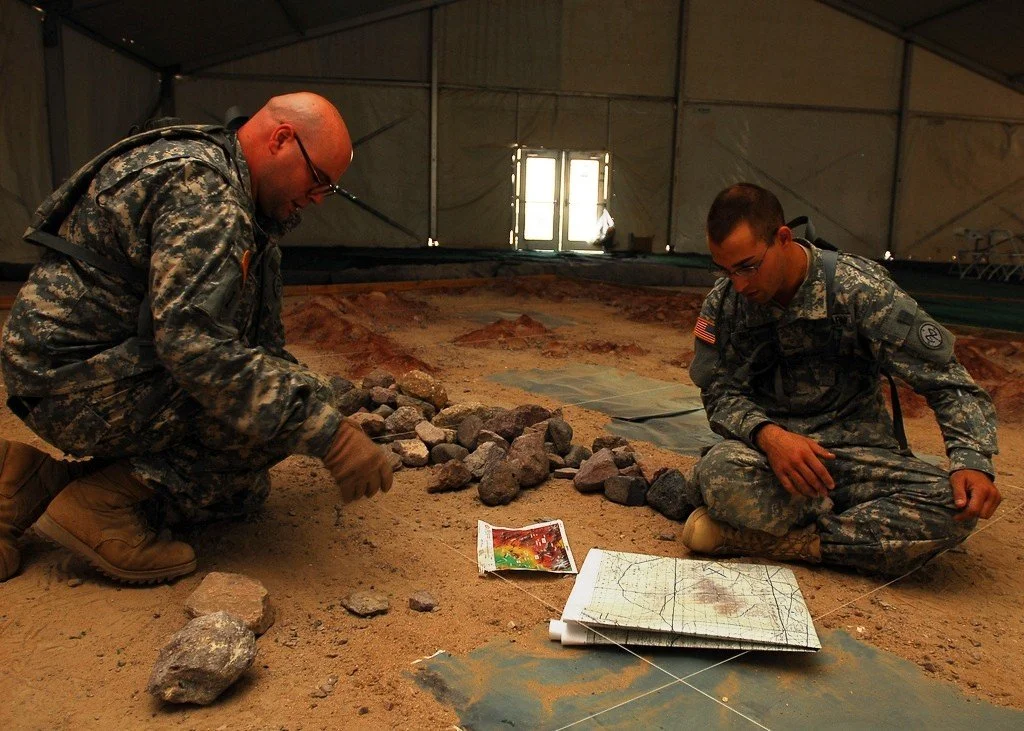
Photo © U.S. Army.
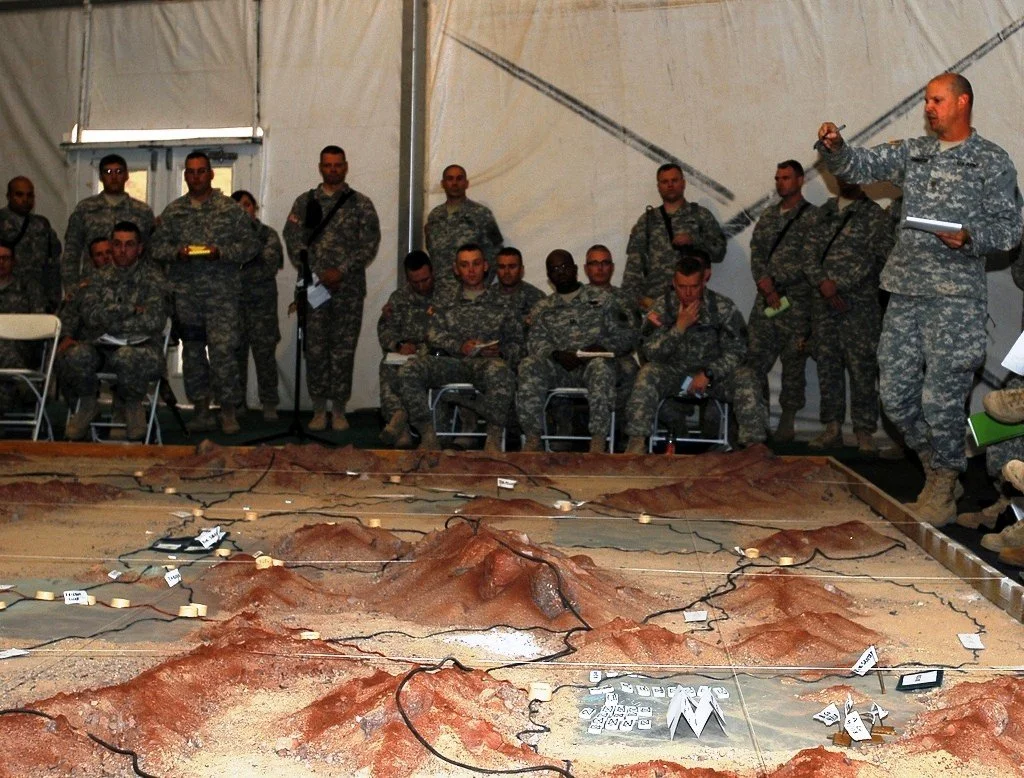
Photo © U.S. Army.