The bend in the blade
Seph Rodney

Milena Boneiek, Fencer, portrait, November 24, 2011. Photo, Alto / Alamy
In the modern sport of fencing, the steel used to manufacture the blades for the three types of swords—épée, foil, and saber—is of a very particular type. There is a very compelling reason for this.
At the 1982 World Fencing Championships in Rome, Italy, during a team foil contest, the world’s top-rated fencer, Vladimir Smirnov from the Soviet Union, faced the number two, Matthias Behr of West Germany. At a point during their bout, they initiated simultaneous attacks. Here, the reader might picture a combatant raising an arm and hand to slash down at their opponent’s head. But the nonintuitive rules of foil fencing dictate that attacks are only valid when they land point-first on the fencer’s torso, front or back. Therefore, attacks are often delivered by stretching out the arm and driving the arm, hand, and weapon to target, with the legs operating like pistons to shoot the body forward into a lunge. During the twinned attacks of Smirnov and Behr, Behr’s blade broke and the jagged, broken tip penetrated the mesh of Smirnov’s fencing mask, passing through his left eye orbit into his brain’s frontal lobe. Smirnov died in the hospital nine days later. This horrific accident brought about several changes to the sport, among them the requirement that masks be made three times stronger — able to pass a 12 kilogram “punch test” — and the replacement carbon steel blades with maraging steel, which is much less likely to break, and even when it does, snaps cleanly in two without leaving a pointed edge.
The international fencing authority that governs formal competition, the Fédération Internationale d’Escrime (FIE), specifies the use of this steel, though practice blades may be made of spring steel. The term “maraging” is a portmanteau of "martensitic" and "age hardening," and refers to a complex fabrication process that involves creating an alloy of iron, aluminum, titanium, and niobium, among other metals, which is then subjected to a cycle of heat treatments. This intricate forging is necessary to make the blade robustly resistant to “crack propagation.”
In practical terms, maraging steel that is graded 2800 has a yield strength — the amount of stress one can put on a material without it breaking — of 2,617 megapascals (a unit of pressure measurement). Stainless, cold rolled steel, graded as AISI 302, which is used in the construction of industrial buildings, firearms, and bridges, only has a yield strength of 520 MPa. Human skin has a yield strength of merely 15 MPa.
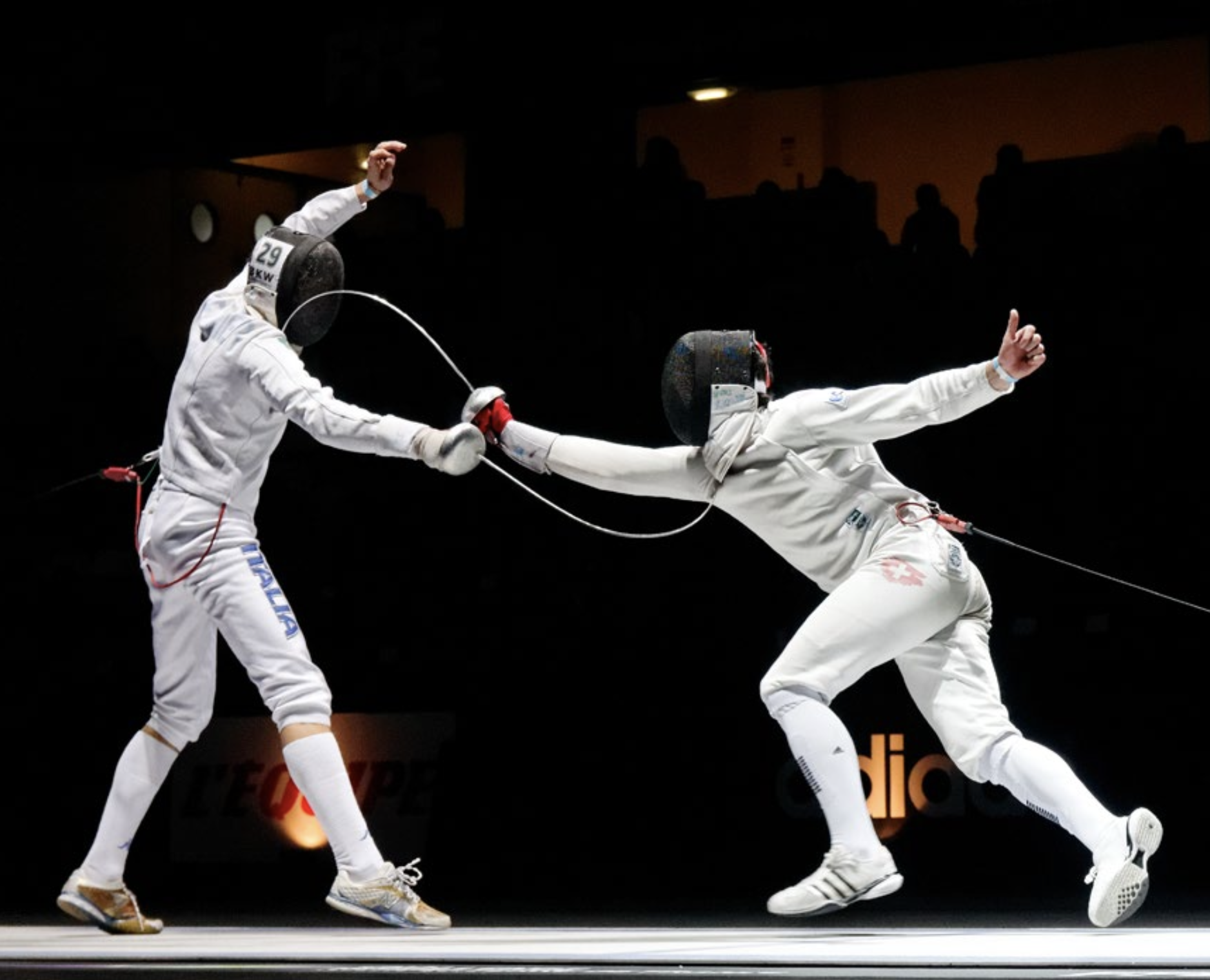
“Fencing Trophee” by Marie-Lan Nguyen, is licensed under cc by-sa 4.0. Wikimedia Commons.
Even with its combination of strength and resilience, the foil weapon typically weighs just over a pound. As a former fencer I recall it feeling light in my grasp, like holding a small sapling, one that would bend upwards under the weight of my flung body meeting another body that would withstand my attack’s penetrative force. It is this bending of the blade and its ability to return to its previous form that makes modern fencing possible. A typical fencing bout, outside of time restrictions, requires the winner to score 15 times on their opponent. Each successful attack is called a “touch,” admitting to the largely symbolic nature of the contest. Still, as a young fencer I was taught to attack with the intent and determination to drive the weapon through the other fencer, understanding all the while that I could not.
In the 2000s I was competing in the Southern California circuit. In one particular bout I was matched with a fencer whom I saw practicing with his coach before we stepped on the piste (the playing area, which according to FIE regulations, is 14 meters long and 1.5 meters wide). He looked well trained. I was immediately unsure of myself as I almost always was in public competitions. Still, I determined to fence my game. I had a habit of letting out an excited yell when I made a touch — more than anything else a release of pent-up anxiety. There came an instant when I saw through his defense, and my body knew, without me imagining the steps to get there, how to make the touch arrive. I was moving without conscious thought and even before the attack landed, I was already yelling: whooo! All the beauty and elegance I could hope to achieve came from me in that moment. All I had to do was see what was in front of me, drive the point to target with my legs, and let my hand go.
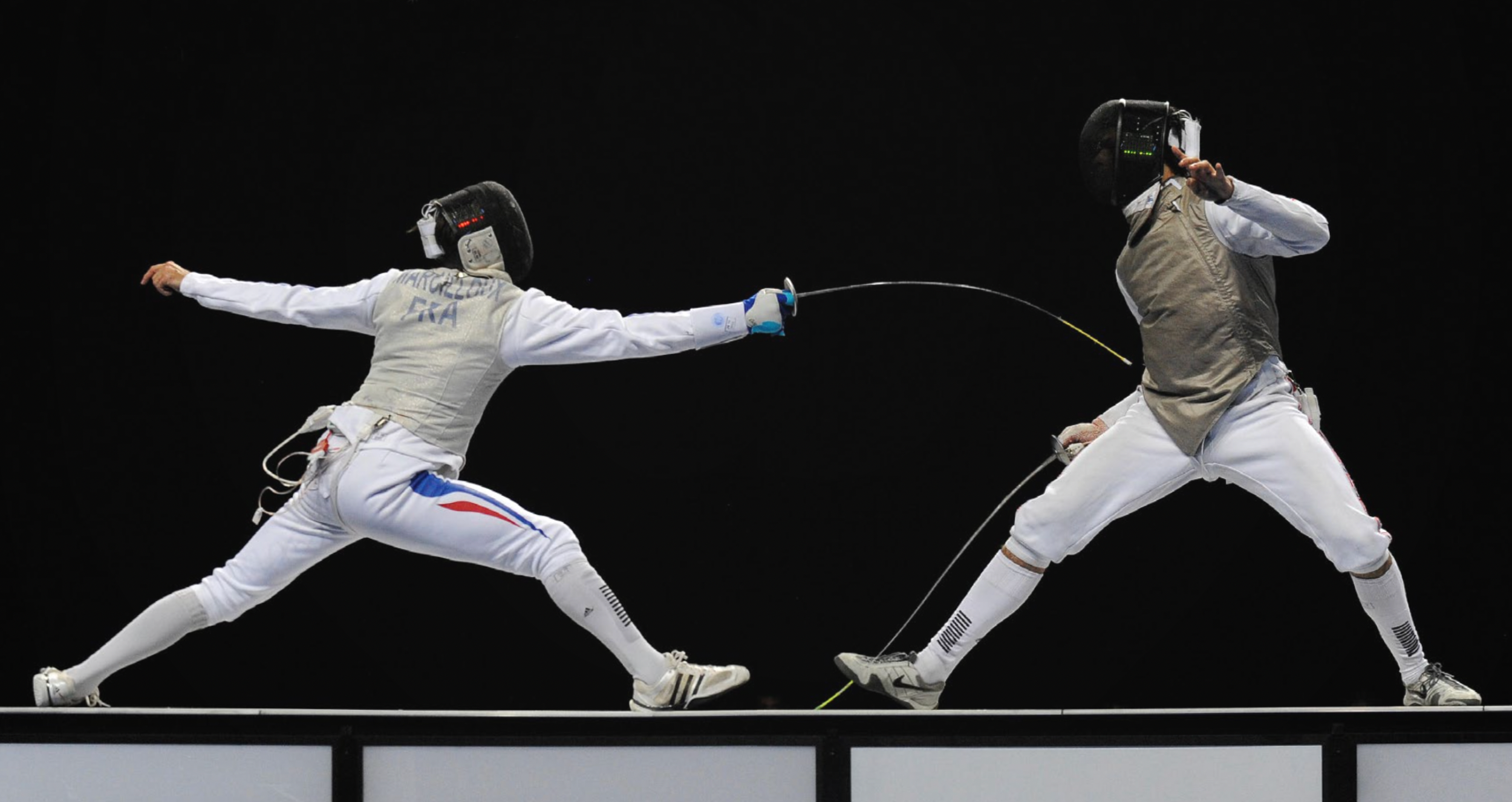
Marcel Marcilloux (fra) [left] v Husayn Rosowsky(gbr) [right] during the men’s foil competition at the London Prepares Olympic Test Event, ExCel Centre, London, England, November 27, 2011.