Home sweet dome
Alyssa Velasquez
Allegheny Conference on Community Development Photographs, 1892-1981, MSP 285, Detre Library and Archives, Senator John Heinz History Center.
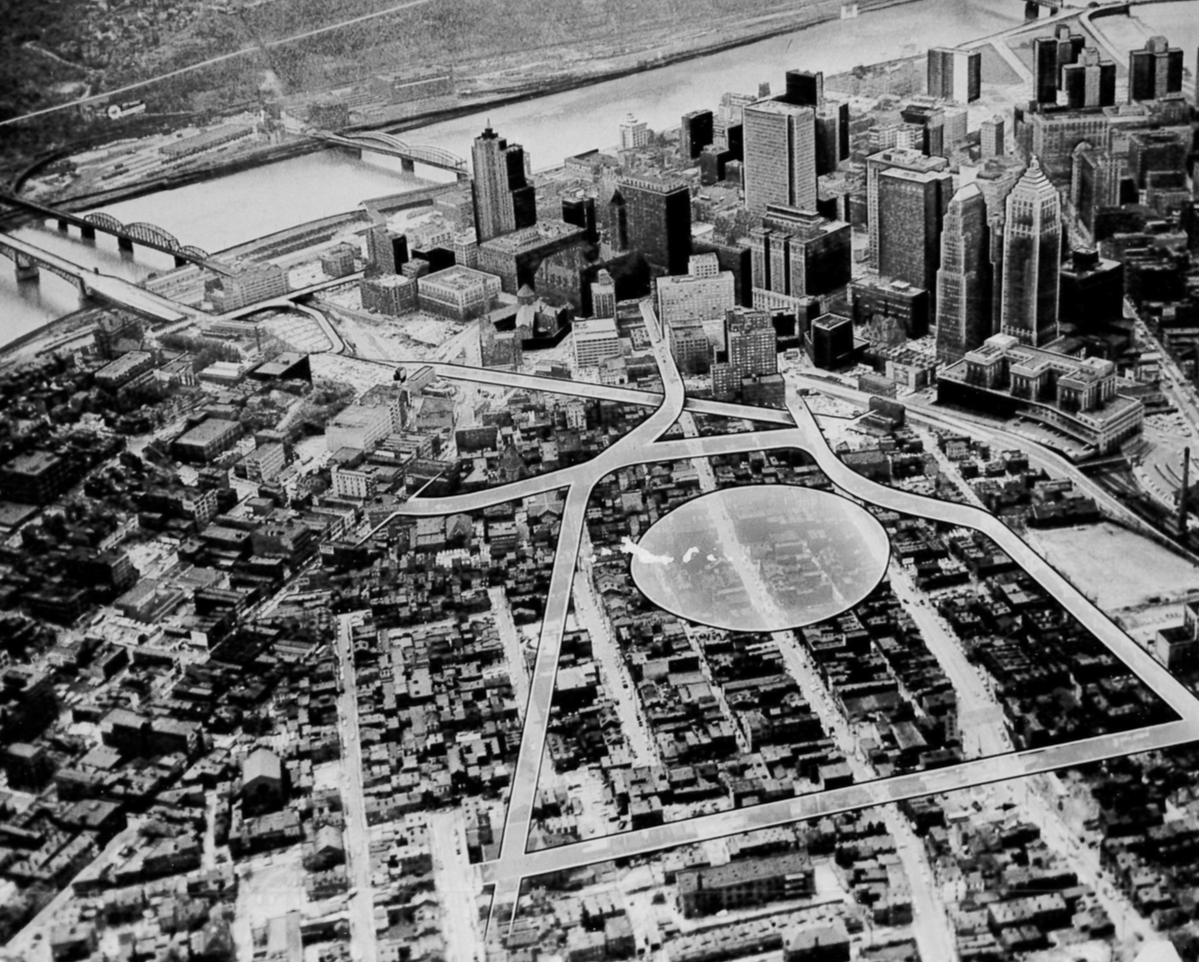
For the first official preview tour of the Civic Arena, in October 1960, the Pittsburgh Progress Committee hosted 36 out-of-town writers and 39 members of the local press. Before a single event had occurred in the newly constructed multi-purpose convention center, it had already been featured on covers and multi-page spreads in Life, Architectural Forum, and Esquire, in addition to trade magazines and newspapers like Variety and the New York Times. The Progress Committee estimated that since construction began in 1956, the Civic Arena garnered more than a hundred pages of publicity—making it one of the most advertised arenas in the nation. None of those articles reported on the removal of approximately 8,500 people that once lived in that section of town. It was the largest attempt to change a city neighborhood in US history up to that time, resulting in the displacement of the biggest African American community in Pittsburgh.
The redevelopment of the Lower Hill district happened at a time of widespread urban renewal projects in the U.S., with $200 million being spent in seven cities. Pittsburgh wasn’t the only metropolis looking for an icon. Edgar J. Kauffman, the department store magnate and client for Frank Lloyd Wright’s Fallingwater, said, “Pittsburgh has been so busy…it has had little time to find proper symbols for its existence.” Tired of sitting in the rain during Civic Light Opera performances at the University of Pittsburgh’s stadium, he pledged one million dollars to the arena project, joining the modernist renewal crusade alongside city councilman Abe L. Wolk.
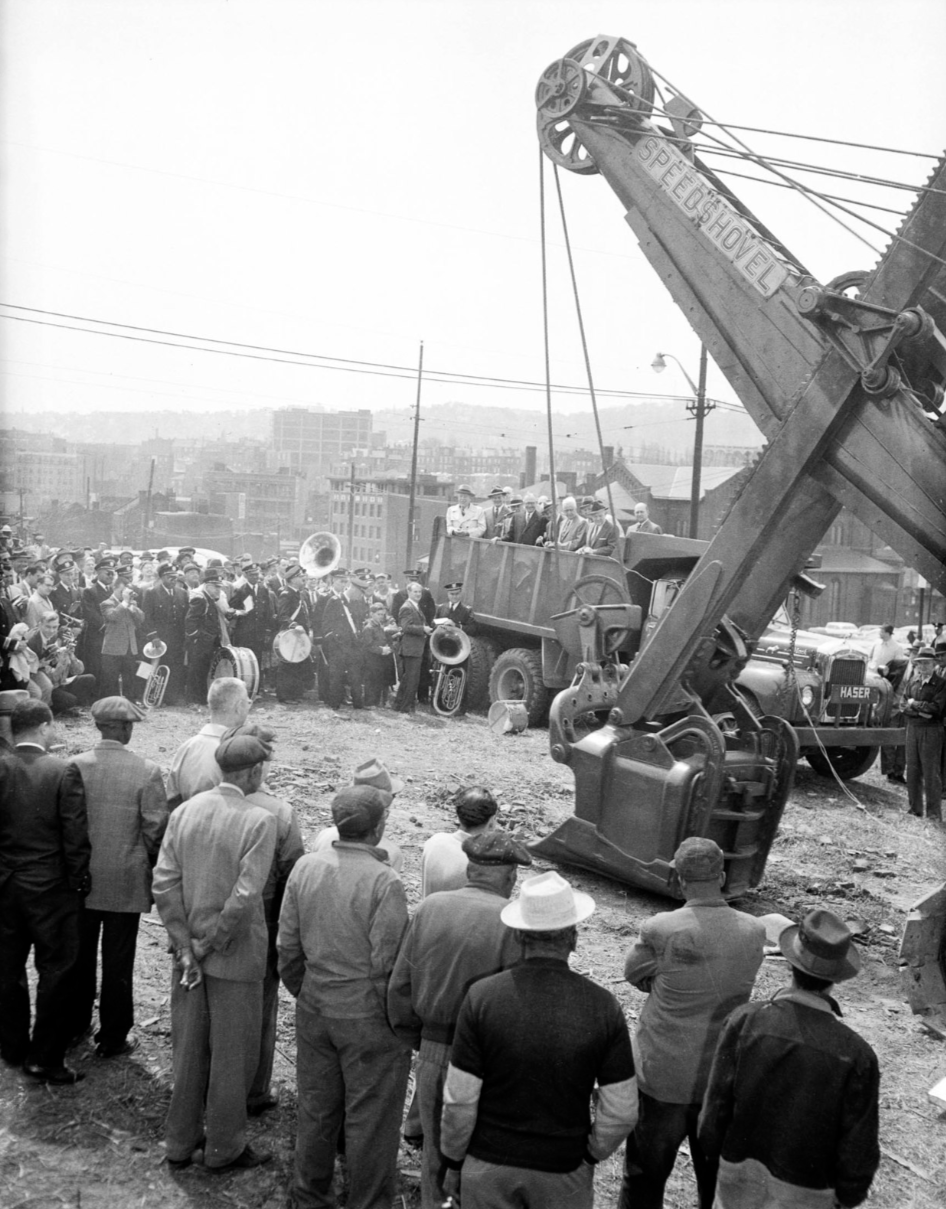
Charles “Teenie” Harris, Mayor David L. Lawrence, Sidney Swensrud, David W. Walker, John J. Kane, Howard B. Stewart, John M. Walker, A. H. Burchfield, and others at Civic Arena groundbreaking, Lower Hill District, Pittsburgh, April 25, 1958, Carnegie Museum of Art, Heinz Family Fund © Carnegie Museum of Art, Charles “Teenie” Harris Archive.
The William V. Winans Jr. Photograph Collection, 1958-1961, pss 027, Detre Library & Archives, Senator John Heinz History Center
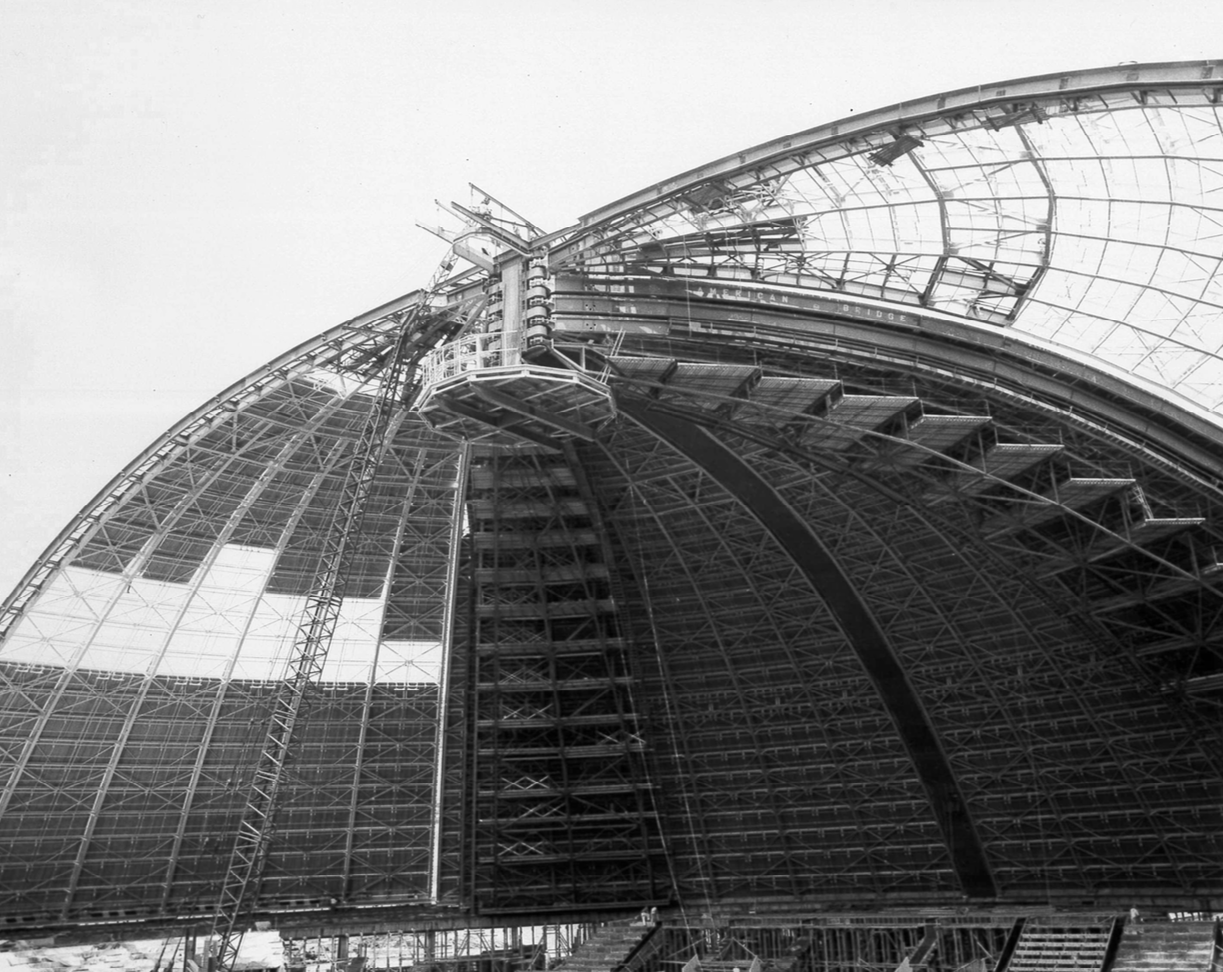
They envisioned a permanent and architecturally notable home for the opera company—a performance space with a moveable roof. In 1957, eleven years after Wolk’s proposal, the Public Auditorium Authority of Pittsburgh and Allegheny county unveiled their plans for a structure that would not only house the Civic Light Opera but become the “the symbol of an era here”—the crowning jewel of a comprehensive redevelopment. Designed by Pittsburgh architects James Mitchell and Dahlen Ritchey, the Arena was nearly circular in plan and as tall as a twelve-story building. Amazingly, the retractable steel roof - 170,000 square feet, or approximately four acres of surface area - had no internal supports. Made from sheets of stainless steel fabricated into eight trapezoidal shapes, it was divided radially into two stationary segments and six moveable ones, which rotated about a pin at the top as they rolled along curved rails laid on a reinforced concrete ring grinder. The moveable leaves had five separate motors and brakes that synchronized to open or close in two and a half minutes.

Morris Berman Photographs, c1950-c1975, pss 0043, Rauh Jewish Archives, Detre Library and Archives, Senator John Heinz History Center.
The construction was a crucible of modernism made of aluminum, steel, and glass – all materials innovated and produced in Pittsburgh. U.S. Steel, in particular, used the auditorium to signal the post-World War II growth of both an industry and city. Fortune magazine in 1961 said, “the great steel dome has a meaning that goes beyond Pittsburgh. If one of the drabbest and dirtiest of cities has been able to remake itself in shining pride, any city in the U.S. should be able to follow its example.”
But there was a terrible price to pay for this unique and ambitious dome: the brutal elimination of a thriving business district and its surrounding residents. In a 1973 oral history, Housing Authority official Irving Rubinstein estimated that when relocations began, the city’s affordable housing had only a 1% vacancy rate. Into that tiny sliver were supposed to fit some 1,551 families (most of them Black) who would forever experience the Lower Hill much differently. As a student in the early 1960s at Central Catholic, Gene Kail was asked to compare the domes of the world to the area in celebration of its opening. He recalls not being able to drum up much enthusiasm for a writing project on the gleaming structure that rose over where his childhood home had stood.
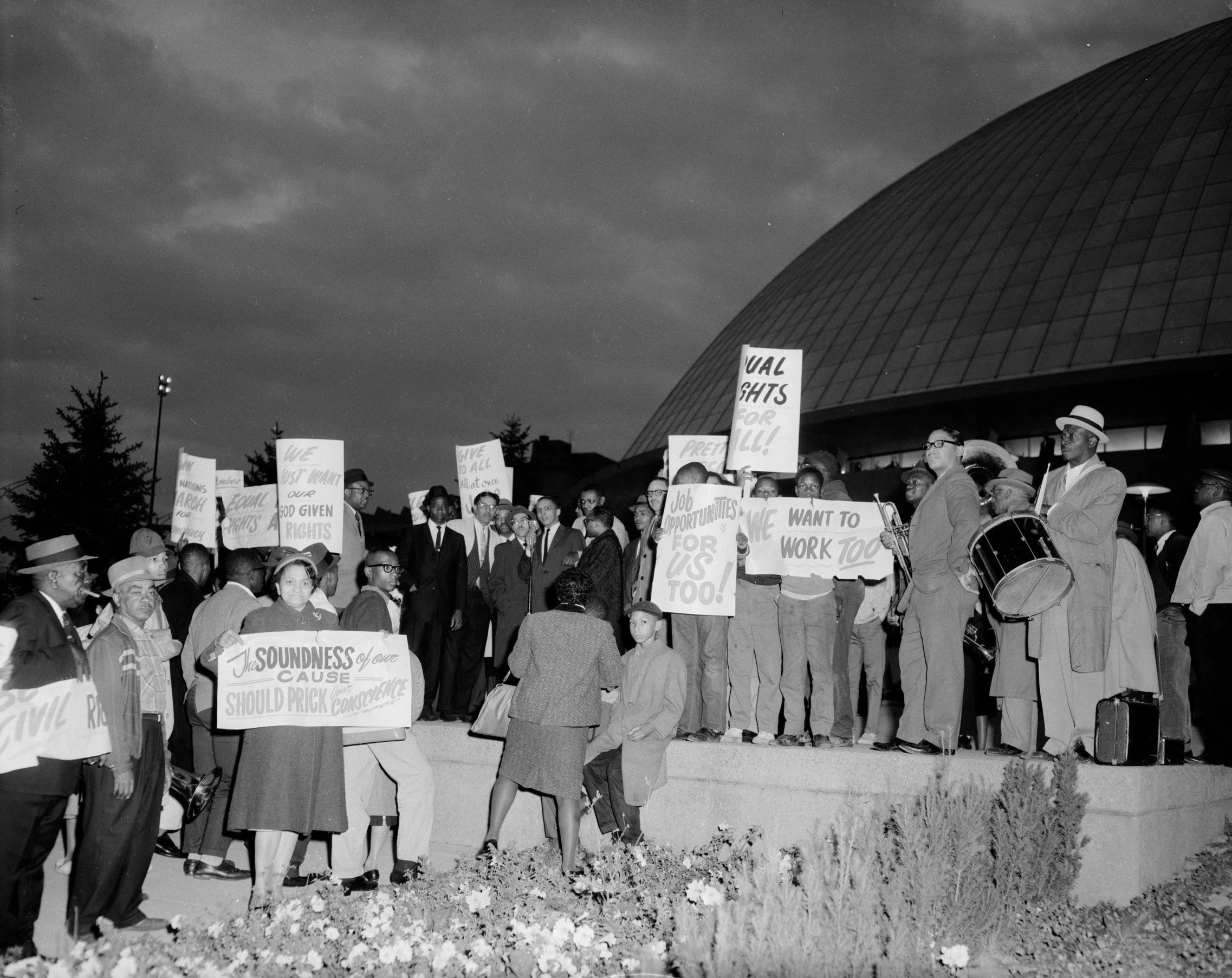
Charles “Teenie” Harris, Rev. Bill Powell and Rev. LeRoy Patrick, James McCoy, Mal Goode, Byrd Brown, and others protesting outside of the Civic Arena, Lower Hill District, Pittsburgh, October 1961, Carnegie Museum of Art, Heinz Family Fund © Carnegie Museum of Art, Charles “Teenie” Harris Archive.
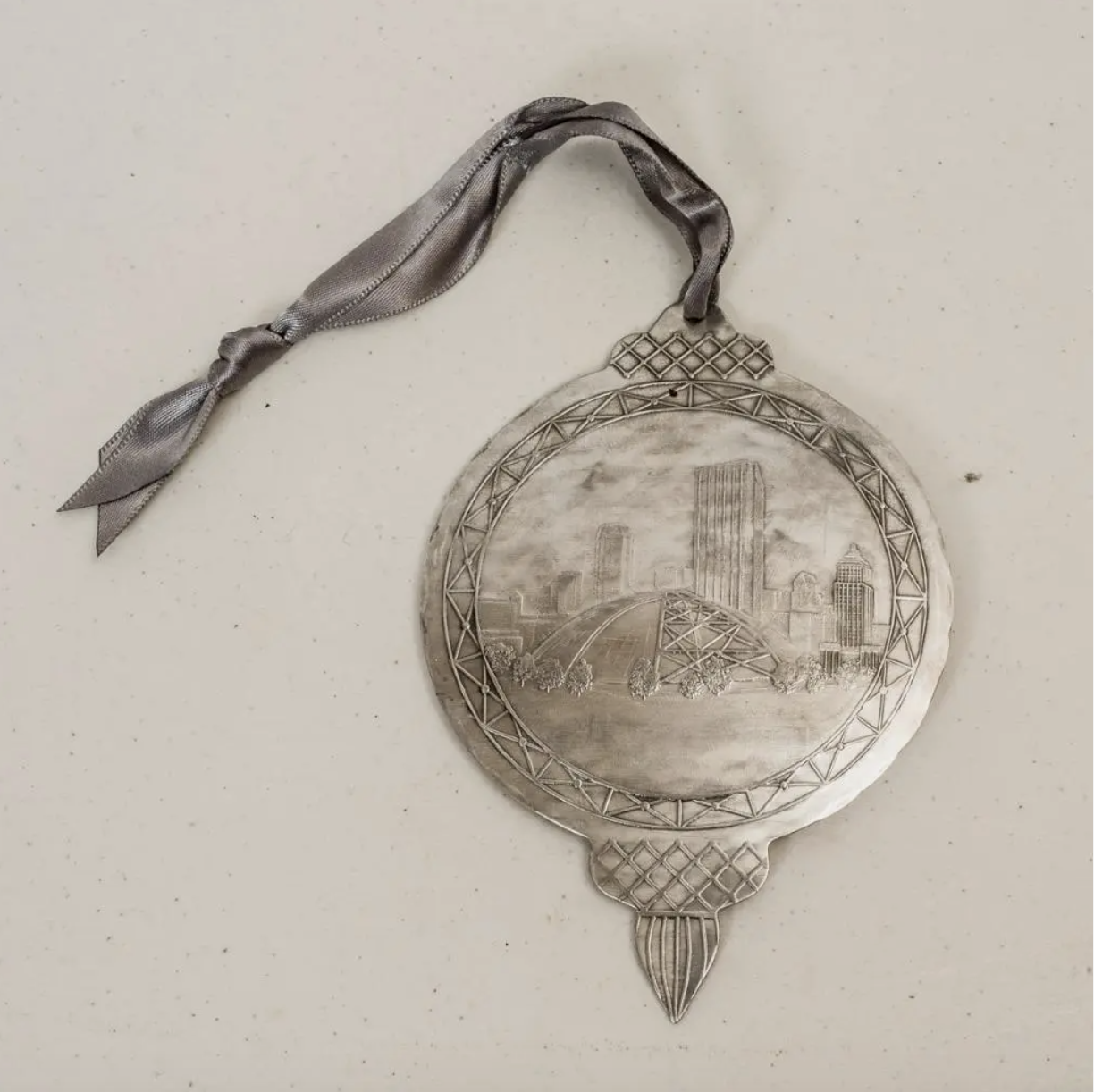
Medallion made from the Pittsburgh Civic Arena steel.