Guns, bikes, and steel
Nathan Cardon

Transportation Library, Northwestern University Libraries. “Iver Johnson’s Arms and Cycle Works”, late 19th - early 20th century Bicycle and Bicycle Parts Catalogs. Courtesy of Northwestern University Libraries.
A popular phrase amongst cyclists is “steel is real.” In a world of $15,000 carbon frames and off-the-peg aluminium, steel may seem like a throwback. But for some enthusiasts, hand-made and bespoke bicycles, using advanced steel tubing from one of two makers—Reynolds Technology (est. 1898) in Birmingham, England, or Columbus Tubi (est. 1919) in Settala, Italy—continue to be celebrated for their “feel” and compliance. For many amateur cyclists, steel’s qualities, its feedback of the road surface and minimization of vibration, still make it the perfect material, even in an age of high-tech carbon fibre wizardry. Thinking about the material intelligence of steel, however, can take us in other directions. As a historian of technology, mobility, and U.S. empire, I am interested in the everyday and subtle ways imperialism shaped lives and things. In the origins of the bicycle frame, we see the weapons of empire at work.
The modern bicycle—diamond frame, wheels of equal size—was first manufactured in England in 1885. When it was combined with air-filled rubber tires a global bicycle boom ensued, with millions sold in the last decade of the nineteenth century. The new geometry meant that tension was better distributed, and thinner and lighter steel tubes could be used. Weapons manufacturers—with their knowledge of interchangeable parts, drop forging, machine tooling, and methods of making steel tubing for rifle barrels—were well-positioned to pivot to this popular new technology.
The Connecticut River Valley, long a center for high-tech weapons innovation, attracted bicycle manufacturers seeking to benefit from the region’s specialist know-how. Guns made there since the 1790s had aided the rapid and violent expansion of U.S. territory on sovereign Indigenous land. One of the many firms to relocate to Hartford was the Pope Manufacturing Company, in 1877, led by its eponymous impresario Colonel Albert Augustus Pope. Over the next three decades it would become one of the largest bicycle manufacturers in the world.
Initially, Pope subcontracted production to Hartford’s Weed Sewing Machine Company, a firm with longstanding connections to the region’s military industrial complex. Weed Sewing was first located in rented space at Pratt & Whitney, then moved to the Sharps Rifle Manufacturing Company. In 1890, Pope purchased its supplier, and the drop-forging machines of the rifle plant were repurposed to build bicycles and parts, using many of the same techniques that had been used to make firearms.

Connecticut National Guardsmen with bicycles, Niantic, 18901899. Connecticut Museum of Culture and History, 2000.212.18.
Central to Pope’s success was the company’s Secretary and Manager, Lieutenant Harold Hayden Eames. Born in Shanghai in 1863, the son of a U.S. consul, he entered the U.S. Naval Academy at the age of 15, becoming an ordinance expert. After stints at the Pratt & Whitney and Colt Factories in Hartford and U.S. Projectile in Lynn, Massachusetts, Eames joined Pope in 1892 to oversee the installation of a new bicycle tube factory. Using his knowledge of gun barrel construction, Eames innovated a thirteen-step process for cupping steel plates that created four-foot-long billets. The subsequent steel tubing was stiffer and twenty-five percent stronger, resistant to denting, and could be made thinner and lighter. Under Eames’ supervision Pope built what historian Bruce Epperson has labelled as the “most advanced seamless steel tube factory in the world.”
At times it could be difficult to separate the bicycle and gun industries. The 1894 New York Bicycle Show, for example, featured displays by Remington Arms (Ilion, New York), Bridgeport Gun and Implement (Connecticut), and J.P. Lovell Arms (Boston, Massachusetts). Technology and people could also move the other way. In 1894, The Cyclist reported that a Mr. F.E. Belden was moving from Pope to Colt firearms, and in the same year, the Brigade Signal Corps of the Connecticut National Guard could be seen riding Pope’s Columbia military bicycles, armed with Springfield rifles and Colt double action revolvers.
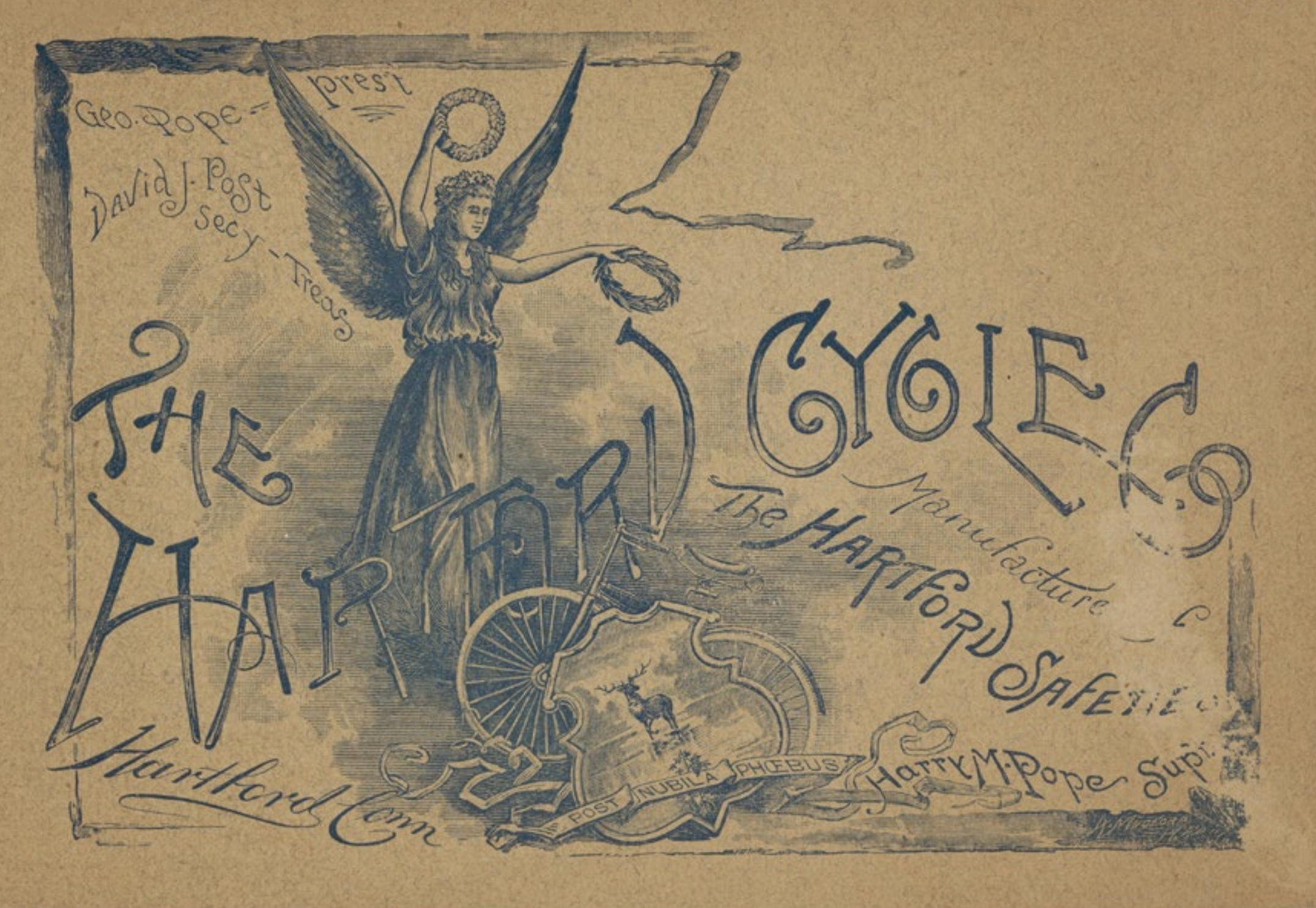
Transportation Library, Northwestern University Libraries. “The Hartford Cycle Co., manufacturers of the Hartford safeties”, late 19th - early 20th century Bicycle and Bicycle Parts Catalogs. Courtesy of Northwestern University Libraries. Courtesy of Northwestern University Libraries.