Flat-pack empire
Stephen Tuffnell
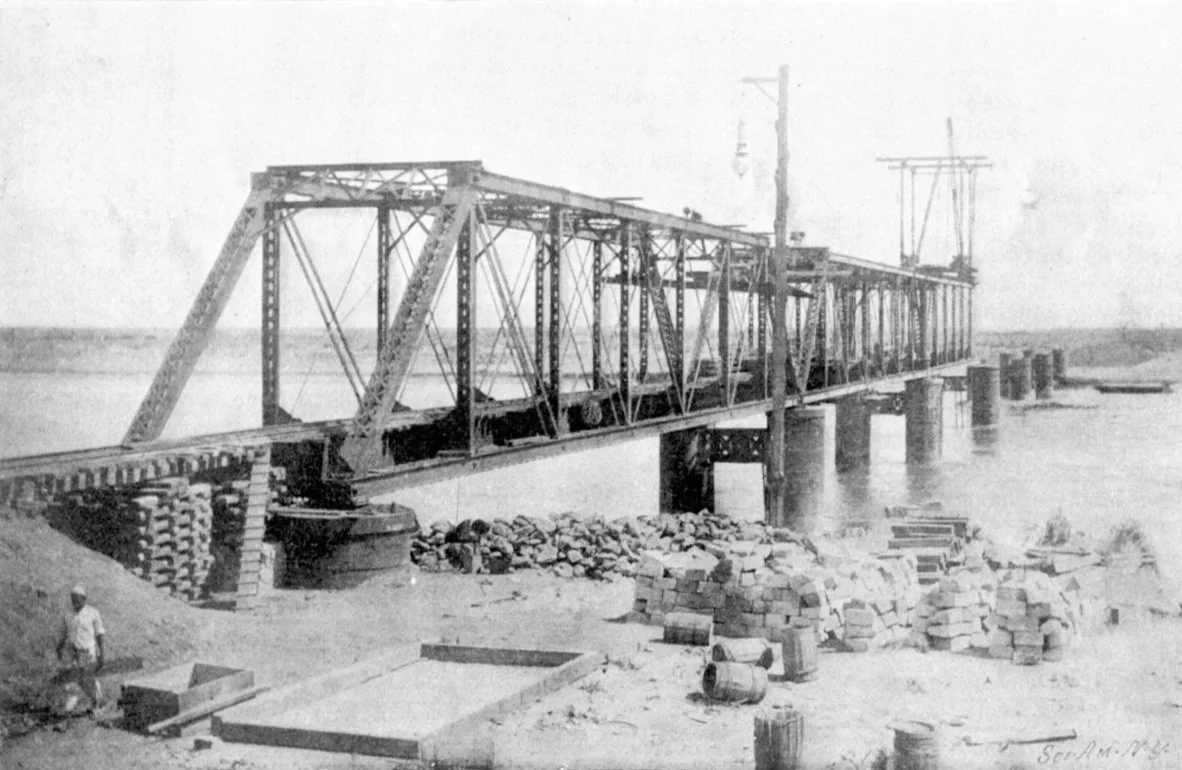
The journey from Philadelphia, Pennsylvania to Atabara, Sudan, is more than 6,000 miles as the crow flies. That’s a long way for 622 tons of steel to travel, but the Atbara River Bridge made the journey nevertheless.
In early February 1899, the component parts of the bridge rolled from the mills of Philadelphia’s Pencoyd Iron Works and began their journey to the middle of the Nubian Desert. After crossing the Atlantic and arriving in Alexandria, this great kit of parts, which included seven steel trusses, chords, pier caps, rivets, and an electrically-powered travelling crane, was loaded onto 67 railway cars and transported to Cairo, where the cars were moved to barges and sailed down the Nile to Wady Halfa. Here, the bridge was loaded onto the Sudan Military Railway and taken to the construction site. Once at the bridge site, the travelling team of American engineers constructed its seven spans onshore before swinging them out onto concrete piers sunk into the riverbed.
The American engineers didn’t work alone. The erection crew managed a mixed labor force of around 200 Egyptian and Sudanese convicts paroled for the work under the supervision of 120 soldiers. These were divided into gangs of six men who ‘worked at the muzzle of the soldiers [sic] rifle,’ with each worker driving 100 rivets per day on the 1000-foot-long structure. They toiled in harrowing conditions: the Nubian Desert is one of the hottest and driest climates on the planet, with temperatures reaching as high as 48˚c in the shade, so that work had to be paused between 11am and 3pm. Costing a mere £6,500 and taking just six weeks to build, the simple cantilever bridge was a crucial part of the Sudan Military Railroad, enabling the supply and organization of British and Egyptian troops who then advanced against the Mahdist State near Khartoum, 177 miles to the southwest, as they consolidated Britain’s North African empire.
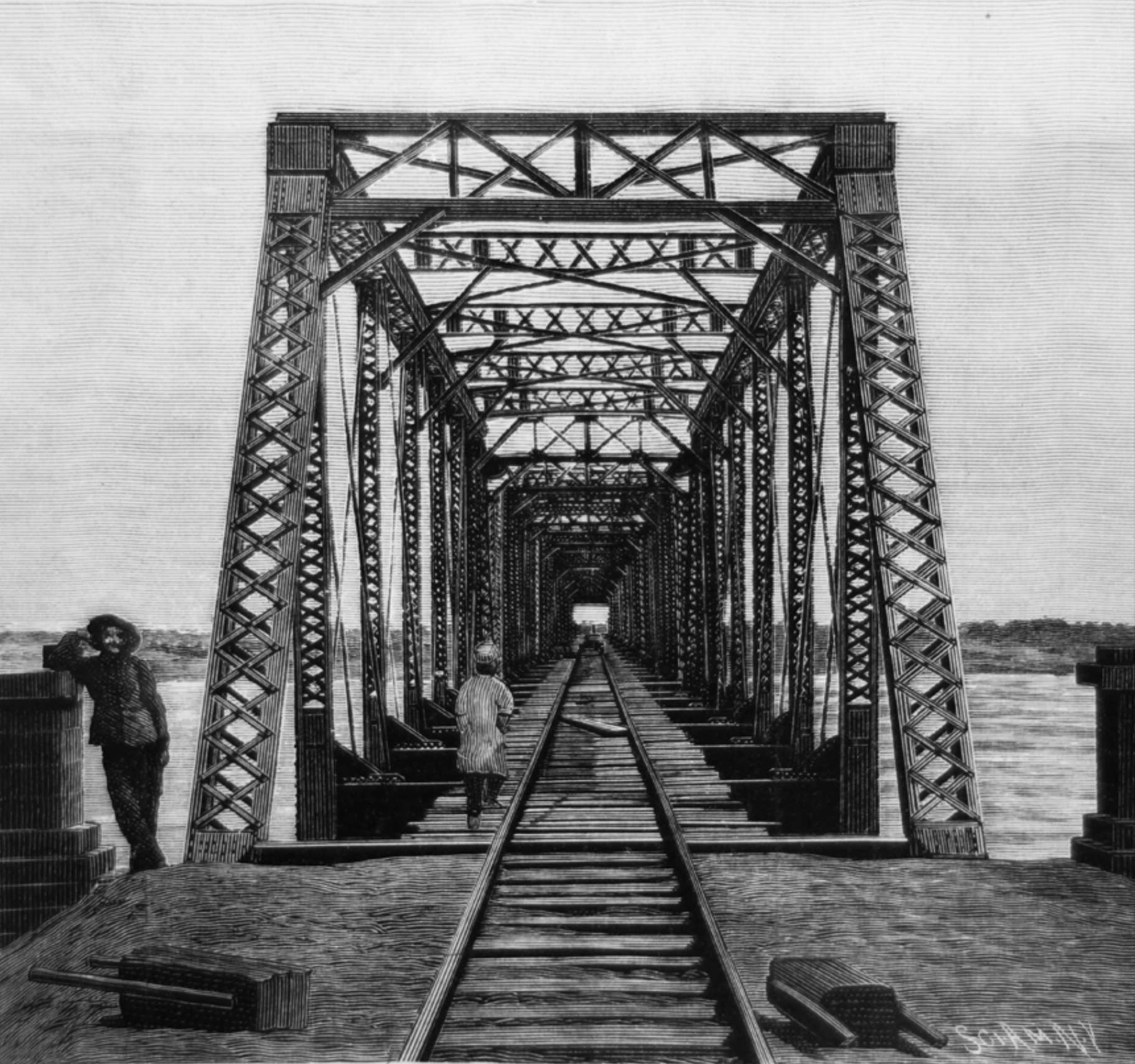
Photograph of “Portal View of the Completed Bridge, The Atbara River Bridge,” Scientific American, Vol. lxxxvi, No. 11 (March 15, 1902): 184.
Bridges are among the largest, most impressive feats of steel. Emblematic of the conquest of time and space by steam-powered modernity, they are usually thought of as immovable objects. But in the late nineteenth century, American railway bridges were surprisingly well-travelled. The portfolio of the Phoenix Bridge Company, by the 1890s the leading bridge fabricator in North America, included prefabricated exports to Guatemala, Nicaragua, Peru, Costa Rica, Cuba, Brazil, Mexico, Canada, Russia, China, and Japan. Pencoyd erected “knock-down” kits in Japan, Taiwan, Mexico, the Netherlands, Uganda, and Australia. The Pennsylvania Bridge Company spanned the vertiginous Goteik Gorge in Burma.
How was all of this possible? Two important factors were involved. The first was a technological innovation, structural steel, which transformed bridge- and skyscraper-building. Pencoyd pioneered the rolling of standardized shapes from open-hearth furnaces in the United States. Open-hearth steel had the advantage of being stronger than wrought iron and less brittle than steel made by the Bessemer process. The introduction of this new structural steel was so rapid and so sweeping that it prompted Andrew Carnegie to declare, ‘Farewell, then, Age of Iron; all hail King Steel.’ By 1900, Pencoyd operated 10 open-hearth furnaces, each of around 30 tons capacity. Pencoyd turned out 5,000-15,000 net tons of steel shapes per month, so the 620-ton Atbara kit was about four days’ work. In addition to beams and girders, Pencoyd also produced the pins, nuts, and rivets needed to assemble its standardized bridge templates. The firm effectively provided flat-pack bridges for global consumers.

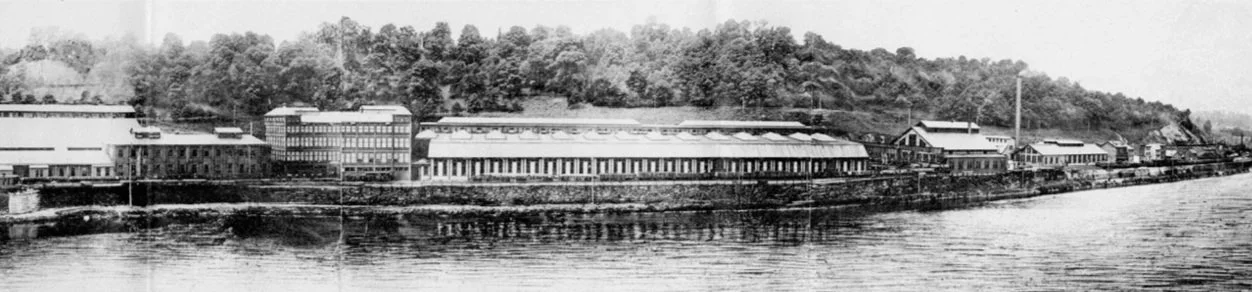
Panorama of Pencoyd Iron Works (Pencoyd, Pa.), 1900, 1986268_1_0570. American Iron and Steel Institute, Public Relations Department. American Iron and Steel Institute photographs and audio-visual materials (Accession 1986.268), Audiovisual Collections and Digital Initiatives Department, Hagley Museum and Library, Wilmington, de.