Speaking in steel

Jenny Bulstrode

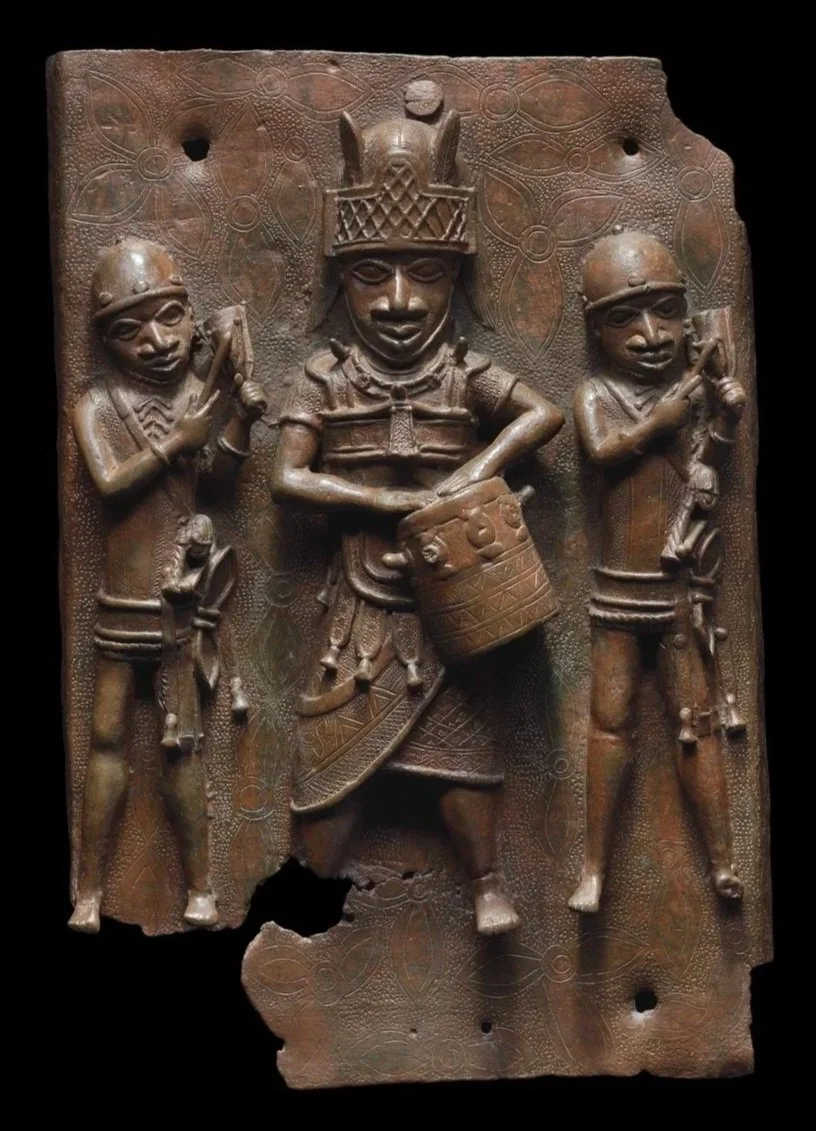
Royal Bronze-casting Guild (Igun Eronmwon), Nigerian. Relief plaque showing a dignitary with drum and two attendants striking 75gongs. Edo, Benin kingdom, Nigeria, c. 1530-1570. Copper alloy. 17 x 11 in. Museum of Fine Arts, Boston. Robert Owen Lehman Collection. Photograph © September 2024 Museum of Fine Arts, Boston.

African gong-languages, which use the vibrations of wood, skin, copper and iron to transmit complex messages, have been described as among the most sophisticated acoustic speech surrogates known to man. Long before telegraph wires, they carried information across seemingly impossible distances and terrains. They are the very definition of material intelligence.

In eighteenth-century Britain, steel was produced in tiny quantities at great cost. It was an expensive prestige commodity that wealthy young men used to decorate themselves and dazzle intended mates. By contrast, African smiths of the same period, and long before, routinely produced alloys of carbon steel quality. The iron metallurgy developed over millennia by great civilizations across the vast continent was fundamentally different from that of Northern Europe. In fact, for most of Africa’s history, speaking in terms of ‘wrought iron’ and ‘steel’ does not make sense. Understanding how ferrous metal was made to speak means first forgetting European expectations, and instead listening to how African experts describe their practice.

O’dyke Nzewi has explained how Igbo smiths beat iron over a charcoal fire and a wooden bell mould that is scorched to destruction with the heat. The Babungo smiths of Northwest Cameroon describe this as the most difficult of undertakings, like forging the iron hammer itself, which they consider “the mother of the world.” Beating the iron over charcoal and scorched wood, they alter the carbon content and structure of the metal to tune the bell: a kind of ‘steel’, so to speak. From orchestras to royal decrees, this iron voice was a herald. As James Anquandah showed, iron gongs depicted on royal burial goods trace the very origins of the Akan civilization.

Gong-languages work by reproducing speech tones, but tone alone does not convey the meaning. To provide an interpretive framework gong-languages use patterns of speech like code, with exceptional information retention. Not coincidentally, the African civilizations that developed these sophisticated speech surrogates have oral histories that are more reliable than European counterparts. Far to the North of Ghana, the living memory of the Nakong people extends back centuries. Among the information that is retained with terrible clarity: the memory of how gong-language was used to sound a warning against the raids that stole away their family members. In just over ten decades, Europeans trafficked almost a million people to Jamaica from various regions of the African coast, and above all regions of Nigeria, Ghana, and Cameroon, renowned not only for their metallurgy but also for coding memory into material voice.

In 1696 the white enslaver government of Jamaica banned drumming to prevent resistance movements organizing. But they underestimated the innovation of the African diaspora. The mountains of Jamaica are the hereditary territory of the Leeward and Windward Maroons, descendants of African freedom fighters who waged war on the enslavers. Metallurgy was central to their resistance. Taking the shackles, chains and agricultural implements of the enslavement system, they forged them anew into weapons and objects of status and identity, forcing the British to formally recognise their freedom in 1739.

Less than five decades later, in 1796, they were in open war once again. For the past year, Black freedom fighters across the island had waged a coordinated campaign against the enslavers. With the British army outwitted and outfought by these ‘quicksilver rebels,’ the military governor of Jamaica had deployed starvation tactics and released dogs bred to hunt people. Now to these war crimes he added deception, keeping his plans secret even from his own generals in the field he plotted to lure the remaining Maroon population into a trap with the offer of a treaty.

Starved and hunted, the Trelawney Town Leeward Maroons agreed. But when they came to parley, the governor revealed his betrayal, seizing and deporting six hundred of them to Nova Scotia. While they were caught in the governor’s treachery, the Windward Maroons received word of what had happened. One the most sacred of their living histories tells the story: an enslaved African smith who had been set to making handcuffs and shackles took up the iron and instead used it to ‘speak’ a warning. The colonists never discovered how the Windward Maroons got warning of the trap, but ‘at some distance… deep into the wood in the direction of Mount Oliphants… a Drum was heard’.

Iron intelligence is a warning of the past, but it is also an expression of the present. Working the blade of a machete and a small piece of scrap metal together, Windward Maroons make an instrument they call the ‘adawo’ or iron. Its voice is not just an echo of African gong-languages, but a new articulation of those great heritages, and, in the words of Suzanne Cèsaire, the ‘unique communions’ forged.

the mettle of our metal,
our cutting edge of steel,
our unique communions
– all will be recovered.

–Suzanne Cèsaire, 1943.


Jenny Bulstrode is Lecturer in History of Science and Technology at University College London. She uses an interdisciplinary combination of archival research, oral traditions, tacit skills and material science to research histories of material practices and how those practices shape differing ways of knowing the world. Her research on flint, glass, copper, and iron has won multiple awards; and for her work with artists, expert practitioners, engineers, and material scientists she was listed one of Apollo Magazine’s 'top ten thinkers in Art and Tech' in 2020.

Brilliant Move

Brilliant Move is the Brooklyn-based creative studio of Marci Hunt LeBrun specializing in building websites on the Squarespace platform – among many other things.

I love working with small businesses, nonprofits, and other creatives to help them organize their ideas, hone their vision, and make their web presence the best it can be. And I'm committed to keeping the process as simple, transparent, and affordable as possible.

https://brilliantmove.nyc
Previous
Previous

Crucible of the divine

Next
Next

Flat-pack empire