Búcaros de Indias
Margaret E. Connors McQuade
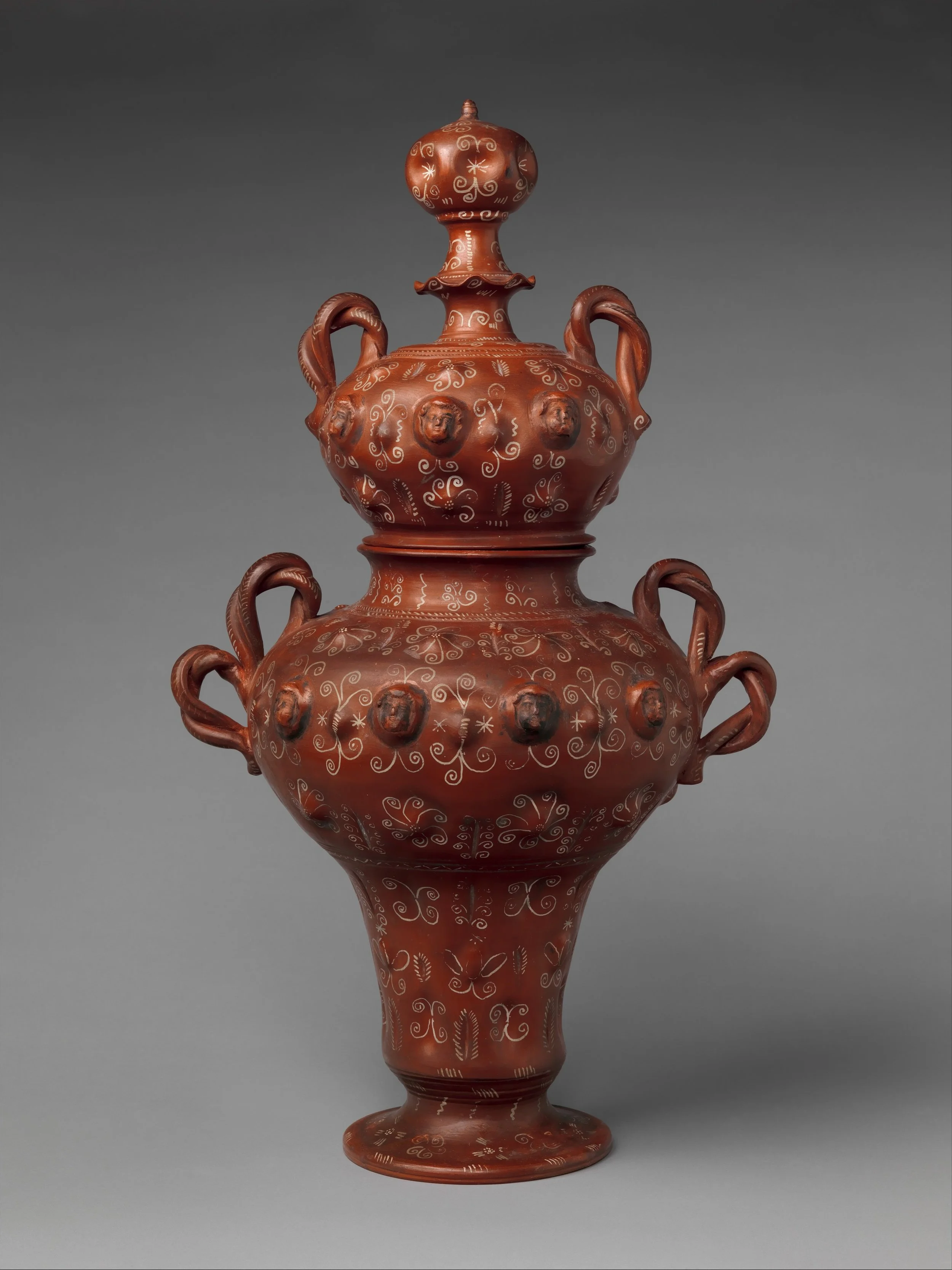
Pottery can be functional, and it can be sculptural. But did you know it could also be aromatic, gastronomic, evaporative, and medicinal? The low-fired, burnished earthenware known as búcaros - from Tonalá in Mexico, Natán in Panama, and Santiago in Chile – was prized by European collectors in the seventeenth and eighteenth centuries. The term stems from the Portuguese word púcaro, thus connecting the ware to a ceramic tradition dating back to the Etruscan period. Portugal was famed for its red pottery, especially terra sigilata, in which the object is surfaced with a very fine clay slip. The region of Estremoz exported vessels beyond the Iberian Peninsula, including Portuguese colonies. While any direct connection between the traditions in Portugal and the Americas remain a mystery, it was important that the pieces from Mexico, Panama, and Chile were distinguished as búcaros de las Indias, pottery from the “Indies,” or Americas.
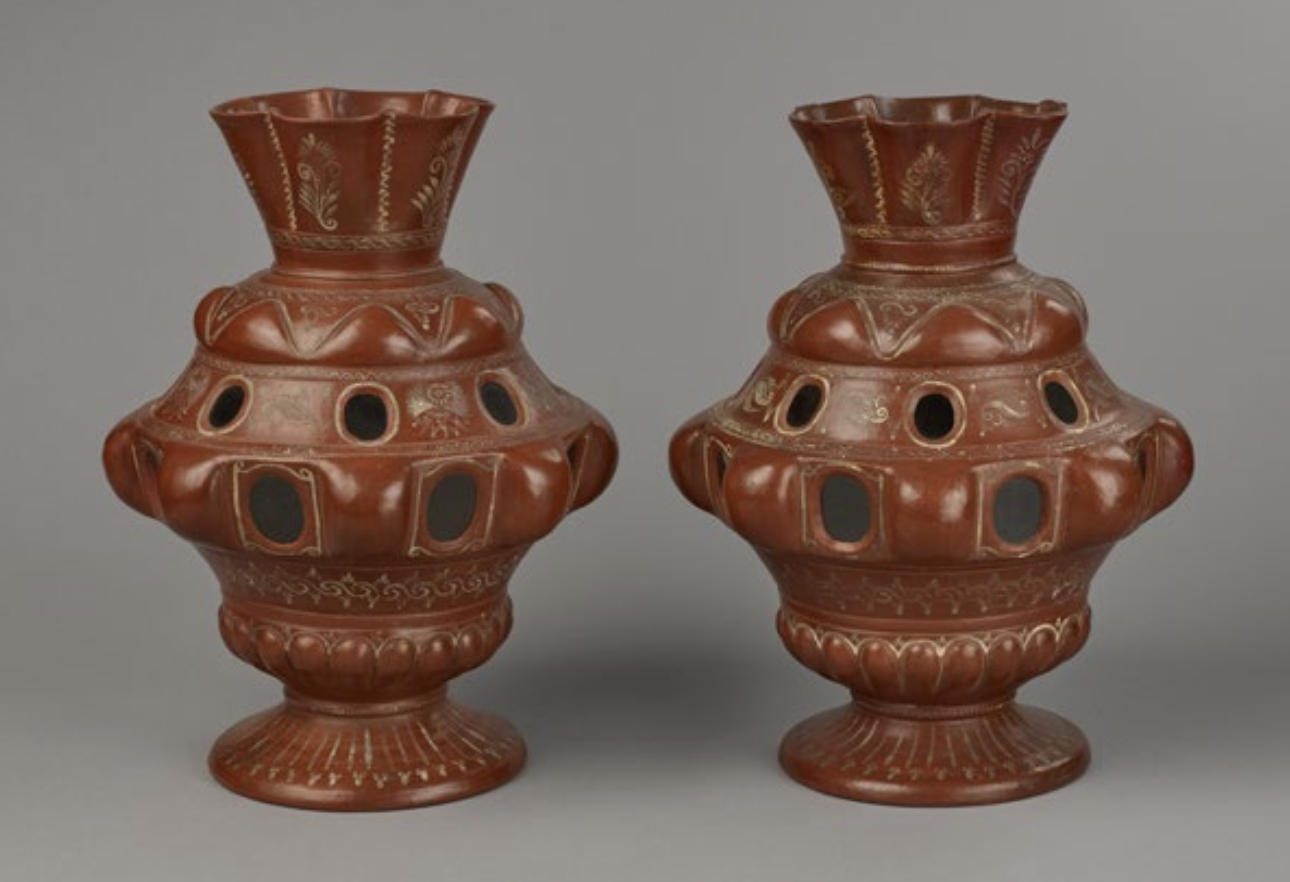
Altar lamps, Monasterio de las Clarisas, Santiago, Chile, ca. 1675, red-slipped earthenware with glass, courtesy of the Hispanic Society Museum & Library, le2221.
The Florentine scholar and scientist Lorenzo Magalotti (1637-1712), who had a particular fascination for búcaros, left the most informative account on their production. Magalotti never traveled to the Americas, but he did study collections in Europe, and documented reports from those who had first-hand information. Magalotti distinguishes three types of Búcaros de las Indias: those from Chile, which he said were the most charming (gracioso); those from Tonalá, which were most delicious (ricos), and those from Natán, which were the most majestic (majestuosos).
It was believed that búcaros purified water; as such, they became preferred vessels for storing and drinking. The aroma of the porous clay bodies was so pleasing that it became fashionable, particularly for women, to consume actual fragments of the búcaros. The practice became known bucarofagia, and was used for a variety of medical needs, including menstruation and contraception. Fragments of búcaros were also used directly on bare skin to improve one’s complexion.
Magalotti attributes the refined quality of Chilean búcaros to the fact that they were made by the hands of nuns in Santiago, who, according to a 1674 account by his informant Diego de Rosales, “take to Peru great quantities of jars and búcaros of very curious forms, very fine and fragrant, that can compete with the búcaros from Portugal and other parts, which are served as delicacies to women; and, even though they appreciate them for their beauty, they request them for their appetite.” There were supposedly 1,000 nuns in four convents involved in the manufacture (one was the Monasterio de las Clarisas, where the National Library of Chile is currently located).
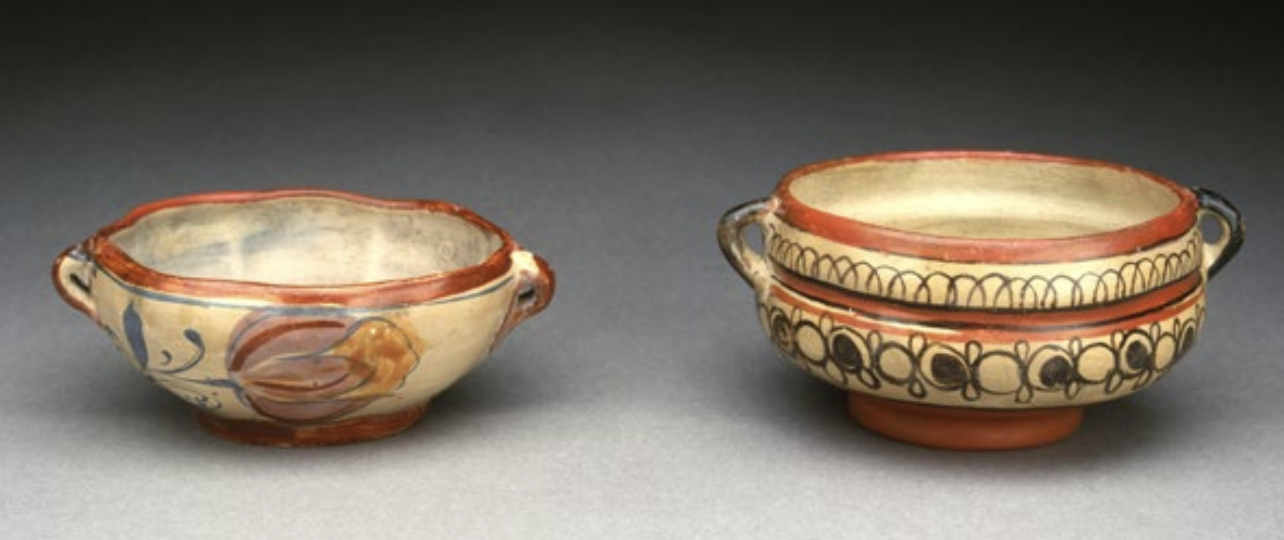
Cups with double handles, ca. 1700, Tonalá (Mexico), slipped earthenware with polychrome, courtesy of the Hispanic Society Museum & Library, le1972-le1973.
Contemporary European accounts refer to Mexican búcaros as coming from Guadalajara, but the workshops were in fact located in town of Tonalá, outside the city. Three general types of búcaros were produced there: redware, black micaceous ware, and polychrome ware, the latter of which included large amphora form known as archibucaros. According to the eighteenth-century Mexican historian, José Antonio de Alzate y Ramírez, the potters in Tonalá were “Indios,” which suggests that the trade was dominated by people of indigenous descent. The city took pride that nearly every household in Tonalá had its own workshop (fábrica), and that men, women and children alike were involved in production. Alzate y Ramírez records that potters used sapodilla plums, known as texocotes (haws), or pieces of pine (ocote) to extract the pleasing aroma of the clay that was so desirable.
Of the three production sites for búcaros de las Indias, the least is known of Natán in Panama. Magalotti describes black burnished ceramics being made there, often fitted with gold and silver mounts. He further relates that búcaros from Panama were distributed to Cartagena, Colombia, the Caribbean, and Spain.
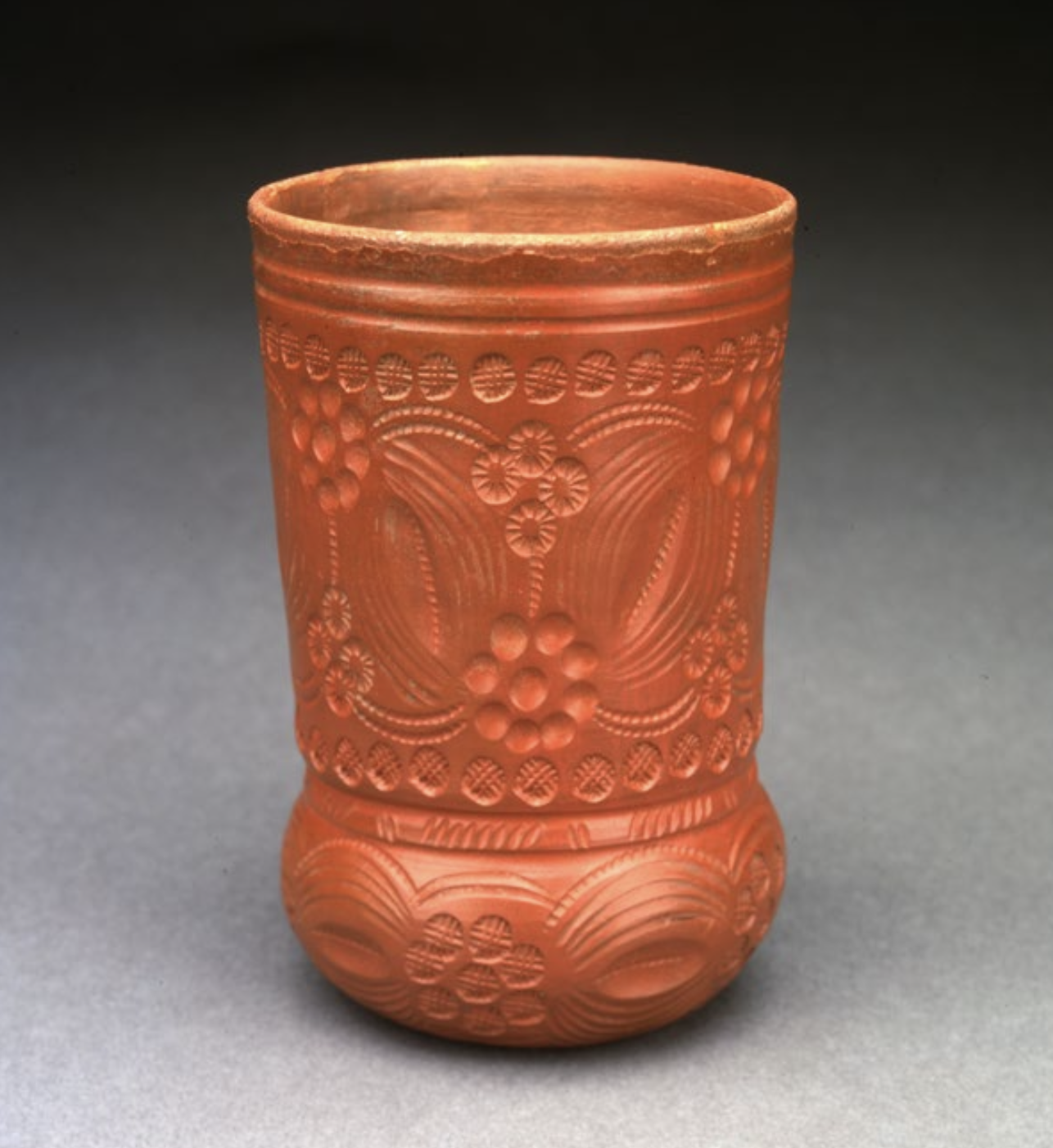
Beaker, ca. 1620, Tonalá (Mexico), red-slipped earthenware, courtesy of the Hispanic Society Museum & Library, le1975.
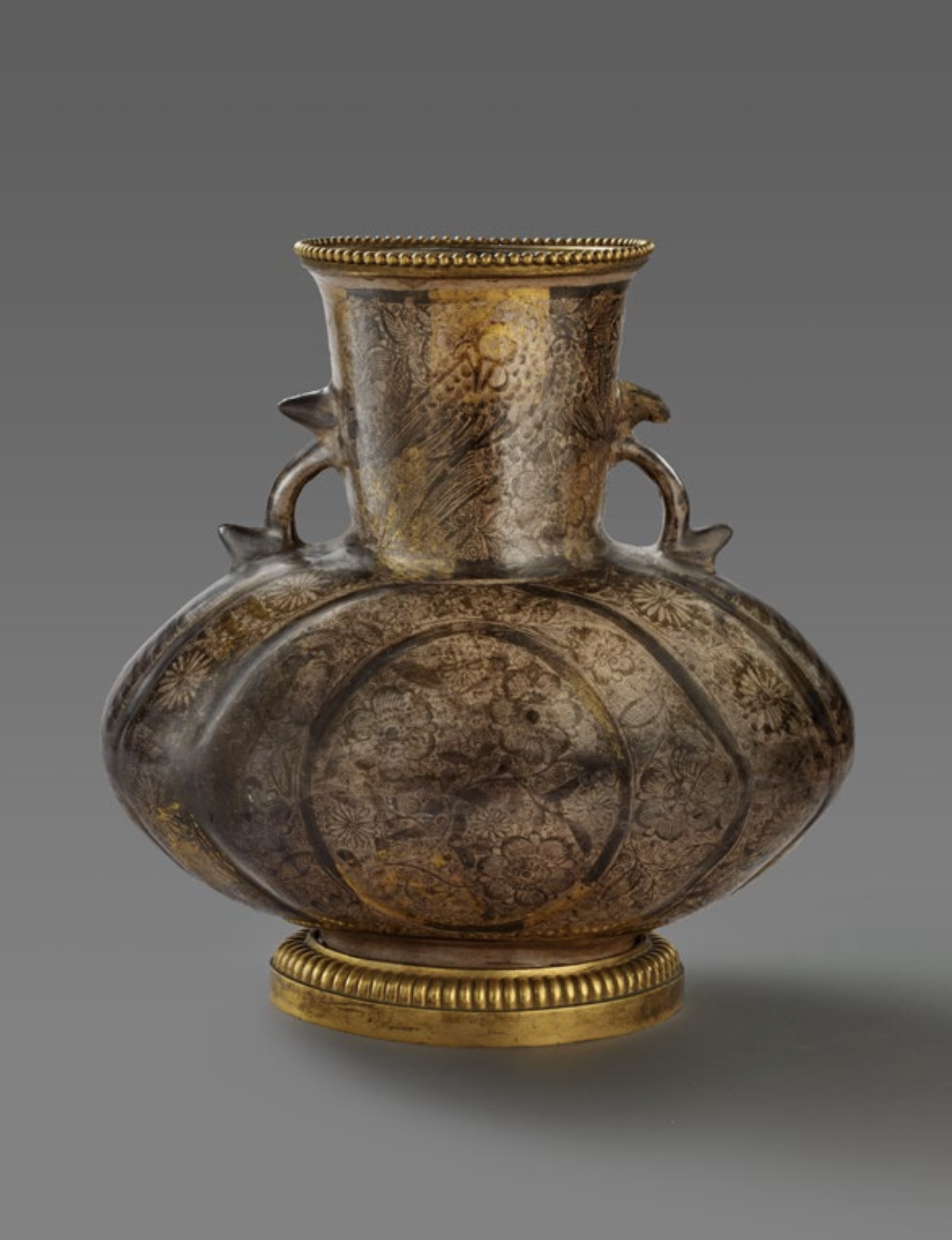
Vase with Ormolu mounts, ca. 1650, Tonalá (Mexico), red-slipped earthenware with 18th century ormolu mounts, courtesy of the Hispanic Society Museum & Library, le2270.