Peripheral gods and magical horses
Ashwini Bhat
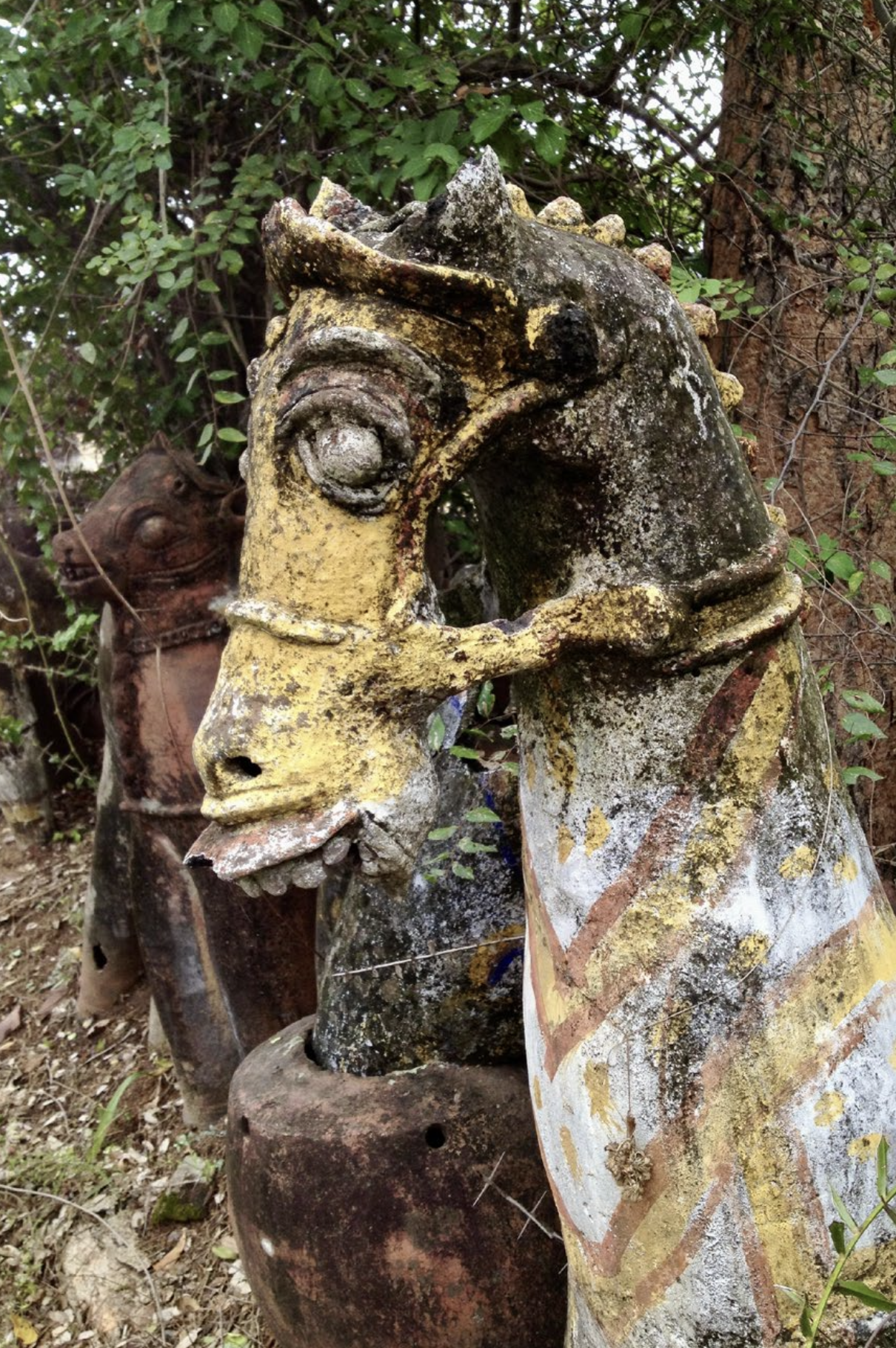
Terra cotta horses with Ayyanar and Karuppan and other deities. All from Urpetti. Photo by Ashwini Bhat.
They come to life at night. That’s what they say about the terra cotta horses of Pudukottai, in rural Tamilnadu, India – and I was ready to trust the stories. Their presence seems to defy rationality; every encounter with them feels like it has come about by chance.
That is how it was for me, anyway. My ceramics teacher, Ray Meeker, had asked me if I’d travel as a translator for the artist Jane Perryman, accompanying her to Pudukottai. She had visited almost a decade earlier while writing her book Traditional Pottery of India, and wanted to return.Perryman was hoping to talk to a man named Pazhanisamy, a potter whose family has been building life-size terra cotta horses in the village for generations. It was soon after the harvest festival, Pongal, in January. Pazhanisamy and his family were preparing the red earthenware clay they would use to create the horses over the next several weeks. Our visit opened up a whole new world to me.
The terra cotta horses are said to carry Ayyanar, who patrols and protects the village. Across Tamilnadu, one sees statues of this god: his powerful eyes wide-open, tongue hanging out, mounted on a terra cotta horse. Hindu deities are often portrayed with companion animals, their so-called vehicles. (Shiva rides a bull, Vishnu an eagle, and the elephant-headed Ganesh is accompanied by a mouse.) Ayyanar, a pre-Vedic, or Dravidian, folk deity is often seen on a horse. He may grant wishes, at times. His main task, however, is to save the villagers and their crops from all calamities. Grateful devotees commission local potters to build horses as ritual offerings. Once they are given to a temple, they become a shrine unto themselves.
The horses are mostly made of local clay and are coil-built. The largest, bigger than the actual animals they depict, are fashioned in two parts and joined together after firing. On occasion, a large makeshift kiln is built on-site around the clay sculpture, but most are fired in kilns, coincidentally themselves of horseshoe-shape. Surrounded by smaller pots and other idols, they are wood-fired to earthenware temperature. As the terra cotta remains porous after firing, some potters paint the horses with a mixture of calcium carbonate and water or color them, with a red earth pigment wash. The surfaces can withstand even heavy monsoon rains, and Pudukottai never freezes. So even after 40 or 50 years, the fierce, magnificent horses stand all but unaltered, with thin layers of moss and lichens growing on them.

Terra cotta horses with Ayyanar and Karuppan and other deities. All from Urpetti. Photo by Ashwini Bhat.
Today, almost fifteen years after I first saw the horses, I find myself living 8,000 miles away from Pudukottai, in California. But I remember the entrance to Urpetti, a small temple in Pudukottai, like it was yesterday. Unlike a typical Hindu temple, it stands in a thickly forested patch of land next to a large pond with pink lilies. A cow herd grazes in the distance. On either side of a dirt path leading to the temple are the horses, standing in action poses. Some have been here so long that they are half-buried in the ground. Others lean their heads on one another, or against a tree. A few of the heads have fallen to the ground, leaving cylindrical hollow necks, out of which vegetation grows. Some horses seem to snarl and show off their teeth, but you can gaze into their eyes and gently touch the moss growing on their foreheads. Their beauty is otherworldly, yet one is also aware that they are tangible artifacts, as complex as the country itself.
It is impossible for me to talk about clay without talking about its connection to the caste system in India. Ayyanar is a folk deity, not a part of the mainstream Hindu pantheon. He is honorable, but has an alter ego named Karuppan, who demands blood and animal sacrifice (which is prohibited by law). Potters invariably belong to the lower caste, rather than the priestly upper caste. This changes during the Kudirai Eduppu (horse procession) ritual, however, when the potter takes on the role of a priest, presiding as the clay horse channels all the community’s wishes, hopes, and prayers.
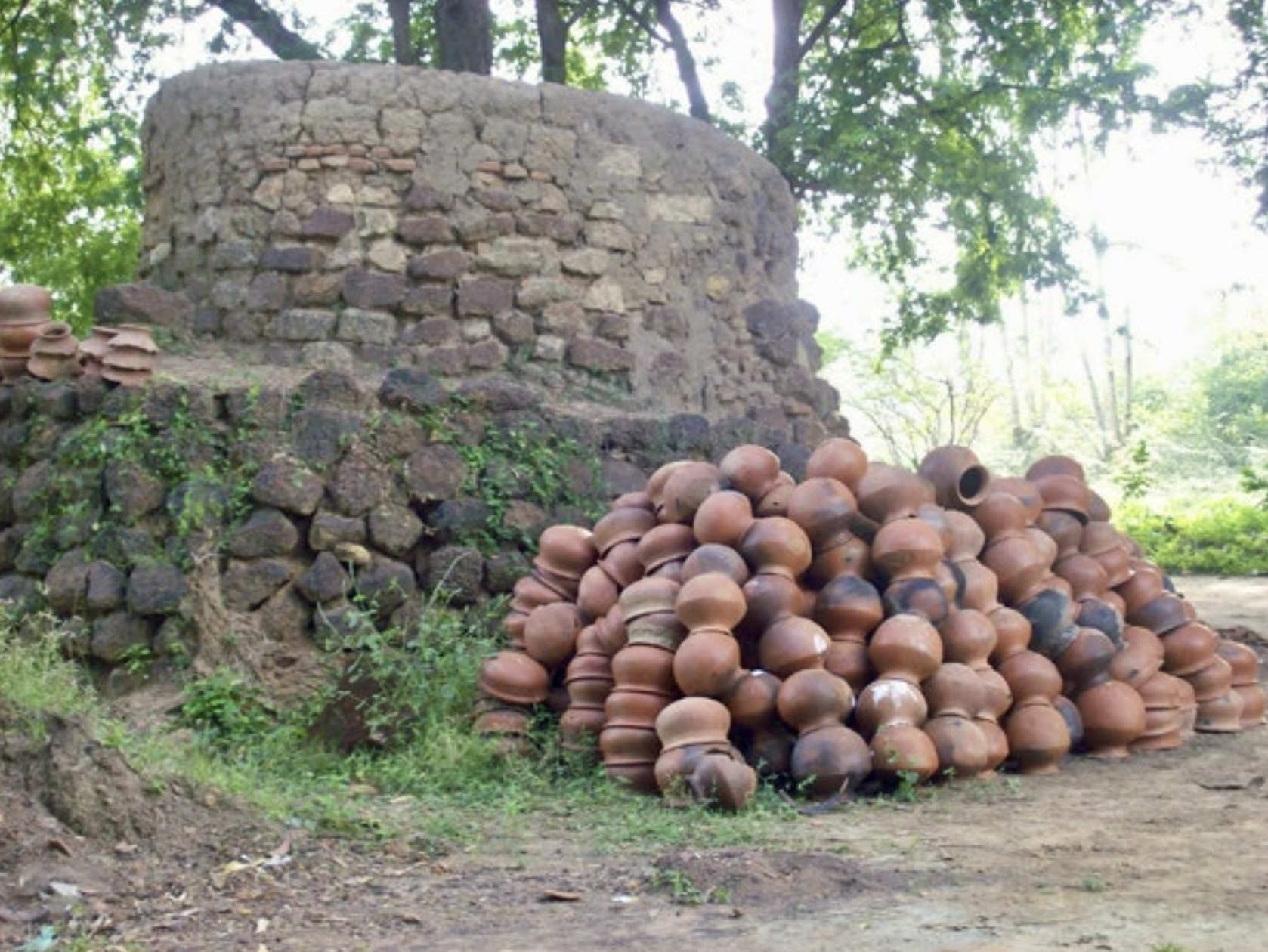
Horseshoe kiln (outer and inner views) in Pudukottai on Pazhanisamy’s property. Photo by Ashwini Bhat.
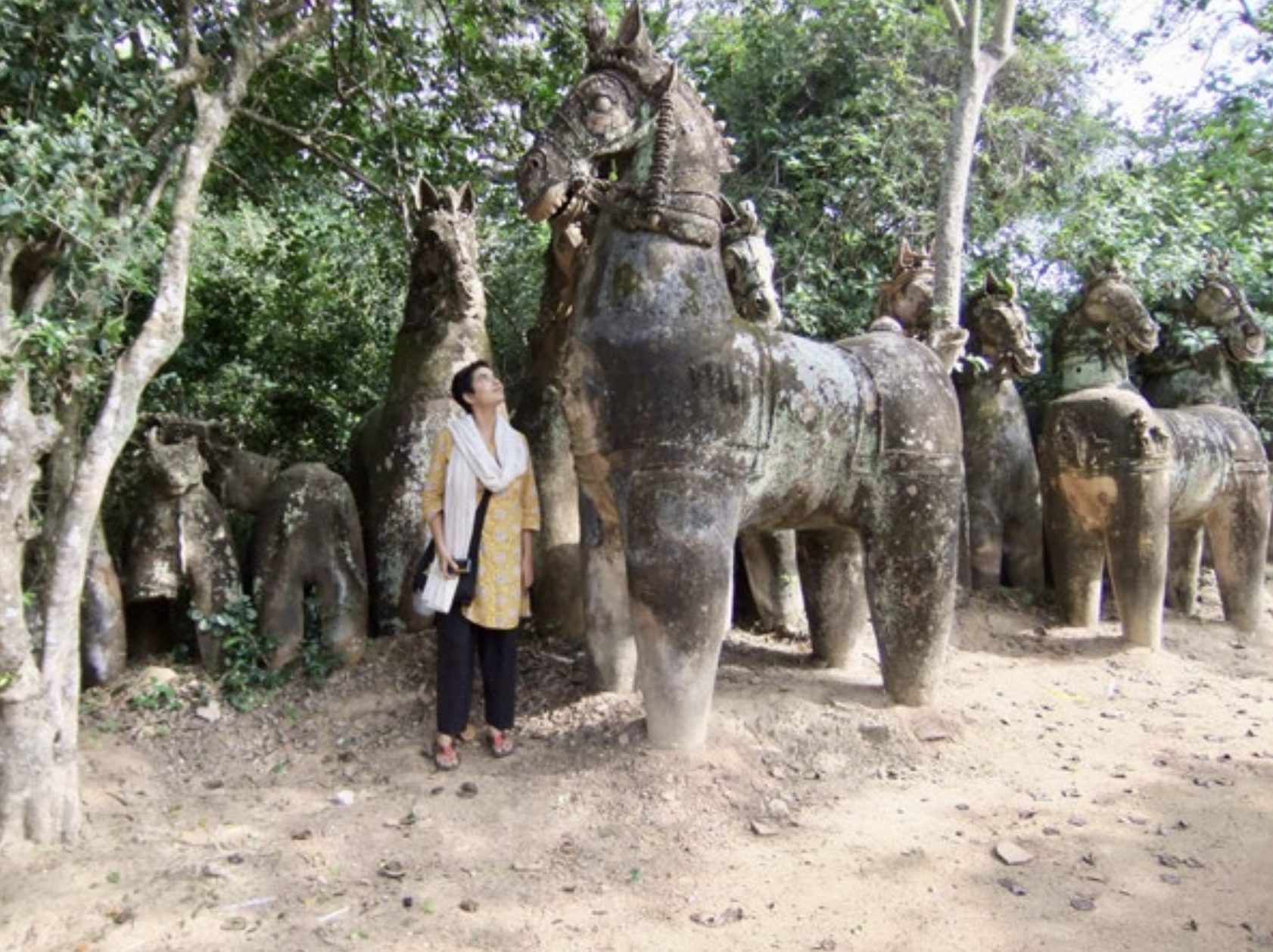
Terra cotta horses in Urpetti, Ashwini Bhat (author) for scale. Photo by Jane Perryman.