Liquid sculpture

Emily Madrigal

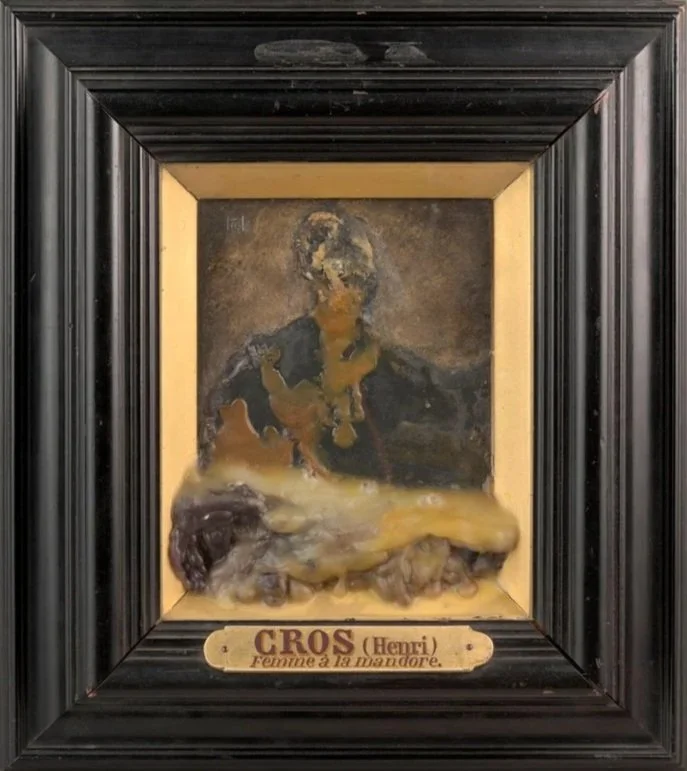
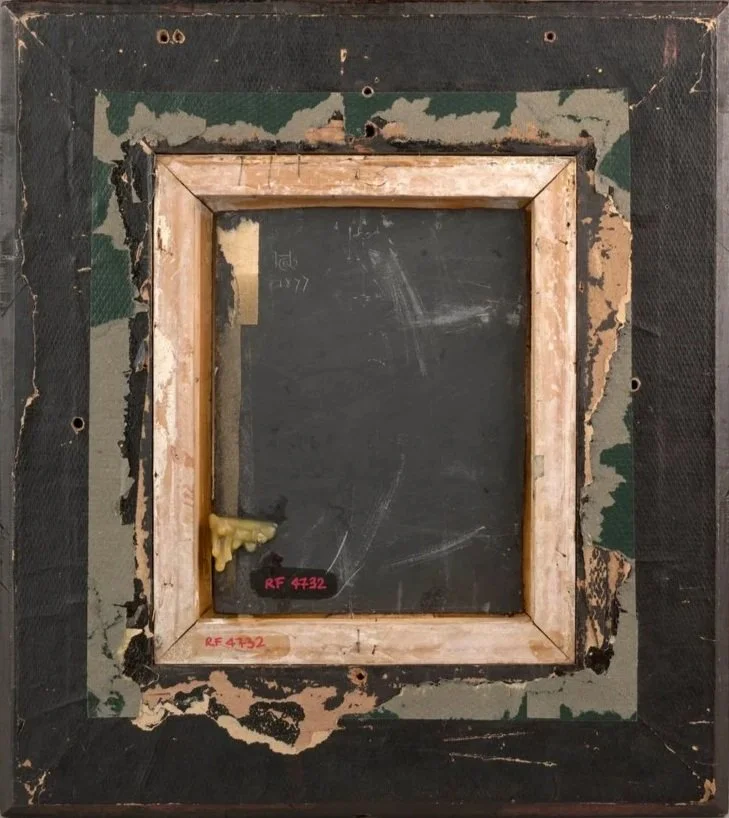
Front and back, Henry Cros, (French, 1840–1907), Woman with a Mandore, between 1868 and 1870. Wax relief painted on slate in a wooden frame protected by a glass. 13 9/16" x 12 3/16" x 2". (Dimensions of the wax before destruction). Don Charles Hayem, 1899 © rmn-Grand Palais (Orsay Museum) / Tony Querrec. (The Chipstone Foundation made best efforts to contact the Orsay Museum. Failing to do so, we have posted this image in accordance with the Fair Use doctrine.)

In 1995, a hundred-year-old waxwork by Henry Cros called Femme à la mandore accidentally melted after being placed in a sunlit vitrine at the Fine Arts Museum in Narbonne. The work is officially considered ‘destroyed’. Once a portrait, it now drips, bubbles, and swirls. The wax even oozes through a crack in the frame, breaking onto the back side of the work, dripping into another dimension, the ordinarily hidden reverse of a relief sculpture. While the melted Cros is no longer a record of its maker’s original intent, it better reflects how sculpture of the period was made. Frozen mid-movement, the wax brings the art history of a technique to life.
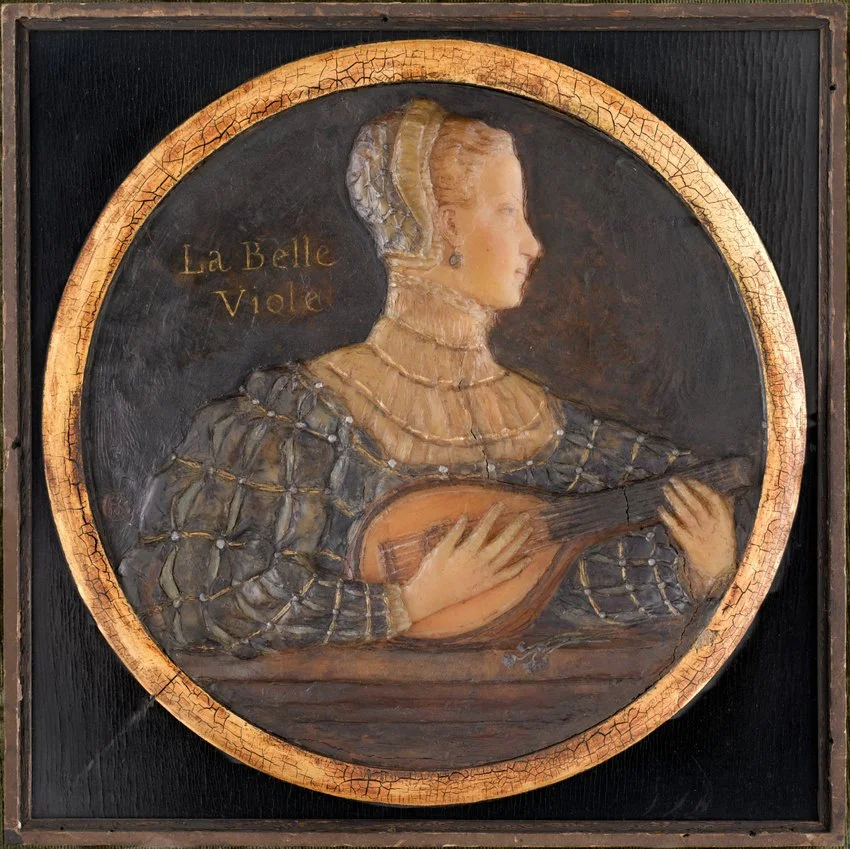
Henry Cros (French, 1840–1907), The Beautiful Viola, 1874. Painted and gilded wax relief on slate. 10 1/4 in. (diam). Purchase, 2015 © Orsay Museum, Dist. rmn-Grand Palais / Patrice Schmidt. (The Chipstone Foundation made best efforts to contact the Orsay Museum. Failing to do so, we have posted this image in accordance with the Fair Use doctrine.)

Originally, Femme à la mandore had been a miniature low-relief portrait, similar to the artist’s still-intact La Belle Viole. Such wax medallions had been popular in the sixteenth century, but by the nineteenth, they were purposefully antique in feel. Instead, wax was predominantly used as transitory material in bronze casting. In France, this was especially notable in the nineteenth century, as it was then that bronze became sculpture’s primary medium, in preference to marble.

Wax is the ideal placeholder for bronze, as it can move back and forth between states of matter without changing chemically. It can be liquid, viscous, or solid. It can be cast, modelled, or carved, and then—as the horrified curators in Narbonne found—remelted. In its ruinous state, Cros’ work also pictures sculpture’s creation. Looking at Femme à la mandore is like peeking inside a mold used for lost-wax bronze casting.

Because of its mutability, wax can be continuously edited. A mold does not determine its final shape. Heat as slight as that from the artist’s own hand can soften the material. This is what distinguished it from other popular casting materials of the period like plaster. Similarly, as a transitional material in the workshop, it could also perform a shapeshifting role within an artist’s career, enabling a practice that traversed various artistic mediums.

Edgar Degas (French, 1834-1928), Study in the Nude of Little Dancer Aged Fourteen (Nude Little Dancer), ca. 1878-1881. Pigmented beeswax, plaster core, metal and wood armatures, on plaster and wooden bases. (overall, without base): 27 3/8" x 11 9/16" x 11 15/16". Courtesy National Gallery of Art, Washington, Collection of Mr. and Mrs. Paul Mellon, 1985.64.46.

Cros’ experiments were well received by the public; Auguste Rodin declared him one of the greatest sculptors of the nineteenth century. But he was just one of many artists who used it to pivot between painting and sculpting. Medardo Rosso made sculptures by melting wax and brushing it into a mold, as if he were depositing paint on to a concave canvas. The results were admired for their painterly qualities by, among others, Edgar Degas, who, having primarily exhibited paintings over the previous two decades, created in 1881 a wax statue titled Petite danseuse de quatorze ans— the only sculpture he ever publicly exhibited. Degas had however modelled wax in his studio, often as an aid or complement to his compositions in two dimensions.

He may have first encountered the technique through his friend Henry Cros, who was fascinated with ancient Egyptian encaustic, or, painting with wax, and wanted to recreate the technique from antiquity in the present. Over the course of his experiments, he gradually built up the thickness of the applied wax, producing low reliefs like Femme à la mandore, then higher reliefs, and eventually wax busts in the round. He thus moved from two dimensions to three, as if reprising the seamless change of the material from liquid to solid. Color and volume—aesthetic properties that had been deemed exclusive to the painter’s and the sculptor’s respective arsenals since the Renaissance—were thus united.

Cros also pursued parallel explorations in pâte de verre, literally “glass paste,” a kiln-casting medium consisting of finely ground frit, a binding medium such as sodium silicate, and metal oxides (providing the material’s polychromy). Deposited wet into a mold with a paintbrush, it feels somewhat similar to watercolor—another material bridging the painterly and the sculptural.

Cros was interested in pâte de verre not only because it, too, had antique origins, but also because it was a more durable alternative to wax. He knew well how fragile his work in the material would be. The framed puddle that is Femme à la mandore today would doubtless have disturbed Cros greatly. Yet, in its incarnation of flux, it perfectly captures the essence of wax and its never-ending passage between states of matter. Rather than seeing the work as destroyed, perhaps we should consider it as reborn: a living portrait of material potential and interdisciplinary practice.


Emily Madrigal is an art historian and artist researching and making with wax, plaster, and pâte de verre. She is currently a PhD candidate at the University of Virginia. Her dissertation investigates materials of sculpture in France between 1870 and 1900. She received a ba from Princeton University and an ma from the Williams Graduate Program in the History of Art. She previously worked as a studio assistant for New York-based sculptor Martha Friedman, making molds and casts, which prompted her interest in the history of sculpture’s materials and techniques.

Brilliant Move

Brilliant Move is the Brooklyn-based creative studio of Marci Hunt LeBrun specializing in building websites on the Squarespace platform – among many other things.

I love working with small businesses, nonprofits, and other creatives to help them organize their ideas, hone their vision, and make their web presence the best it can be. And I'm committed to keeping the process as simple, transparent, and affordable as possible.

https://brilliantmove.nyc
Previous
Previous

Gallery

Next
Next

Season of the wick