Waxing incorruptible
Sara Frier and Samuel Luterbacher

Santa Maria della Vittoria Church, Rome, Italy. December 26, 2017: The wax effigy and relics of St. Victoria. iStock / Runoman.
Saint Victoria was an early Christian daughter of Picenum who was martyred for refusing to marry her pagan betrothed. When her corpse did not decay—a frequent miracle among Catholic saints— its sanctified remains, or “relics,” were sheathed within a tinted, life-size wax likeness and displayed at the Church of Santa Maria della Vittoria in Rome. Many churches still display such so-called “incorruptibles” as testimonials to Christian triumph.
The substitution of wax for flesh reveals this material’s liminal role as a boundary between permanence and decay within art history. On the one hand, wax has typically been equated with transience, often via an iconography of melting candles that disappear over time like the aging human body. On the other hand, it has served as a preservative coating for the perishable flesh of supermarket apples and martyrs alike.
In the case of incorruptibles, it paradoxically enlivens the fragments of long-dead bodies to serve a doctrine of eternal life. Pure and smooth beneath Saint Victoria’s sleeping-beauty white dress and floral crown, wax evokes the youthful virginity the young woman died for. As a flexible substance that can be molded and tinted, it also forms the raised beads of blood at the rim of her gashed neck, the lips of her mouthful of (real) filed teeth, and the split tips of balletically unfurled fingers to show desiccated tendon and bone.

Stefano Maderno (1570–1636), St. Cecilia, 1600. Marble sculpture, main altar, Church of St Cecilia in Trastevere, Rome, Lazio, Italy. © NPL - DeA Picture Library / G. Nimatallah / Bridgeman Images.
In this time-stopping context, wax also relates to harder inorganic materials like stone, the preeminent immortalizing medium of the Western tradition. For example, the sculptor Stefano Maderno used marble to re-create the virgin martyr Saint Cecilia’s incorrupt corpse upon its alleged discovery beneath the high altar of her eponymous church in Trastevere in 1599. Cecilia lies face-down on her side beneath chiseled drapery shrouds parted to frame her slit neck. While the stone replica does not contain Cecilia’s actual relics, it declares an inviolable resistance to decay over time, forever reprising the finding of her body for each new beholder.
Wax’s dual relationship to permanence and decay persists in the contemporary artistic imagination. In 2011, the Swiss artist Urs Fischer used it to re-create canonical stone sculptures whose slow melting exposed the entropy of cultural value. If his work imposes transience on art history, the Los Angeles-based sculptor Isabelle Albuquerque has recently explored its generative and even cyclical potential. Her Orgy for Ten People in One Body (2020-2022) is a multipart self-portrait featuring numbered sculptures of her (mostly) headless self in different materials. Two is cast in pearlescent white resin; she teeters, supine, at the edge of a commercial mattress with her raised legs spread in the V of childbirth. Instead of a baby’s crowning head, however, her fingers lace around a burning taper candle whose drippings garland her hands with growing encrustations that crack off and pile on the floor, incrementally altering the piece’s form by the minute.
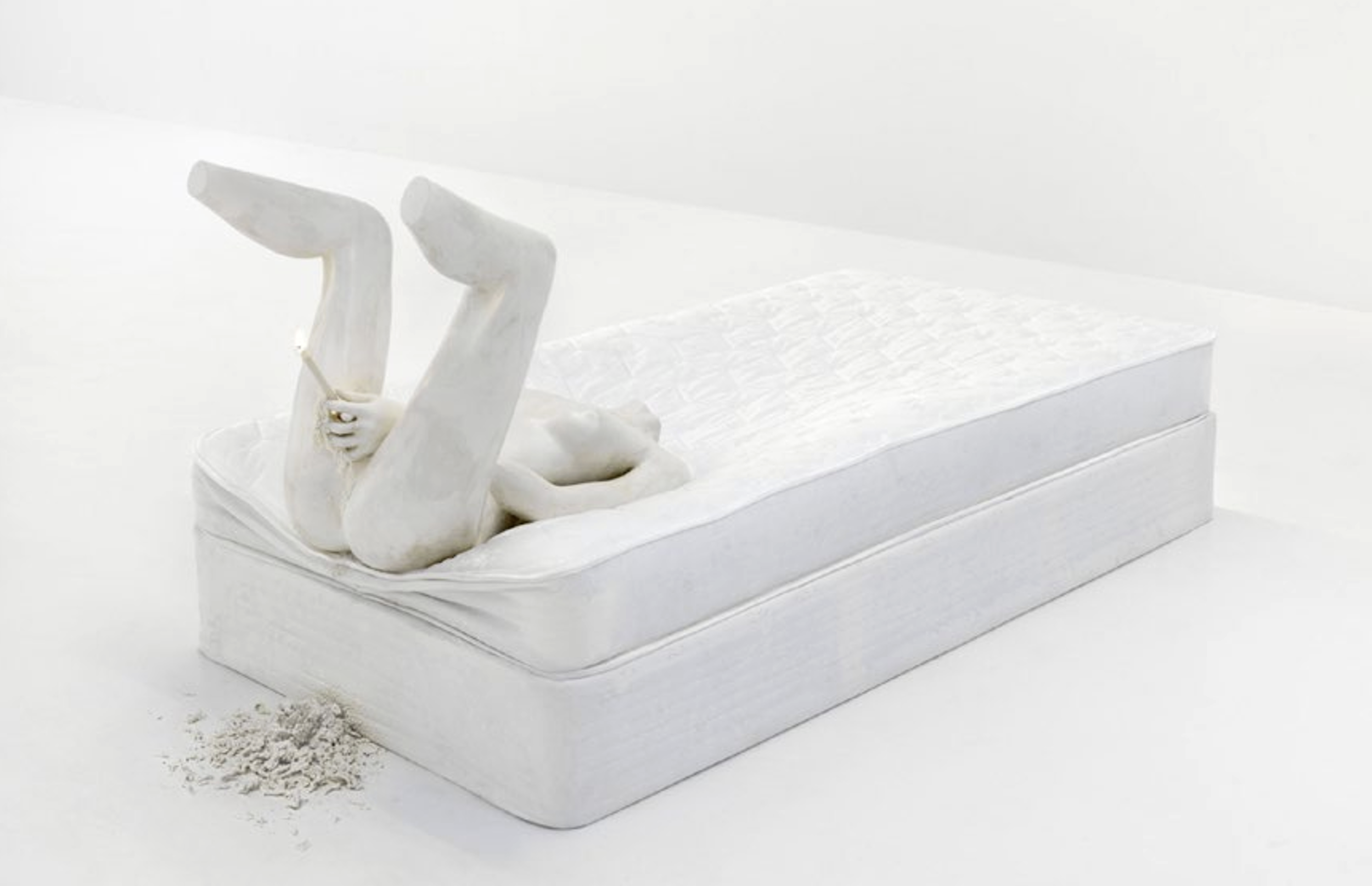
Isabelle Albuquerque, Orgy For Ten People In One Body: Two, 20202022. Plaster, beeswax, mattress, and flame. (figure): 26" x 23" x 32".; (plinth): 16" x 38" x 74". Ed. of 3, 2 AP’s. Photo by Genevieve Hanson. Courtesy of the artist and Jeffrey Deitch Gallery.
Is this sculpture a dream of motherhood deferred? Two evokes an urge to blow out the candle and stop time before the flame burns her, as wax rivulets roll down her wrists and dry on her belly in scarifying ropes. A crowd gathers as the gallerist wields a knife to cut out the spent candle stub with surgical precision and slide a fresh rod into her. They relight the flame and everything begins again. Two denies that time, and the body, can only splutter away. Instead, it is perpetually renewed, precariously borne by a headless, footless figure whose severed extremities deny both beginning and end. If the waxen globs suggest the messy excretions that herald a newborn, their immaculate whiteness also bears the violent memory of those virgin saints who prized chastity over life itself.
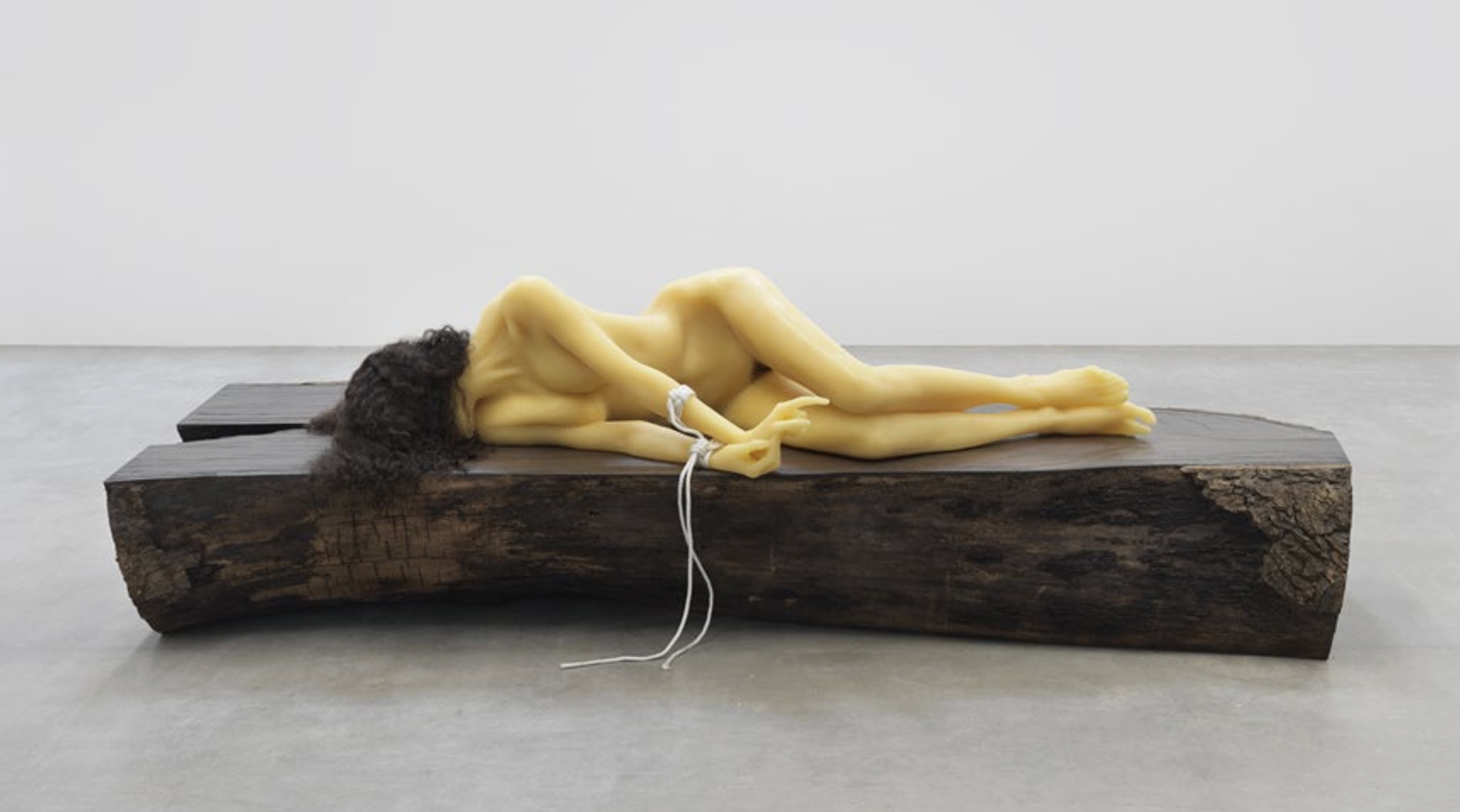
Isabelle Albuquerque, Orgy For Ten People In One Body: Ten, 2022. Beeswax, human hair, gold wedding ring, rope, and walnut tree. 28" x 42" x 95". Photo by Genevieve Hanson. Courtesy of the artist and Jeffrey Deitch Gallery.