In bed with feathers
Janneken Smucker
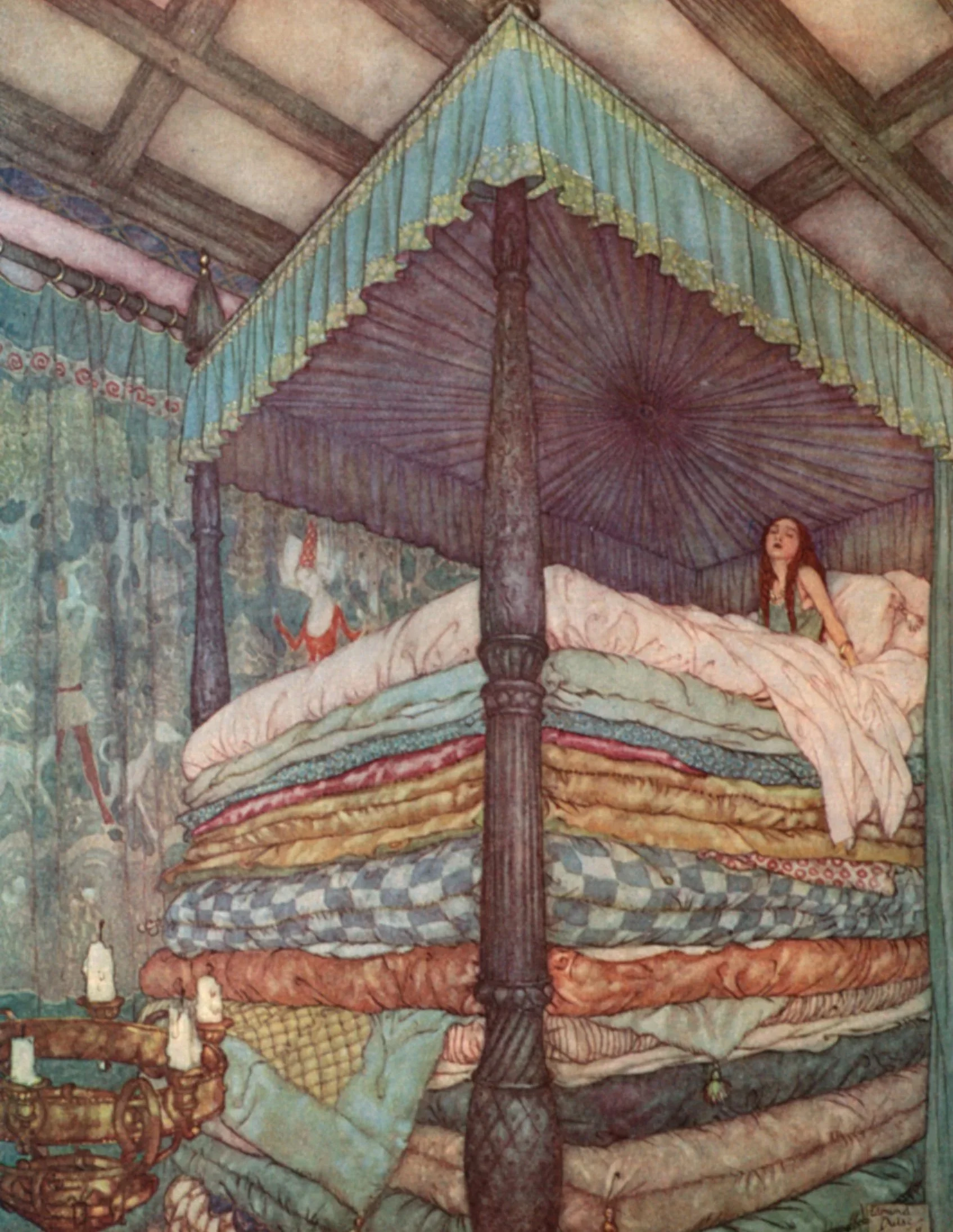
Edmund Dulac, The Princess and the Pea, 1911, originally published in Stories from Hans Andersen, with illustrations by Edmund Dulac, London, Hodder & Stoughton, Ltd., 1911. pd-us-1923-abroad.
Before innovations such as Thinsulate, Quallofil, G-Loft Supreme, and other forms of synthetic insulation, humans relied on materials from the natural world for warmth. We turned to plant-based resources such as flax, painstakingly retted, combed, carded, spun, and eventually woven into linen; and expensive, prized cotton, picked by hand, often by enslaved individuals, run through a gin invented to remove seeds to allow manipulation into other forms. The animal kingdom also offered warmth: humans exploited extruded strands of silk produced by worms that feasted on mulberries; wool sheared from camels, alpaca, and sheep; hide and fur from fellow mammals; and feathers from birds, most notably the down of geese and ducks.
Humans are creative. We combined these ingredients of warmth borrowed from the natural world to make bedding. We turned finely woven linen or cotton ticking into sacks called ticks, which could be filled with cornhusks or straw to make mattresses. A wealthier sleeper may have slept on a tick filled with feathers; imagine the princess avoiding the pea by stacking these ticks one on another. The feather tick also frequently served as a top cover, variously called a featherbed, duvet (from the French for “down”), or in mid-twentieth century England, a “continental quilt.”
Feathers had greater longevity than less expensive cornhusks, straw, and or old rags–and thus were saved even after poking through the tick. Frequently owners reused the expensive feathers in a new tick, as does L.M. Montgomery’s eponymous Anne of Avonlea, who emerged from the task covered in white fluff. Families passed down valuable feather ticks and mattresses in their wills, preserving generational wealth. A second-hand market for down also existed.

John Collier (American 1913 –1992), [Untitled photo, possibly related to: Bridgeton, New Jersey. FSA (Farm Security Administration) agricultural workers’ camp. Filling mattress ticks with straw], 1942. Photographic negative. Library of Congress, Prints & Photographs Division, fsa/owi Collection, lc-usf34-083101-c (b&w film neg.).
By the nineteenth century, the feather-filled version of the tick had become a common base to sleep upon, with another covering the body in cold climates. Northern Europeans brought this bedding kit with them to North America. The English had historically slept under linen sheets, scratchy woolen blankets, and sometimes pieced cotton quilts, but eventually feather ticks crossed the English Channel too, where they were adapted into “continental quilts” or “Eider Down Quilts,” named for the duck that often provided the feathers. Decorative continental quilts, like the one in the Habitat advertisement, caught on in the mid-twentieth century, and featured paned quilting stitches to secure the feathers.
Within the New World, another bedding kit had begun to dominate in the early nineteenth century, coinciding with the industrial revolution that enabled cheap and abundant textiles. Quilts—a form brought with the English upper classes to colonial North America—were democratized once Americans could buy fabric with the explicit purpose of cutting it up to stitch back together. The ubiquitous American patchwork quilt—with its repeat block patterns, graphic boldness, and sentimental charm—entered the bedding scene.
Quilts, unlike their cousins the duvet and comforter, historically are thin and flat, filled with an inner layer of batting from cotton or wool, or more recently with synthetic “poly-fil.” These covers typically have provided the decorative top layer to a bedding kit, and unlike their down-filled relatives, do not attempt to provide warmth by trapping heat in billows of feathers. Although today’s retailers market camping gear with names such as “cascade down barn quilt,” and “Thermadown 30 Down Quilt,” such puffy, lightweight products filled with either bird- or fossil fuel-derived down share little with the patchwork quilts that inspired their names. These essentially are synthetic comforters—space-aged products—designed with technical features that mimic the feathers humans have long known will keep us warm.
The feather, however, was not lost with the addition of quilts to the bedding scene. In the nineteenth century, as quiltmakers innovated new patterns, several feather-themed patterns took hold. But these were not shout-outs to the birds that sacrificed their feathers to ticks. Feather-themed quilt patterns, with evolving folk names like Princess/ Prince’s Feathers, Feathered Star, Washington Feather, and California Plume, circulated among quilters, often as commercially published patterns. Feathers were fashionable; foreign visitors like Marquis de Lafayette and Lajos Kossuth famously wore hats with large plumes, and quilt historians have suspected that they may have inspired feather patterns.
Feathers also figured into quilts more subtly. My own great-grandmother was a professional quilt marker with a reputation in eastern Ohio as skilled at drafting undulating feathers, using a small hand-drawn cardboard feather template and a dinner plate. She drew these lines on quilt tops indicating where the detailed quilting stitches should go. When it comes to patchwork quilts, unlike “continental quilts,” the feather is on the quilt, rather than in it.
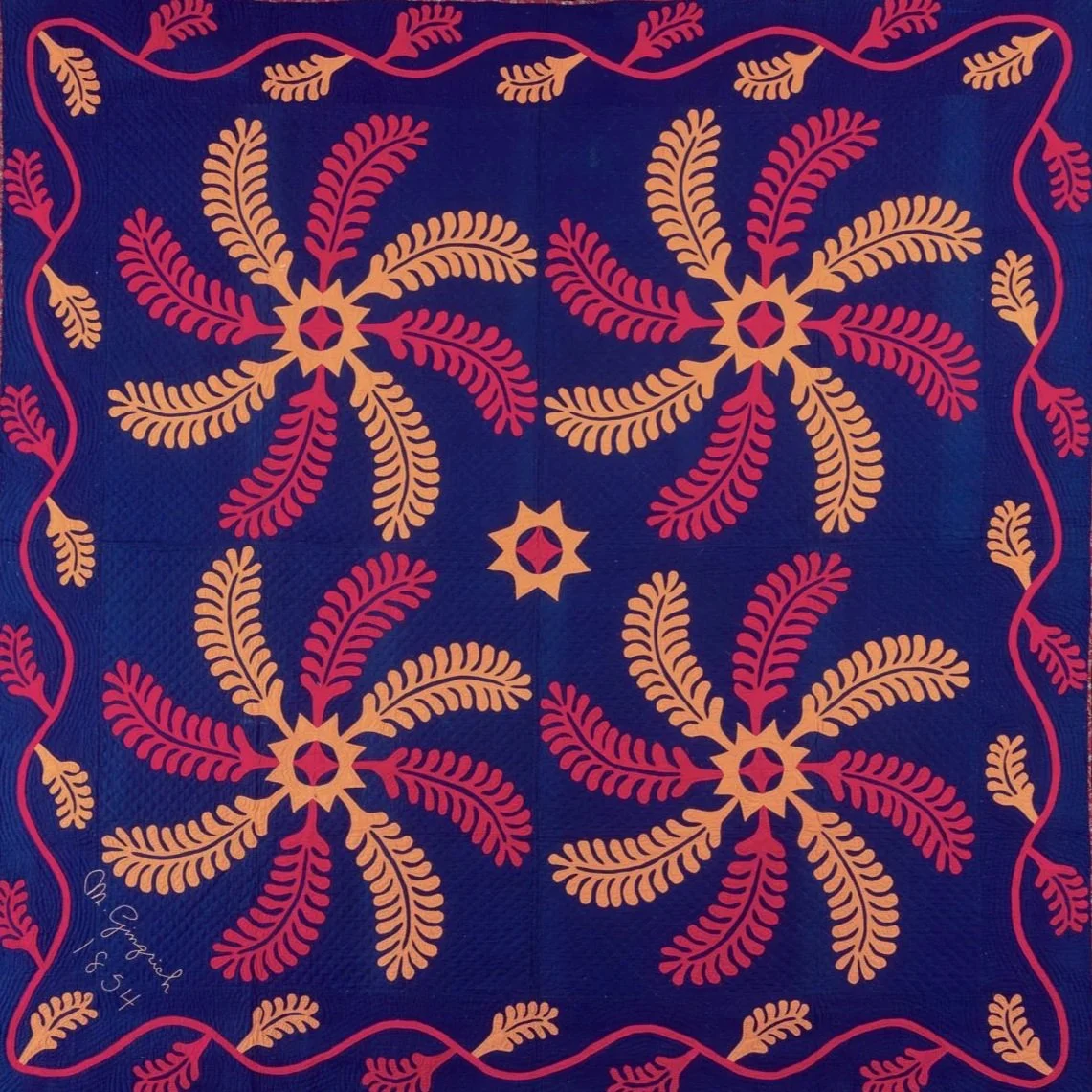
M. Gingrich (Dauphin County, Pennsylvania), Princess Feather (pattern), 1854. Cotton muslin. 86" x 84 1/2". International Quilt Museum, 1997.007.0774.

Susan Theresa Holbert or Emily Holbert, Original feather design, ca. 1850–1860. Cotton. (overall): 92" x 85". Smithsonian National Museum. of American History, Gift of Mr. and Mrs. John Beard Ecker 1988.0245.