Pewter, the advantageous alloy
Edward S. Cooke, Jr.
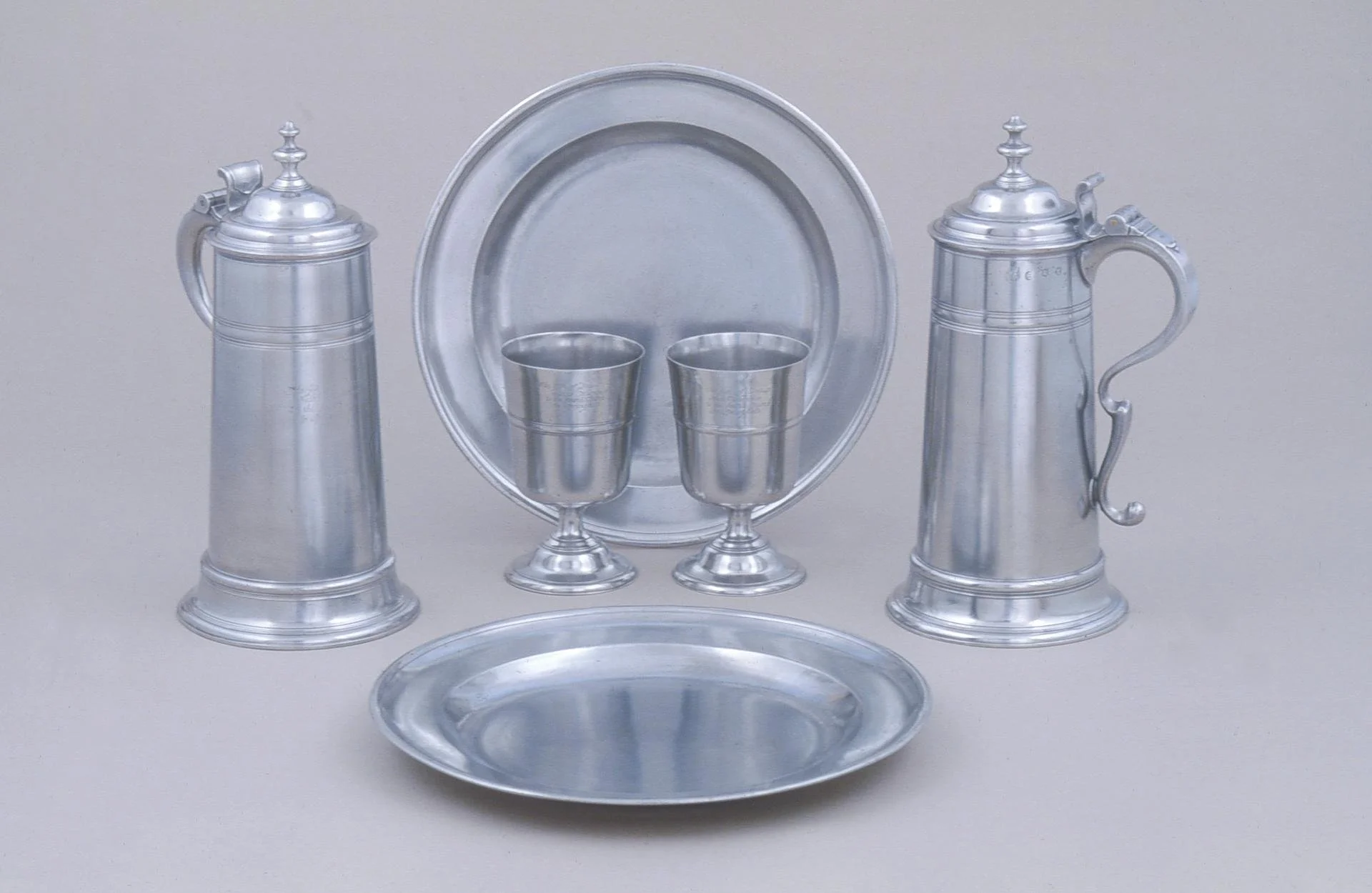
Thomas Carpenter, Communion service set, 1713–60. Pewter. Yale University Art Gallery, Gift of Mr. Donald R. Hyde, B.A. 1912, 1970.19A-F.
Lead is a common mineral found throughout the world. It is also soft, with a low melting point. These properties make it unusually advantageous in making up an alloy: a fusion of multiple metals with complementary qualities.
Historically the most common lead alloy was pewter, which is mostly tin with some lead, and often smaller amounts of other metals like antimony, bismuth, and copper. Lead serves several purposes in the alloy, assisting in the smelting of tin ores, improving the metal’s flow in casting, and making the material both durable and recyclable – it can easily be melted down and recast.
Pewter is a remarkable but often misunderstood metal, affordable for common drinking vessels and liquid measures yet also prized for communion vessels and large chargers displayed in affluent homes in the early modern period. When new or with low lead content, it could approximate the appearance of silver, yet the soft gray tone of pewter with more lead has often been highly valued, including by Euroamerican and Chinese connoisseurs in the 19th and early 20th centuries.
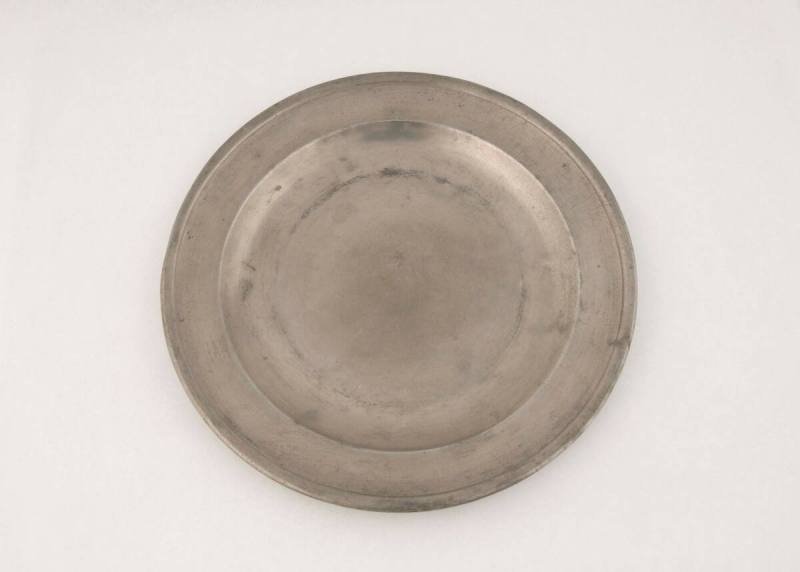
Robert Bush & Co., Plate, ca. 1770-1793. Pewter. Mount Vernon Ladies Association of the Union, Gift of Dr. and Mrs. Joseph E. Fields, 1999, W-3945/9. Courtesy of The Mount Vernon Ladies’ Association.
In ancient times, pewter with lead content close to that of solder (about 40% lead, 60% tin) was used as a white metal for figurines, jewelry, badges, and similar decorative objects. In medieval England, a pewter with reduced lead content (no greater than 25%) began to be used for religious objects like chalices, pattens, and spoons. In 1348 the London Pewterers’ Company set standards for a lead-free “sadware,” the evocative period term for plates, basins, and bowls (94% tin and up to 6% copper); and “trifle” or “lay” pewter for mugs, flagons, measures, and holloware, which typically had 4 parts tin to 1 of lead, though more complex molded forms may have necessitated slightly more lead to allow the molten metal to flow evenly.
In medieval Europe tin was primarily sourced from northern Spain and Central Asia. With the rise of in Cornwall and in Bohemia in the 16th and 17th centuries, there was a boom in pewter production in England and on the continent. While London maintained the standards for fine pewter with very little lead (90% tin, 8% lead, and 2% copper or bismuth), pewter produced outside the city and for export tended to contain as much as 25%. London pewterers continued to develop fine alloys with tin, copper, bismuth, and a little lead to improve casting.
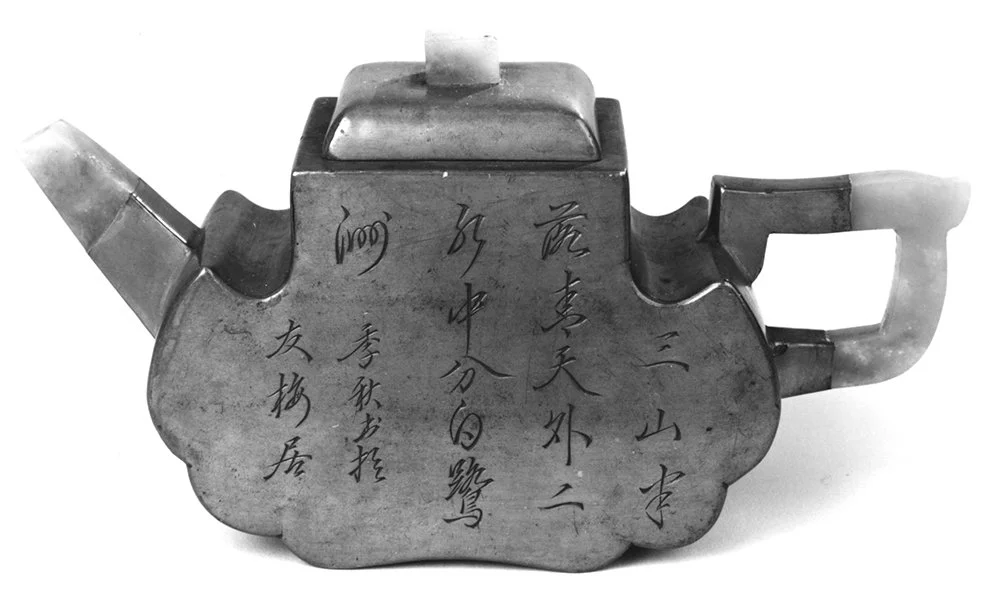
Han Chinese, Teapot, ca. 1830. Fabricated sheet pewter, earthenware lining, and carved jade. Field Museum of Natural History, Gift of Edward E. Ayer, 1923.125840. Courtesy of: R. Testa. © Field Museum of Natural History. CC BY-NC 4.0.
Then, at the end of the 18th century, British metalworkers developed Britannia ware, another lead-free alloy composed of 90% tin, 8-10% antimony, and small quantities of copper and bismuth. Britannia could be cast in molds, hammered up on a stake, spun on a lathe, or worked in sheets. This versatility, combined with the increasing awareness of lead’s toxicity, gradually made traditional pewter obsolete, but it took time for the lead content in circulation to be diluted, as it was continually melted down and reconstituted. Not until the end of the 19th century did nickel and zinc alloys finally replace pewter as the preferred the white metal in Europe and America.
In China, too, pewter (xi, though the term is also used for tin and lead) was a commonplace alloy through the 19th century. Tin mines in the southern provinces of Guangxi, Guangdong, and Hunan provided raw material for the pewterers of the Jiangnan region, particularly in Suzhou. As in Europe, lead was used in the refining process to accelerate the smelting of tin ore, and pewterers would often add lead to produce a soft, grayish metal, ideal for hammering and engraved calligraphic decoration. Typically, the Jiangnan pewter was fabricated and brazed rather than being cast, allowing for greater variety of forms.
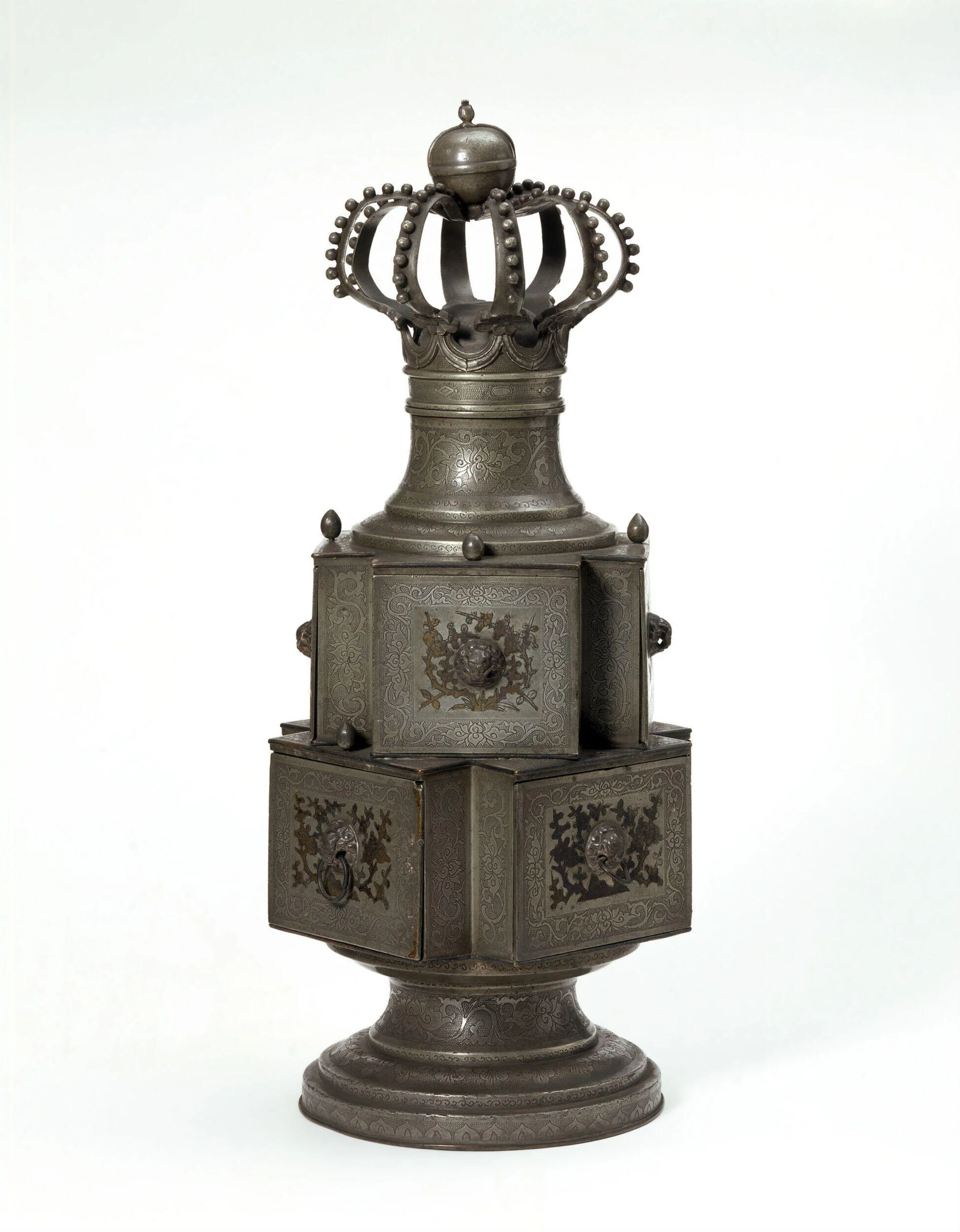
Chinese, Secret Box, 1800-1850. Chaozhou. Fabricated pewter embossed and inlaid with brass. Given by Mr O. Marriage, 1454-1903. © Victoria and Albert Museum, London.