The poison pigment
Susan L. Buck

William L. Breton (artist), Kennedy & Lucas's (printer), Wetherill & Brothers white lead manufactory & chemical works, corner of 12th & Cherry streets, Philadelphia, 1831. Lithograph. Library Company of Philadelphia, P.9830.4.
White lead, alongside carbon black and clay-derived ochre, has been the most ubiquitous paint pigment since antiquity. It is also the most vilified. Though only banned for commercial use in the USA in 1978, its toxicity has been well understood for centuries. In a 1661 submission to the Royal Society for making “ceruse” (a period term for white lead), Sir Thomas Moray described a new production method: rolled sheets of lead were placed in pots with vinegar at the bottom and packed with horse manure for three weeks. The sheets were then unrolled and the white corrosion was beaten off, ground into fine powder in water, then finally spread out to dry. Even as he presented this process, Moray advised that the fumes from this manufacture could produce stomach cramps, constipation, shortness of breath and “blindeness in the eyes & a stupiditie in the brain,” among other dreadful effects.
Despite such hazardous properties, lead was used in cosmetics to whiten complexions and hide scars, with added red dye to color the cheeks. Radiocarbon dating has found traces of lead carbonates (white lead from the mineral cerussite) in small cosmetic pots and boxes from Egyptian and Greek archaeological sites, now in the collection of the Louvre Museum. In the eighteenth century the skin lesions and early deaths of society beauties were blamed on lead-based cosmetics. Erasmus Darwin, grandfather of Charles, wrote in 1796 that “some of the usual remedies, particularly cosmetics containing white lead, have destroyed the health of thousands.”
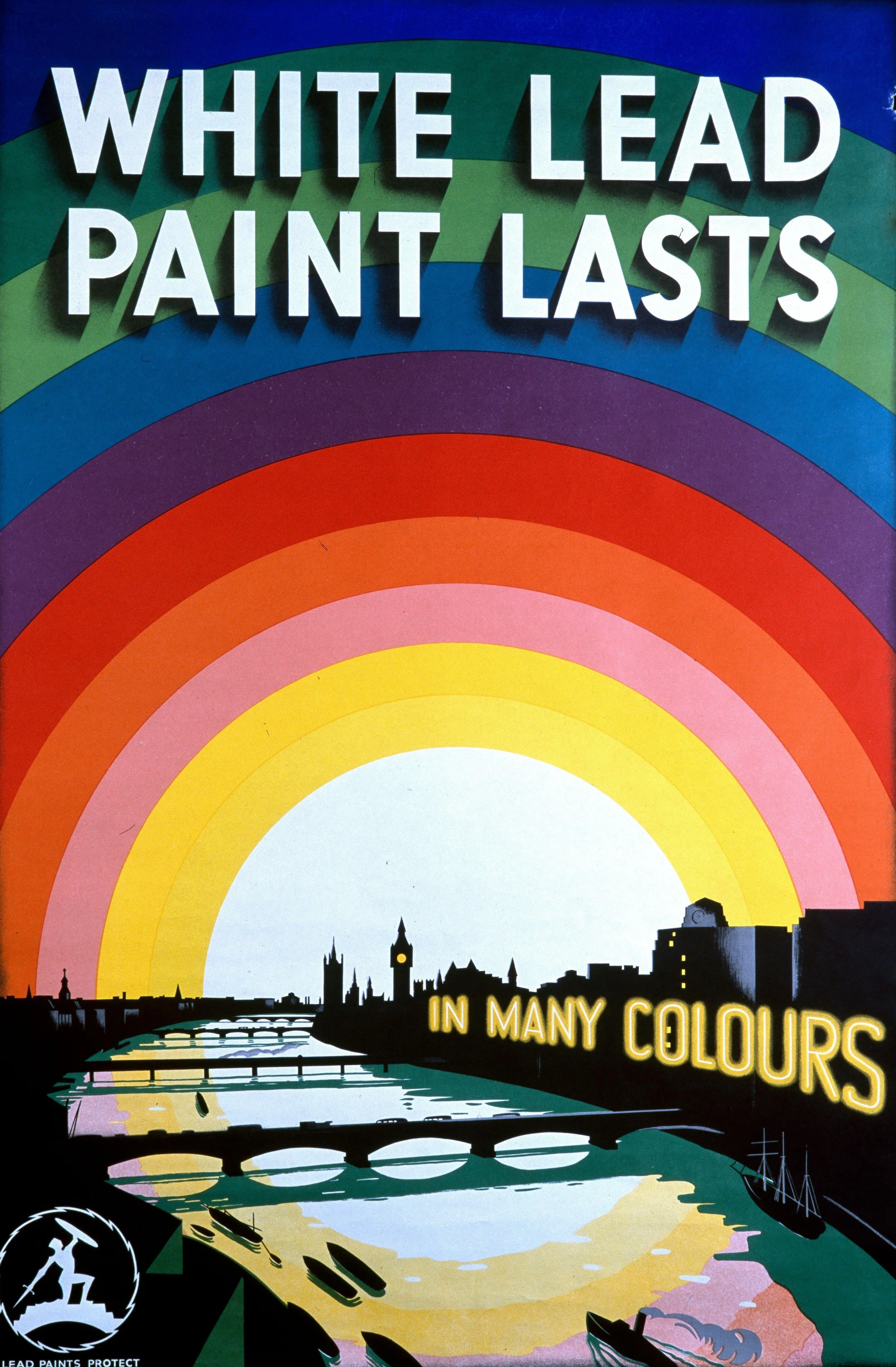
Advertising poster, ca. 1938. Chronicle / Alamy.

W. H. Rease, (artist), Thomas S. Sinclair (printer), Wetherill's white lead, red lead, chemical glass, drug & dye stuff store. Wetherill & Brother, manufacturer of white lead & red lead litharge chrome yellow & green, oil vitrol, copperas, chemicals [graphic] : Sons of and successors to Samuel Wetherill who established the first white lead manufactory in the United States. Old stand 65 North Front Street east side, three doors south of Arch St. Philadelphia. Drawn by W. H. Rease, No. 17 S. 5th St., ca. 1845. Lithograph. Library Company of Philadelphia, P.2239.
Given that lead’s poisonous nature has been so well known for so long, it is still surprisingly common to find it in products today – not only paints, putties, and cosmetics, but also in food, candies, spices, dyes, and Ayurvedic and homeopathic medicines. In 2025 the US Center for Disease Control (CDC) even warned about lead in spices. One culprit is red lead (Pb3O4), a bright orange-red pigment used as a cheap additive to increase the weight of chili powder and tamarind. The CDC also found lead in traditional powders and pills for a range of digestive ailments, for soothing teething babies, and cosmetics used in Hindu and Sikh cultures.
By far the greatest use of lead-based pigments by volume, however, has been in paint. Historically, white lead ground in linseed oil was the best stable, opaque white paint; its use in art and architecture was an accepted practice across a wide geographical range. Period advertisements, like one that ran in the Boston Post in 1763, attest to the importation of white and red lead alongside “Powder Oaker, Prussian Blue, Spanish Brown and Lynſeed Oyl.” The onerous Townshend Acts specifically targeted “painters colours” like these, spurring a search for alternative domestic pigments.
In 1800, Philadelphia merchant Samuel Wetherill began trying to manufacture white lead. Though his first factory was destroyed by fire, by 1810 he and his son Samuel had established a large operation to make it, as well as red lead and litharge (PbO, commonly used as a dryer for linseed oil paints). By the elder man’s death in 1816, the company had reorganized as Samuel P. Wetherill & Co. Five generations of the family ran the business, contending with increased competition as well as alternative white pigments like zinc oxide in the mid-nineteenth century and titanium white in the 1920s. Finally, in 1933, Wetherill & Sons White Lead Factory was sold to the National Lead Company, which now continues operations as the NL Company, using the familiar Dutch Boy image to advertise its products.
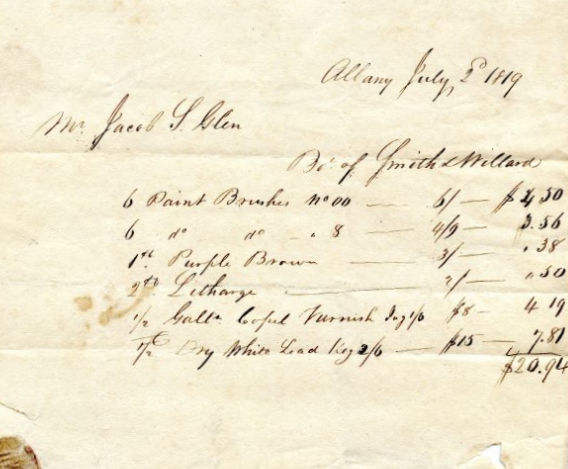
Smith & Willard, Non-printed bill for paint, July 2, 1819. Winterthur Library Digital Collections, Courtesy Winterthur Museum, Garden & Library, Collection 145 16x097.013e.
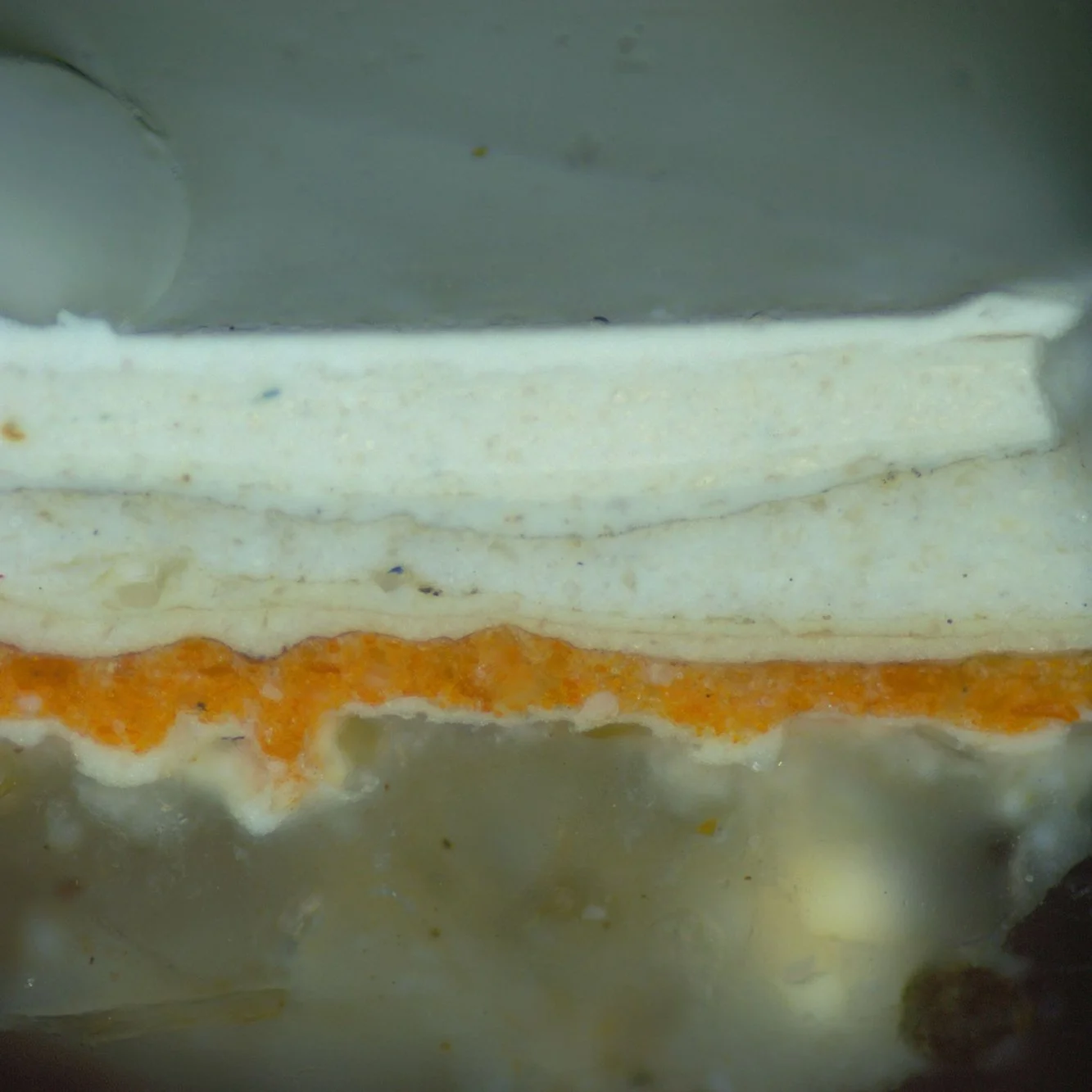
Cross-section microscopy of plaster from a built-in cupboard at the 1799 Asa Stebbins House at Historic Deerfield. Paint analysis shows that the entire interior was originally painted brilliant orange with a red lead-based finish coat on a white lead-based primer. Photograph by the author.
The earliest known American house paint recipe book dates to 1812 and was authored by Hezekiah Reynolds, a house and ship painter who claimed more than thirty years of experience. Most of the recipes start with white lead in oil as the base coat. To prepare “ Prussian Blue Color” for inside work, for example, he recommends adding one ounce of “best quality” Prussian blue to five pounds of white Lead, adding, “If the quality be inferior the quantity must be increased. In laying this paint, use a half-worn brush; and press the brush harder than laying the other colors.” Reynolds also described making exterior paints in large quantities, in an iron kettle suspended on chains, with an iron ball inside to thoroughly mix the components. Such slow methods were replaced with paint mills and then roller mills as demand for commercially prepared paints grew after the Civil War.
Until the ready availability of pigment-grade titanium white (TiO2) in about 1920, there was no other white pigment with the opacity of white lead. Titanium has a cool white cast, and is a smaller particle than lead, so it performs differently when mixed into paints. It has largely replaced lead white in commercial paints, though in the UK one can still get a dispensation from Historic England to use lead-based paints on Grade I and II buildings. Lead-based pigments are also still available from art supply stores in dry powders and as prepared pastes. Hand-grinding these into paint is a sensual process, done with a glass muller or smooth stone on a glass or stone slab. With the proper proportions of lead white to oil, the muller will glide across the slab to produce a creamy, warm white paint which flows easily off a brush.
There are also other notable lead-based pigments, though some are now archaic. The earliest European paint recipes for a bright yellow made with lead and tin date to the early 15th century; though not much used in easel paintings after about 1750, that combination has been used for centuries as an opacifier for glass. Brilliant Naples yellow Pb3(SbO4)2 was in use in England by the early eighteenth century, though it was mostly supplanted in the twentieth century. Lead was also an ingredient of chrome green (which includes Prussian blue), chrome orange, and chrome yellow (PbCrO4), perhaps best known as the color for school buses – though I am glad to say that lead is no longer used for that purpose. Toxicity has always been a problem when it comes to lead-based pigments; but they have also made our world more colorful and beautiful.

The Dutch Boy Painter, Poster stamp. Winterthur Library Digital Collections, Courtesy Winterthur Museum, Garden & Library, Collection 408 96x003.73.
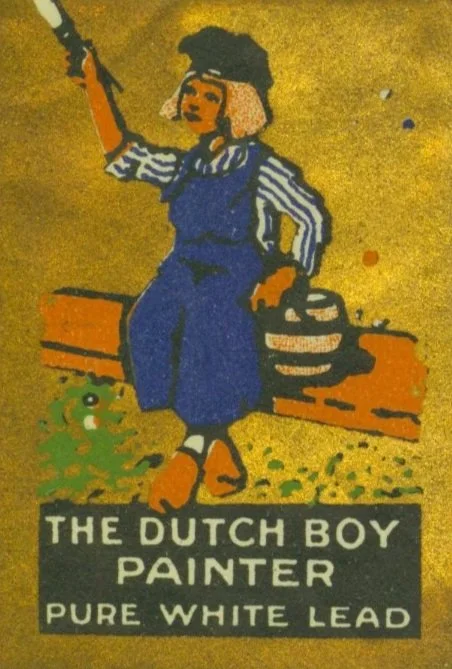
The Dutch Boy Painter, Poster stamp. Winterthur Library Digital Collections, Courtesy Winterthur Museum, Garden & Library, Collection 408 96x003.74.