A bangwato kaross

Novelette-Aldoni Stewart
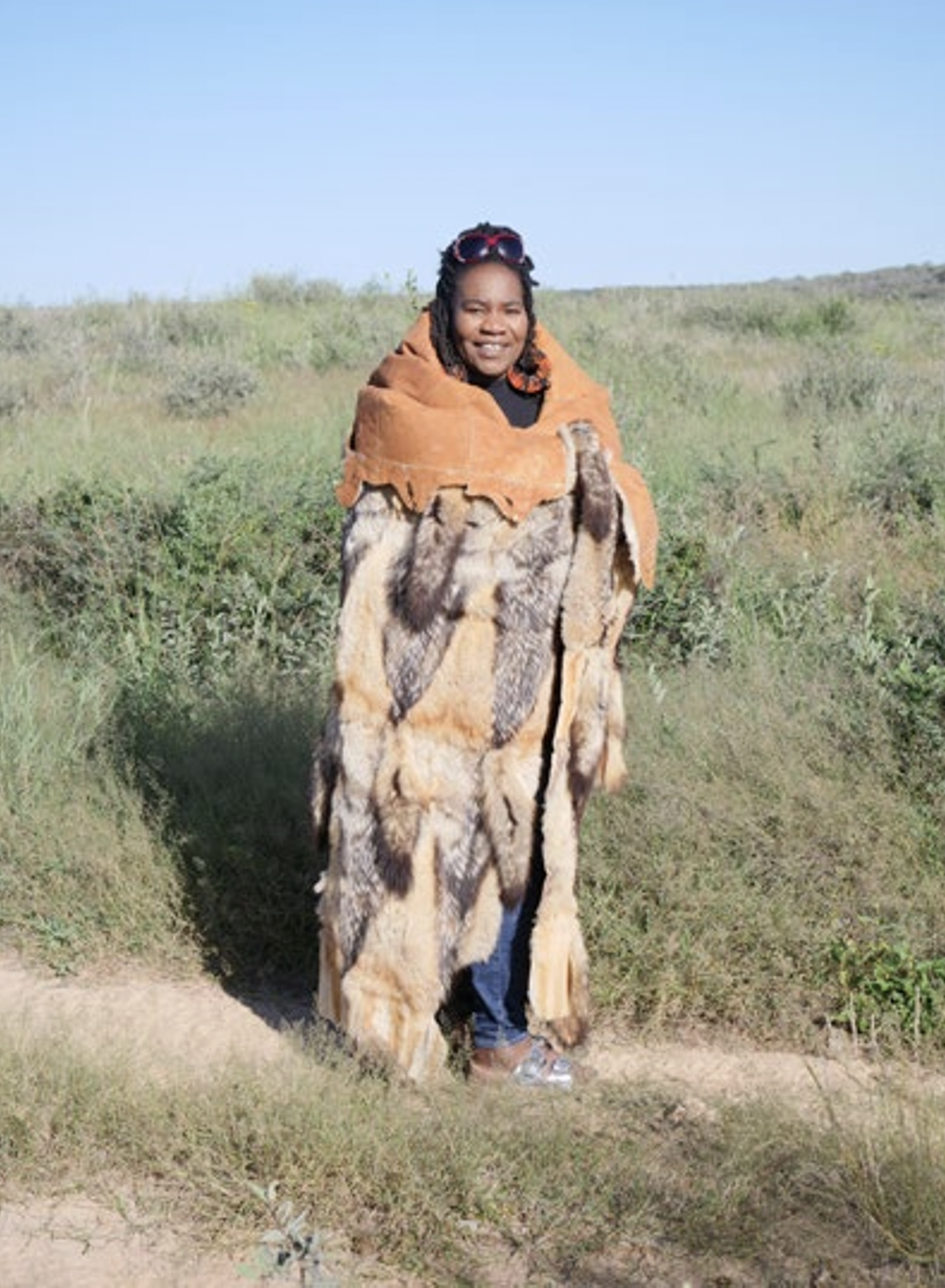
The author wrapped in one style of historic Southern African wear, the Kalahari.

For societies without written histories, objects serve in the role of texts, recording cultural norms and achievements. This is particularly important in places where events have been purposefully suppressed. An object can be an aperture through which the truth shines through. 

This is one way to look at the kaross, a type of leather cloak made by the Bangwato peoples of Serowe, in present-day Botswana. In the late nineteenth century, the Bangwato were undergoing turbulent times. Like other polities in what was then the Bechuanaland Protectorate, they struggled against their inclusion into Cecil Rhodes’ southern African empire. Intermittent wars between the British and South African Boers were fought over their terrain. Equally, they contended with natural disasters such as the rinderpest virus, or “cattle plague,” which decimated local herds.  

This was a time when modernity was actively sought out by many African peoples, and also imposed by foreigners, including traders and missionaries. Thread replaced sinew. Textiles supplanted leather. Today, the once commonplace practice of making a kaross is a rarity, the leatherworking skills involved known by comparatively few. Like the buffalo robes produced by First Nations peoples of the American Midwest, historic Bangwato garments speak to expertise in manufacturing and material science knowledge.  

The kaross (or sometimes, kobo), made and worn by indigenous peoples throughout southern Africa, is variable in style and construction. It may be made from single or pieced hides of large animals such as gemsboks and hartebeest (two varieties of large African antelope), cows, and leopards, or with a collection of skins from smaller species such as jackals or honey badgers. It may be further embellished with other animal parts – fur, tails, or flayed and flattened heads – and is sometimes decorated with metal beads. Though flexible, it is sturdy and robust enough to be an effective barrier against inclement weather, and to serve as bedding on a harsh terrain. 

Traditionally, after defleshing a skin with an adze or knife, it would be processed with many natural products, which have functional equivalence to those used in industrial leather manufacturing such as fatliquoring (adding oil to a tanned skin). Indigenously-used substances such as natural lipids (like brain matter and milk), botanical tannins, powdered minerals, and dung, amongst others, were used to tan the skin, penetrating its collagen structure, contributing to the leather’s durability and softening the fibres. Many southern African leather objects are still pliable even a century later. 
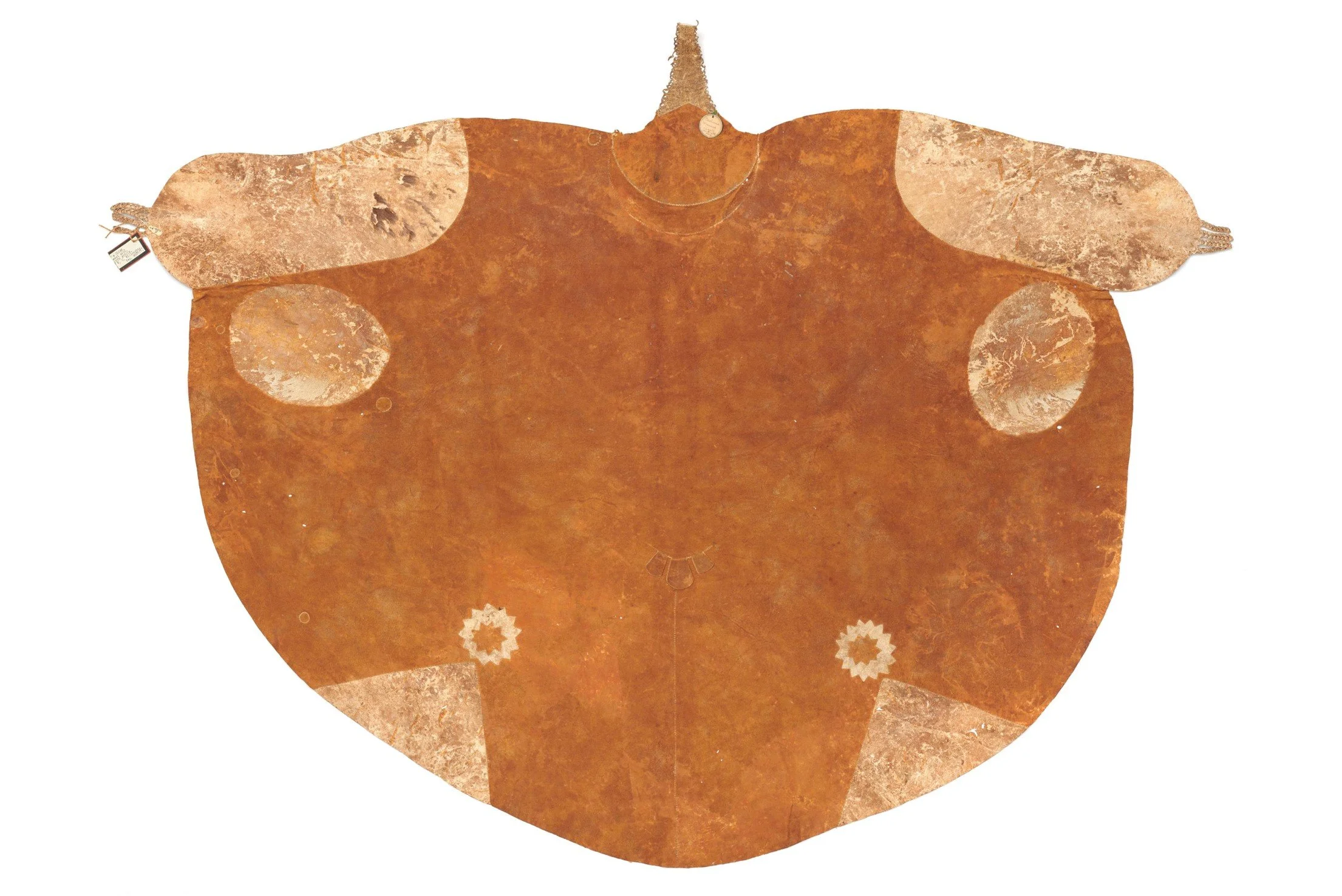
Unknown Bangwato maker, Kaross (or kobo), pre-1899, Botswana, Southern Africa, Hartebeest hide and sinew, Royal Pavilion & Museums Trust, Brighton and Hove Museums, R4007/7.

The use of manure should not be considered a primitive technique: it was used contemporaneously by African and Western societies. Many southern African peoples historically used cattle dung for leather processing, while pigeon, hen, or dog excrement were used in parts of Europe. All these treatments find a present-day counterpart in proteolytic enzymes, which break down the protein bonds in the leather. 

A 130-plus-year-old kaross, now in the Royal Pavilion Museum Trust in Brighton, provides insights into the leather-making expertise possessed by the Bangwato peoples. The object was donated by the missionary Rev. William Charles Willoughby (1857 – 1938), who lived and preached in Brighton, and ministered between 1893 to 1904 in the Bechuanaland Protectorate, under the auspices of Khama III, the paramount chief of the Bangwato peoples.

The kaross is comprised of a series of neatly-shaped hartebeest hide, sewn together with sinew. Furred skin was placed on the arms, lower back, and at the end, reinforcing the hide where it was thinnest – suggesting a physiological understanding of the animal. A zoomorphic motif of plaited leather thongs, bearing a resemblance to claws, project from the sleeves.  The neck of the kaross is designed with seams in the skin so that it folds backwards; at this site a flayed tail (once furred) was added as decoration.  Lastly, the skin has a series of geometric shapes on either side of the lower half, executed in patchwork. 

Unlike karosses made from leopard skin, which would have designated elite ownership, this example has no distinctive fur patterns. The hide was a blank canvas for its maker, and if regarded with a painterly eye, it could be said that it was ‘primed’ with tannins, resulting in an unevenness of tone on each integral piece of skin. The unseen processes used to prepare the hide contribute to its longevity, its velvety texture, and material robustness.

The construction of southern African leather objects – be they clothes, bags, or bowls – provide insights into peoples, their scientific knowledge of natural materials, and their ingenuity in processing hide so that it was fit for a variety of uses. They challenge us to revise our expectations of leather.


Novelette-Aldoni Stewart specializes in the conservation of anthropological objects from non-European countries. She has worked for museums in Europe and the United Kingdom including the British Museum and the Horniman Museum and Gardens. Stewart trained at the Institute of Archaeology at University College London, the Pitt Rivers Museum at Oxford University, and specialized in the conservation of Congo-diasporan objects. Presently, she is undertaking a Ph.D. sponsored by the Arts and Humanities Research Council, jointly administered by the British Museum and the University of East Anglia, focusing on nineteenth-century leather technologies of Kalahari peoples.

Brilliant Move

Brilliant Move is the Brooklyn-based creative studio of Marci Hunt LeBrun specializing in building websites on the Squarespace platform – among many other things.

I love working with small businesses, nonprofits, and other creatives to help them organize their ideas, hone their vision, and make their web presence the best it can be. And I'm committed to keeping the process as simple, transparent, and affordable as possible.

https://brilliantmove.nyc
Previous
Previous

In front of the hide

Next
Next

Boil, fold, lounge