Boil, fold, lounge
Brecht Gander
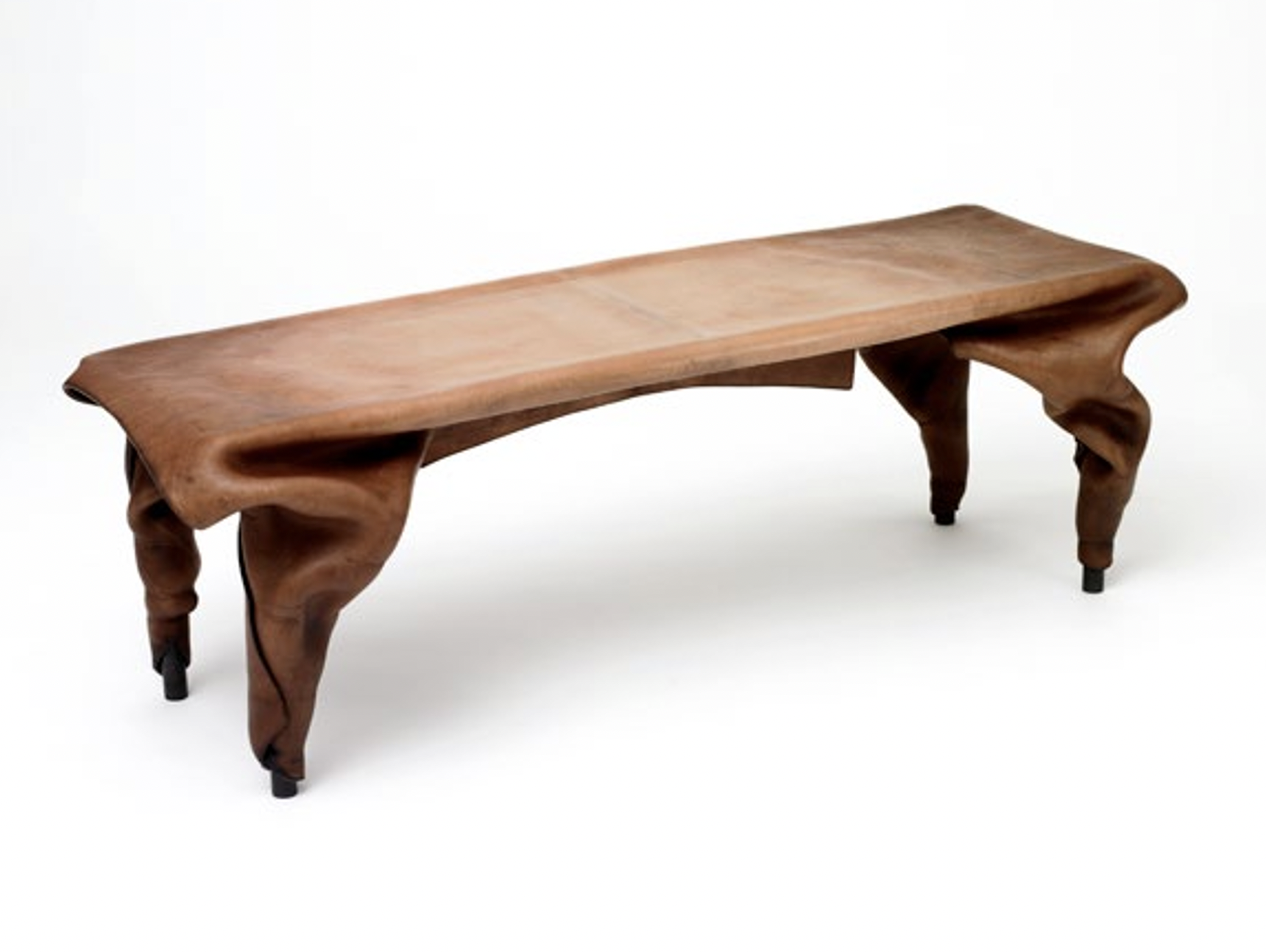
Simon Hasan (British), Twist Bench, ca. 2010, London, England, Vegetable-tanned leather, steel, Courtesy of the artist.
More than timber milled from sun-devouring trees, more than bone-born limestone, leather occupies the discomforting zone that lies between extraction and use: the space between a beast of the fields and a handbag. Simon Hasan is the leading designer today whose work refreshes our sense of leather’s in-betweenness. In 2007, he was a graduate student in the thrall of the experimentalists orbiting Droog, the famed avant garde design collective. Marcel Wanders’ Knotted Chair, 1999, was an important early influence. To make it, Wanders dipped a custom-formed macramé net in resin and hung it in a frame to harden. Once the frame was removed, the fibers remained frozen in graceful suspension.
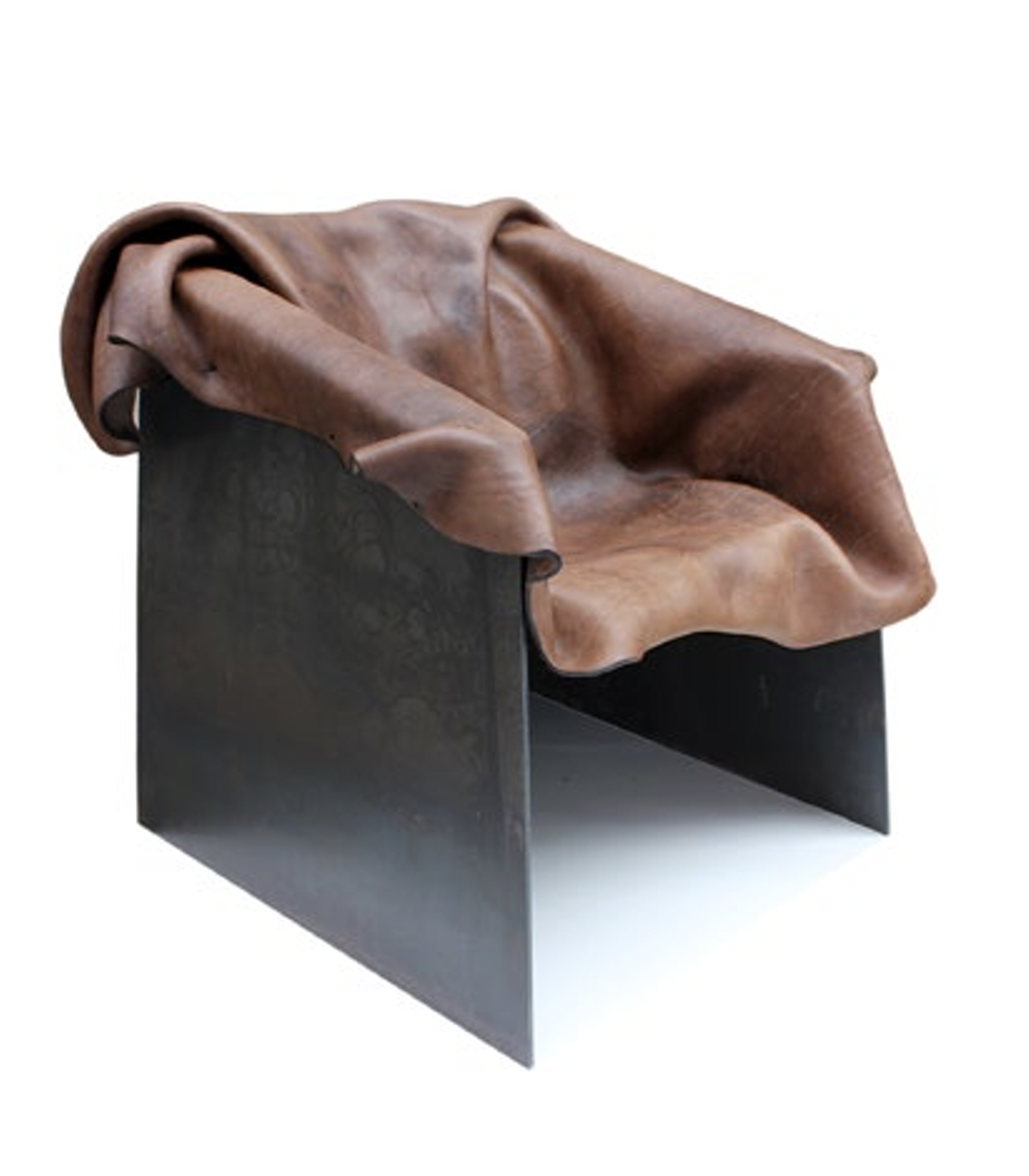
Simon Hasan (British), Fold Chair, ca. 2010, London, England, Vegetable-tanned leather, steel, Courtesy of the artist.
Haasan sees his work as sharing this process-driven ethos. The process he struck upon is cuir bouilli, a medieval technique of hardening leather into a fixed form. Once associated primarily with the armorer’s craft, it is still used today in shoemaking. Cuir bouilli has an appealing simplicity. First, vegetable-tanned leather is submerged in nearly-boiling water. Once extracted, it is supple for just five to ten minutes before it stiffens. Quickly, it must be arranged in the form it will retain; Hasan describes the process as “an exercise in speed and immediacy.” Water leaches oils to the surface of the material, making it difficult to grasp. As the water evaporates, a material that began as a hide transforms into a carapace, or shell.
Hasan’s most identifiable work is marked by a sense of dynamism and motion–the leather is bunched together, twisted around, or curled languorously. Wielded in this way, cuir bouilli presents itself as a limp material, miraculously petrified, much like the slack but rigidized cords of Wander’s Knotted Chair. In 2010, Hasan created his first Fold Chair by draping a single hide over a functional-looking steel frame, which supplies the chair’s legs and arm supports. In early editions, Hasan reinforced the underside of the leather seat with fiberglass. The cuir bouilli technique makes the leather not just firmer, but also more brittle. Immersion at too high a temperature can lead to cracking, crumbling, and a loss of structural integrity. Too little and the leather will remain pliable to a degree that undermines form-giving. Hasan viewed the fiberglass reinforcement as a conceptual compromise, however. So he kept experimenting. Iteratively, he honed the tolerances of temperature and immersion such that the bare leather could act as both surface and structure, skin and bone. In these subsequent versions, the leather is flexible enough to avoid splitting yet stiff enough to maintain its shape under the sitter’s weight, despite hanging in the open space of the metal frame.
There is a brutal contrast in Fold Chair’s composition–the steel’s cold orthogonality and the leather’s supple, warm undulations. The homogeneity of the factory-milled metal contrasts with the characterful surface of the leather, which has an articulately distressed patina. Hasan works exclusively with vegetable-tanned material, which, he explains, tends to be “much more marked and scarred… you see little insect bites.” Most leather products in circulation today appear to have homogenous surface textures, an effect achieved by removing the natural texture, and then embossing a pattern back in. Fold Chair presents toughened vegetable-tanned leather in a vividly original form–arrested in motion, pocked and blemished by the particularities of an animal’s life. It gives rise to a certain uneasiness: if other beings can become things, can we?
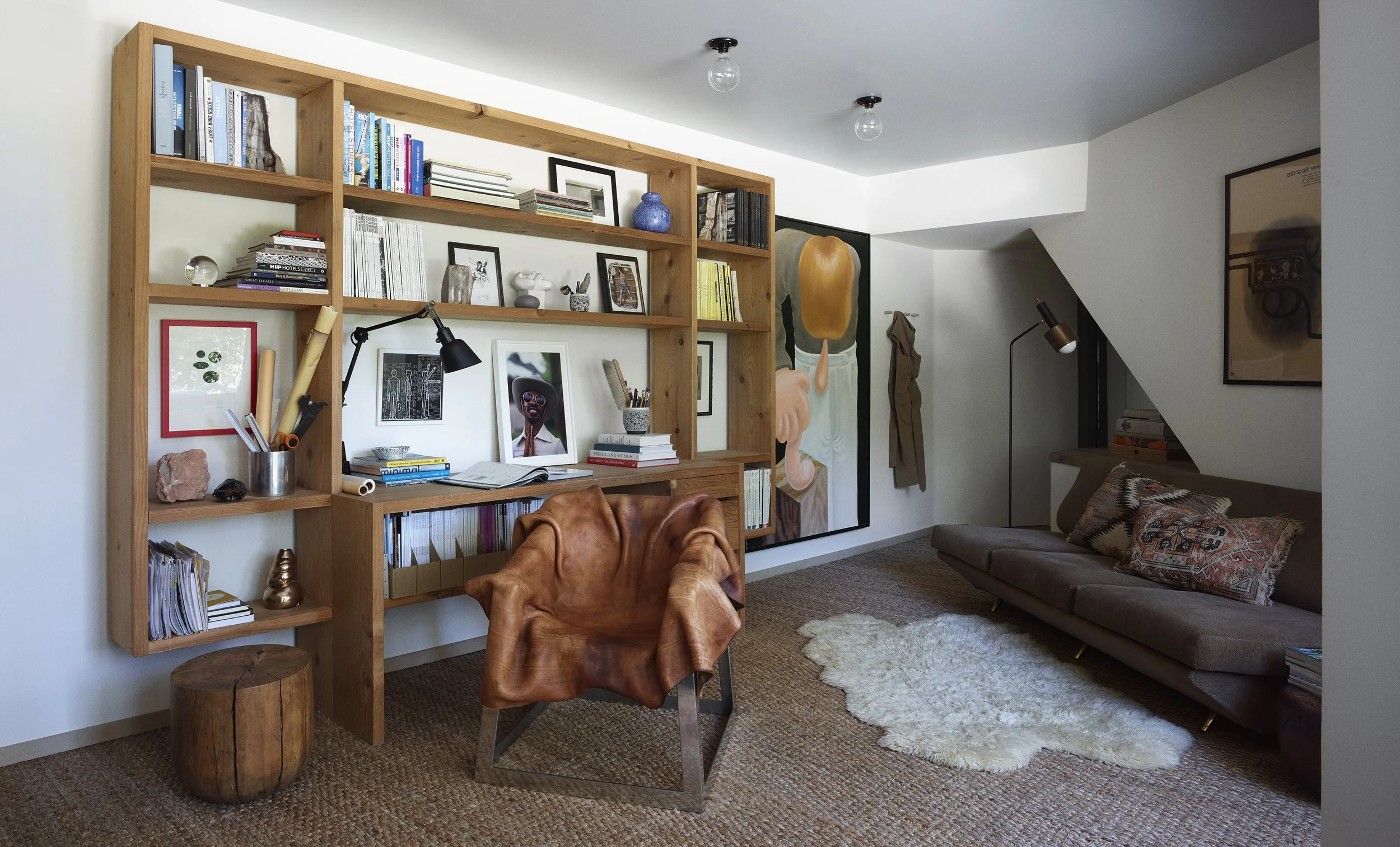
© Anthony Cotsifas / Art Partner Inc.