The indigenous origins of Russia leather

Rose Camara

Unknown Nenet Maker, Hide, ca. 1780, Russia, Leather, The Chipstone Foundation, 1996.171, Photo credit: Gavin Ashworth.

In 1786 Die Frau Metta Catharina von Flensburg, a two-masted sailing ship, was en route from St. Petersburg, Russia, to Genoa, Italy. It carried a six-person crew and hundreds of bundles of Russia leather, made from reindeer hide. Caught in a worsening storm, the vessel docked in Plymouth Sound on the southwest coast of England. The Metta Catharina was not spared, though. The tempest ripped her from her anchor and smashed her into rocks near Drake’s Island. The crew survived, but the ship sank 98 feet to the bottom of The Sound, and there lay derelict for nearly 200 years.

Between 1973-2006, the Nautical Archaeology branch of the Plymouth Sound British Sub-Aqua Club, led by Ian Skelton, excavated the shipwreck. They made an extraordinary discovery: the cargo was mostly intact. While the outer layers of the bundles were decayed, the inner layers had been preserved due to the stable, oxygen-free environment.

In the 17th and 18th centuries, Russia leather was a valuable luxury material, in high demand across Western Europe and the American colonies. It upholstered furniture, lined coffins, and made bags, shoes, and saddle goods. Treated with birch oil and seal fat, it was known for its softness, suppleness, water resistance, insect repellence, distinctive aroma, and diced pattern on the hair side. Luxury goods today continue to be made from the surviving leather, attesting to its durability.

Rather than focusing on the fate of the Metta Catharina and the continuing use of its cargo by contemporary leather brands, such as George Cleverley, here I want to look in another direction: to this leather’s possible origin with Indigenous peoples such as the Chukchi, Evenki, Khanti, Mansi, and Nenets. It may well be that all those hundreds of reindeer hides, salvaged from the submerged wreckage, were originally extracted as spoils from the Indigenous groups of the far North.

Sue Flood (British), Nenets reindeer herders at camp, Yamal-Nenets Autonomous Region, Yamal peninsula, n.d.

This story begins with the Russian conquest of Siberia, from 1580 to 1778. A major motivation for the incursion was the collection of hides: sable, fox, beaver, marten, and reindeer skins, gathered by confiscation, barter, or an annual fur tax, known as Yasak. These furs, as well as leather, were collected in fortified zimov’es, or winter camps, that eventually developed into larger settlements. At the time of the sinking of the Metta Catharina, the resources extracted from the Indigenous populations amounted to fully one-third of the Russian Empire’s wealth.

Reindeer facilitated Indigenous wellbeing in many forms: food, garments, shelter and transportation. Nenets clothing, for example, is the result of centuries of migration and adaptation to arctic climate conditions. The thick guard hairs and dense underfur of the reindeer hides work together to prevent air movement and heat dissipation. In a study led by Michigan State University in 2020, researchers documented the insulation qualities of Chukchi reindeer clothing, which are superior to modern military-grade down equipment.
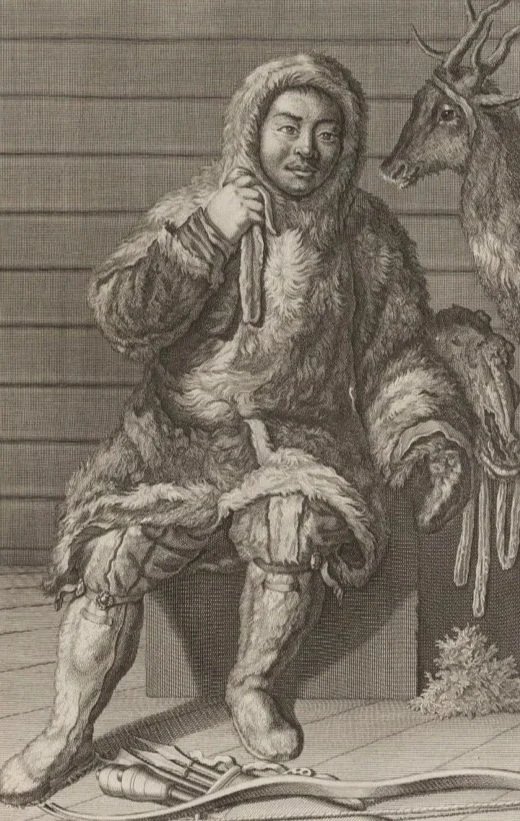
Cornelis de Bruyn (Dutch, 1652-1727), Samojeedse Man, 1714, Amsterdam, Netherlands, Copperplate print on laid paper, Rare Books Division, The New York Public Library, b11544489.

Reindeer were also significant in a religious context. In Siberian shamanism (the word “shaman” comes to English from the Evenki language), the animal’s hide and bone was used to make ritual tools. An Evenki shaman served as an intermediary between people and spirits through drum journeys, while in a trance. The drum was made of a wood loop, oval or circular in shape, with reindeer skin stretched across it. It was struck with a baton known as pogonyalka, conceptually a tool for driving the “reindeer” represented by the drum.

Yasak had a terrible destructive effect on these practical and spiritual aspects of Indigenous life. It brought all the expected effects of colonization: death by disease, conversion to the state religion (Orthodox Christianity), and the exhaustion of natural resources. The Nenets previously had a hunter-gatherer nomadic lifestyle, with small herds of reindeer that they used for labor. As contact with the Russians became more frequent, and violent, focus shifted to breeding the animals for use in transportation and even in battle. Domesticated herds became the primary source of sustenance. Some Nenets abandoned their traditional itinerant lifestyle and moved to towns or the coast for marine hunting.

The Khanty and Mansi, similarly, dealt with near constant demands of the fur tax. So much time was spent hunting that traditional modes of living, diet, and economy were disrupted. The introduction of bread and alcohol led to a dangerous reliance on these goods, which the Russians exploited, raising prices and taking advantage of growing alcoholism in the clans. With the adoption of Christianity, some Khanty and Mansi learned the Russian language and culture, severing the connection with the reindeer as a sacred being.

The trade in leather between the Indigenous peoples of Siberia and the Russian Empire is not just a story of supply and demand, and the hides found in the shipwreck of the Metta Catharina are not just miraculously preserved luxury goods. Their origin matters. These reindeer hides are yet another reminder of the colonizer's dependence on the exploitation of people and nature. At the same time, they are surviving evidence of traditional knowledge, and a centuries-old harmonious relationship that tribal people had to the animals around them: moving according to their migration patterns, worshiping their existence, and living in their skin.


Rose Camara is a curator, illustrator, and the current Charles Hummel Curatorial Fellow at the Chipstone Foundation. She received her MA in History of Art from the Courtauld Institute of Art, University of London (2020) where she investigated the presence of Black women in Renaissance Venetian paintings. As a curator and art historian, she sheds light on the black presence in Medieval through Early Modern Europe (and more broadly where marginalized voices have been left out of art historical scholarship). As an artist, her practice ranges from mixed media abstractions to inky streams of consciousness in minute detail.

Brilliant Move

Brilliant Move is the Brooklyn-based creative studio of Marci Hunt LeBrun specializing in building websites on the Squarespace platform – among many other things.

I love working with small businesses, nonprofits, and other creatives to help them organize their ideas, hone their vision, and make their web presence the best it can be. And I'm committed to keeping the process as simple, transparent, and affordable as possible.

https://brilliantmove.nyc
Previous
Previous

Golden leather

Next
Next

In front of the hide