The most trying ordeal
Jonathan Square
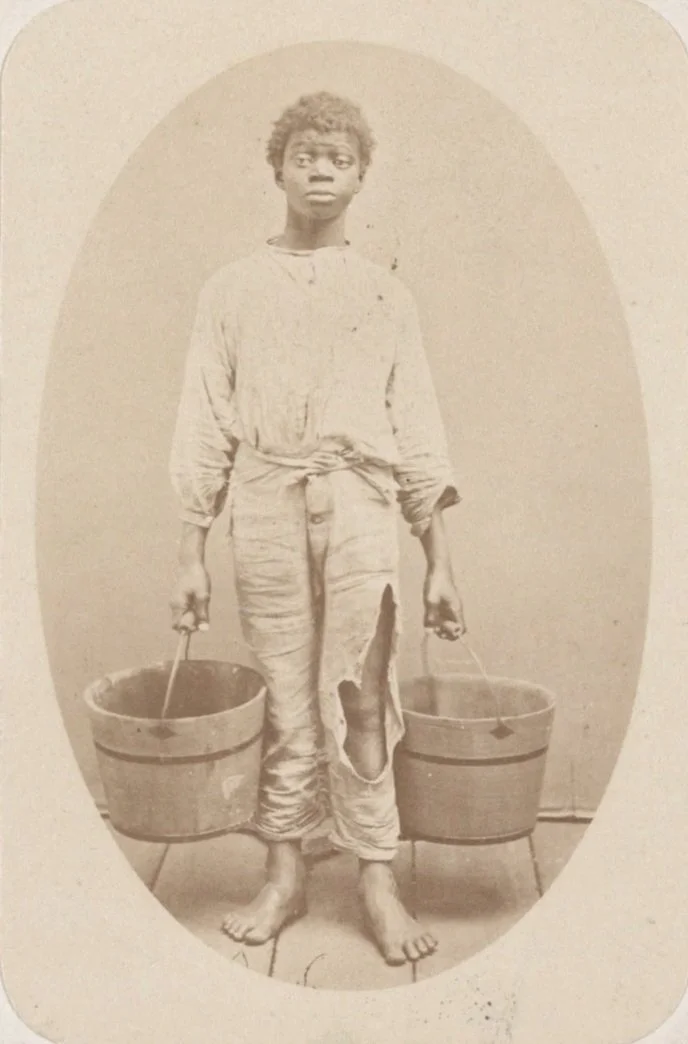
African American boy, possibly a slave, holding two buckets, Isaac Haas, photographer & dealer in stereoscopic views, Green Cove Springs, Fla. Courtesy, Library of Congress, prints and Photographs Division, [lc-dig-ppmsca-53047].
A surviving carte de visite of a young black boy, archived at the Library of Congress, shows him in ragged clothing - not atypical for enslaved persons. We unfortunately do not know his name or history, but we can see that his threadbare attire was probably constructed from linen. We know, too, that clothing like his could be dreadfully uncomfortable, a little-recognized part of a dehumanizing and brutal reality. Cheap, coarse garments like these played a critical role in the experience of enslavement.
While cotton is the textile most associated with slavery, linen also played an important role in the day-to-day lives of enslaved people. Tracing this history is difficult due to indiscriminate terminology at the time. “Negro cloth” was used to describe any cheap textile intended for enslaved people’s clothing, whether cotton, wool, linen, or some combination of these. But researchers like Eulanda Sanders have also gathered more specific evidence that African Americans wore a variety of low-quality textiles like osnaburg, a plain-weave textile sold unbleached or in white, blue, or neutral colors and named for the German city of Osnabrück where it was originally produced.
Most enslaved people received either allotments of “negro cloth,” from which they were responsible for hand-sewing their own clothing, or ready-made garments, typically once or twice a year. Frederick Douglass reported that a field hand received a yearly allowance of “two coarse linen shirts, one pair of linen trousers . . . one jacket, one pair of trousers for winter, made of coarse Negro cloth, one pair of stockings, and one pair of shoes.” Children too young to work received “two coarse linen shirts per year. When these failed them, they went naked” until the next year.
Wearing these inferior fabrics was often tortuous, as firsthand testimonies tell us. Harriet Jacobs was born into slavery in Edenton, North Carolina, in 1813. In her autobiography, Incidents in the Life of a Slave Girl, published in 1861, she wrote: “I have a vivid recollection of the linsey-woolsey dress given me every winter by Mrs. Flint. How I hated it! It was one of the badges of slavery.” Linsey-woolsey, as the name implies, was a strong but coarse fabric with a linen warp and a woolen or cotton weft. Jacobs well understood the use of coarse, uncomfortable clothing to mark her identity as an enslaved person.
Booker T. Washington included an especially long and harrowing description of wearing an unfinished linen shirt in his own autobiography, Up from Slavery:
The most trying ordeal that I was forced to endure as a slave boy . . . was the wearing of a flax shirt. In the portion of Virginia where I lived it was common to use flax as part of the clothing for the slaves. That part of the flax from which our clothing was made was largely the refuse, which of course was the cheapest and roughest part. I can scarcely imagine any torture, except, perhaps, the pulling of a tooth, that is equal to that caused by putting on a new flax shirt for the first time. It is almost equal to the feeling that one would experience if he had a dozen or more chestnut burrs, or a hundred small pin-points, in contact with his flesh. Even to this day I can recall accurately the tortures that I underwent when putting on one of these garments. The fact that my flesh was soft and tender added to the pain. But I had no choice. I had to wear the flax shirt or none; and had it been left to me to choose, I should have chosen to wear no covering.
In connection with the flax shirt, my brother John, who is several years older than I am, performed one of the most generous acts that I ever heard of one slave relative doing for another. On several occasions when I was being forced to wear a new flax shirt, he generously agreed to put it on in my stead and wear it for several days, till it was “broken in.” Until I had grown to be quite a youth this single garment was all that I wore.
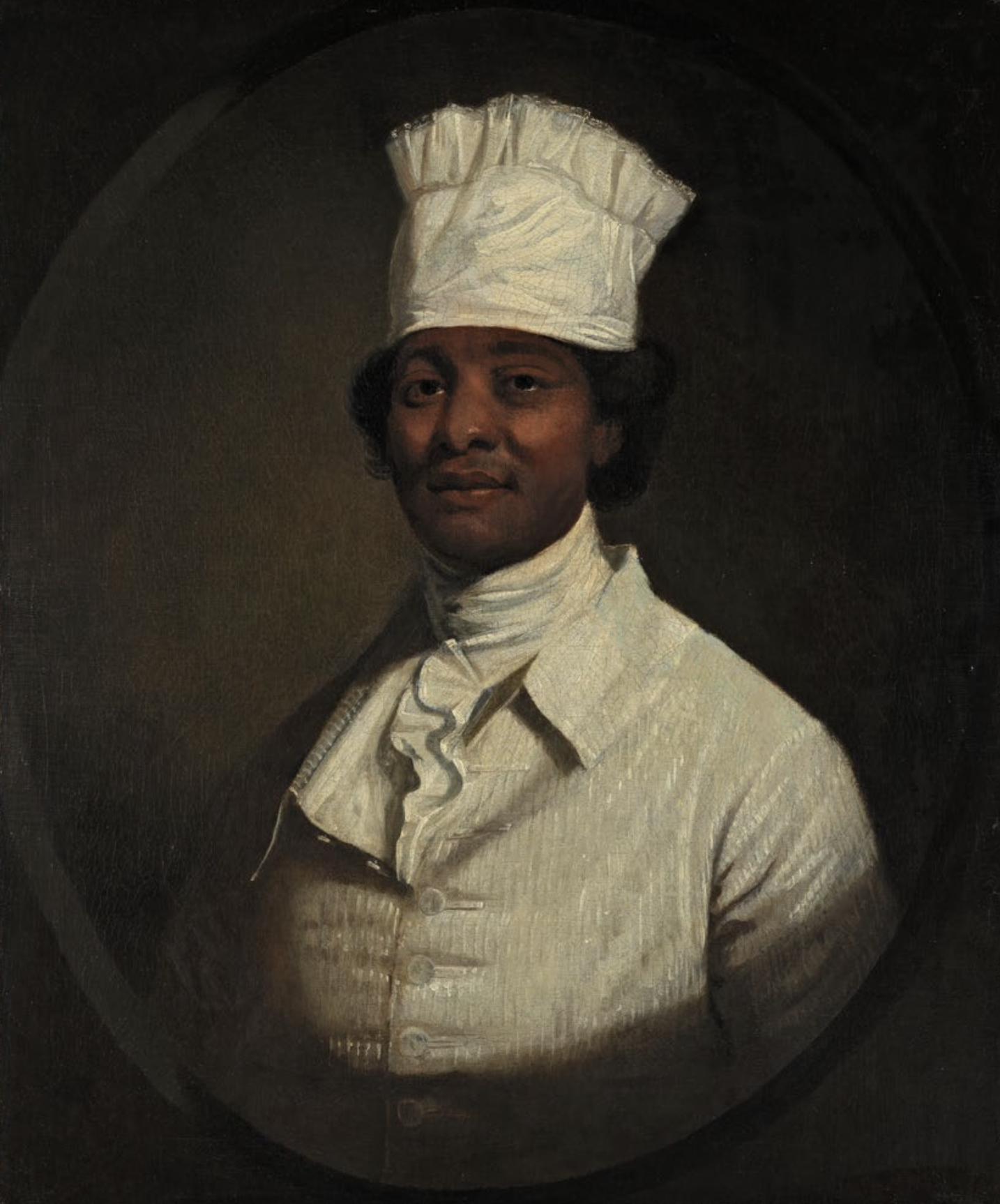
George Washington’s Cook, attributed to Gilbert Stuart, ca. 1795–97. Copyright Museo Thyssen-Mornesmisza, Madrid. His name was Hercules.