The Piestewa Tree
Carolyn Herrera-Perez
I am visiting The Piestewa Tree.
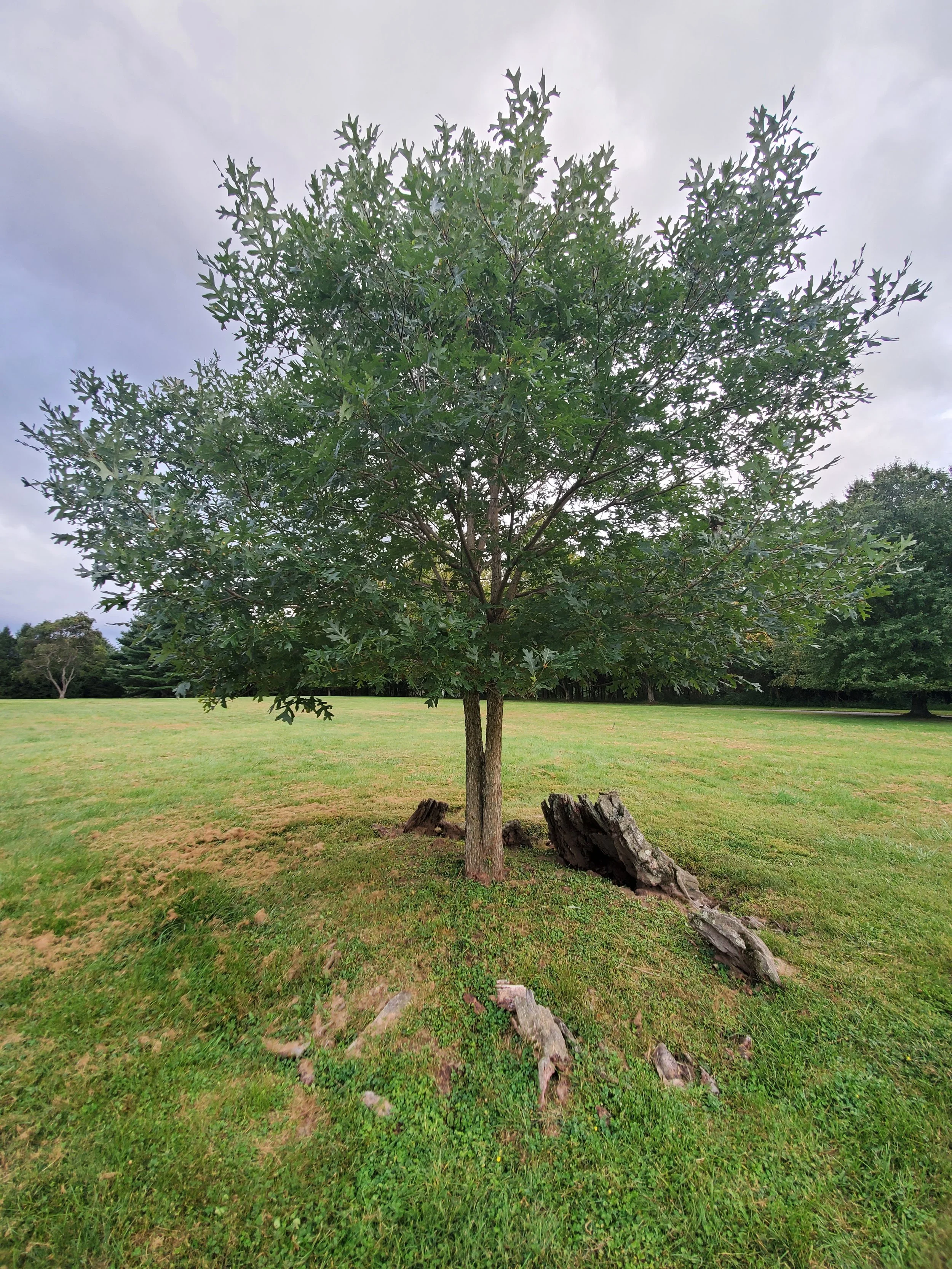
In Solebury Township, Pennsylvania, the tree stands circled by the remnants of its parent’s trunk, living on as the child of a local celebrity, the “Columbus Oak”. By the time that this oak died at 516 years old, it served as an emblem of the township, spotlighted in local history and even in special edition multi-colored license plates. Now, the Piestewa Tree is thriving in its place. Hopefully this memorial may similarly become an honored witness to the next five hundred years.
Oak trees accomplish many roles in their lifetimes, notably contributing to and nurturing the flora and fauna all around them. And in their afterlife, when cut down, this remarkable wood is used by woodworkers, basketmakers, tanners, boatbuilders, and many other craftspeople. But the oak tree has long had another vital role in many cultures: as a symbol, an emblem, a marker, or even a monument for a community and a country. Think of the Charter Oak, whose life and death captivated generations. In 1687, King James II demanded the return and revocation of the Connecticut Charter, the official document that legitimized the colony’s legal existence. As the story goes, the threatened colonists scrambled to hide the papers within its trunk. This legendary oak’s death in 1856 was met with grief and excitement in equal measure; it’s said over ten thousand pieces of its wood were dispersed throughout the country as many sought its scraps.
While The Charter Oak and The Columbus Oak are the assigned historical names for these trees, they could tell many more tales. For example, The Charter Oak first served the Pequot Tribe as a landmark, a council tree, and a guide to planting their corn, before it received its name later on in life when it partook in a colonial legend. Meanwhile, The Columbus Tree is formally associated with Christopher Columbus, whose search for a quicker route to India in 1492 landed him in the Bahamian Island of Guanahani. There, he initiated the exploitation and genocide of the then numerous Taíno Tribe, whose population verged close to extinction by 1550.
Now consider the Piestewa Oak that has sprouted from the Columbus Oak. The tree was named in honor of the first Native American woman to die in combat on foreign soil, Lori Piestewa. When encountering this memorial, we are comforted by the fact that the life that it honors will be long remembered because this oak will be a living monument that far outlasts those who planted it.
Qötsa-Hon-Mana (White Bear Girl) was Lori Piestewa’s Hopi name. She was born and raised in Tuba City, Arizona within the Hopi reservation. Historically, this land was taken by the U.S. federal government, though a piece was later returned to the independent nations, Hopi and Navajo. Lori Piestewa’s family had a long military tradition. As a member of the U.S. Army’s 507th Maintenance Company, she became the third generation to serve. Piestewa wanted to go to college; she enlisted instead, to provide a secure income for her family. In 2003, when she deployed to Iraq, she was twenty-three years old and a single mother to two children. Five weeks after she arrived, during the first days of the Iraq War, her company was making their way to Baghdad through the desert. Her unit was ambushed. Lori Piestewa died from her injuries as a prisoner of war.
Many natural wonders now celebrate Lori Piestewa’s life. A mountain in Arizona has been renamed in her honor, a burr oak was planted for her at White Sands Missile Range in New Mexico, and in 2008 a ceremony was performed as a seedling of the Columbus Oak, what is now known as The Piestewa Tree, was planted in her memory.
It was in 1999 that the Columbus Oak fell in Solebury Township and shortly thereafter David Benner, a local horticulturist and ancient tree aficionado, visited the site. By then, any remnant acorns that fell in Autumn were sprouting. As his son Al Benner explains, “I envision him thinking, ‘I have to find the offspring.’”
I too picture David Benner crouching to look for these germinated oaknuts—picking up and inspecting one between thumb and finger. And I imagine him then placing the Columbus Tree’s acorn in his pocket. For the next nine years he cultivated that sprouted acorn into a sapling.
On a gray day in April 2008, a tree planting ceremony in Solebury Township began as Lenape Elder Ed Fell led a smudging for the group to cleanse those who gathered. This area was once the home of the Turtle Tribe of the Lenni-Lenape and despite their lasting presence in the area Pennsylvania is still one of the thirteen US states that do not recognize Native American tribes. “In the arms of the Mother Oak,” the sapling that David Benner had raised from an acorn was placed. Danawah Buchanon blessed the planting, and Barbara Bluejay, a granddaughter of Lenni Lenape Chief Thompson, organized visitors to link hands and partake in a circle dance.
Today, The Piestewa Tree is twenty-one years old. I enter Solebury Township, and turn onto a residential street off Aquetong Road. I actually miss the oak tree when two young boys whoosh by me on motorbikes. As I park my car, one plummets from his bike, tumbles with it, and hops up as he runs for his parents down the road.
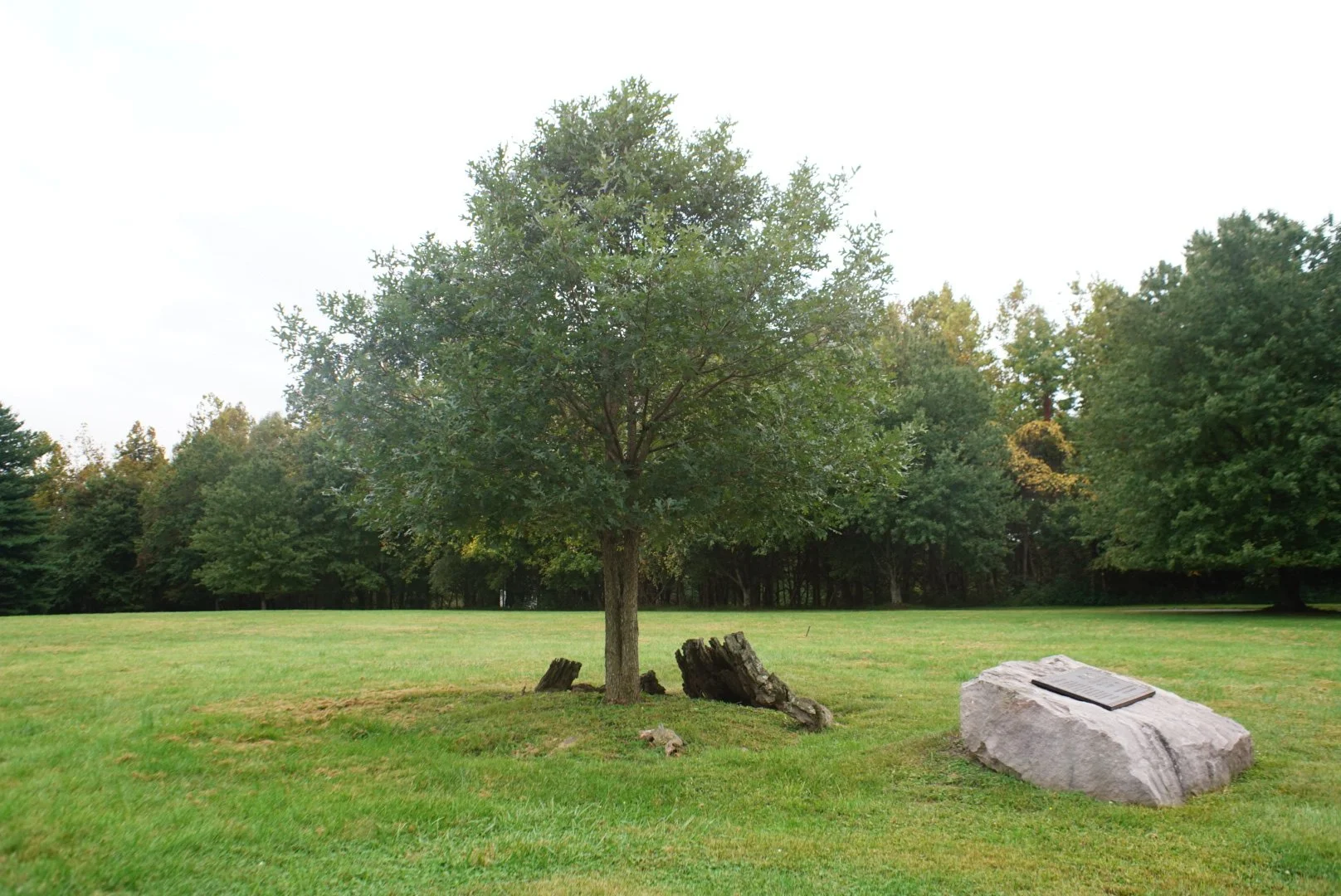
The bike is still humming on the ground as I check with his parents to see that everything is okay. On my way back, I finally notice the Piestewa Tree in the center of a soggy f ield. It’s now clear that I had some expectations for this tree, because I am surprised not to find a little sapling here. What I have in front of me instead is a tree whose canopy reaches higher than fifteen feet; an already thriving Quercus alba within the arms of her parent.
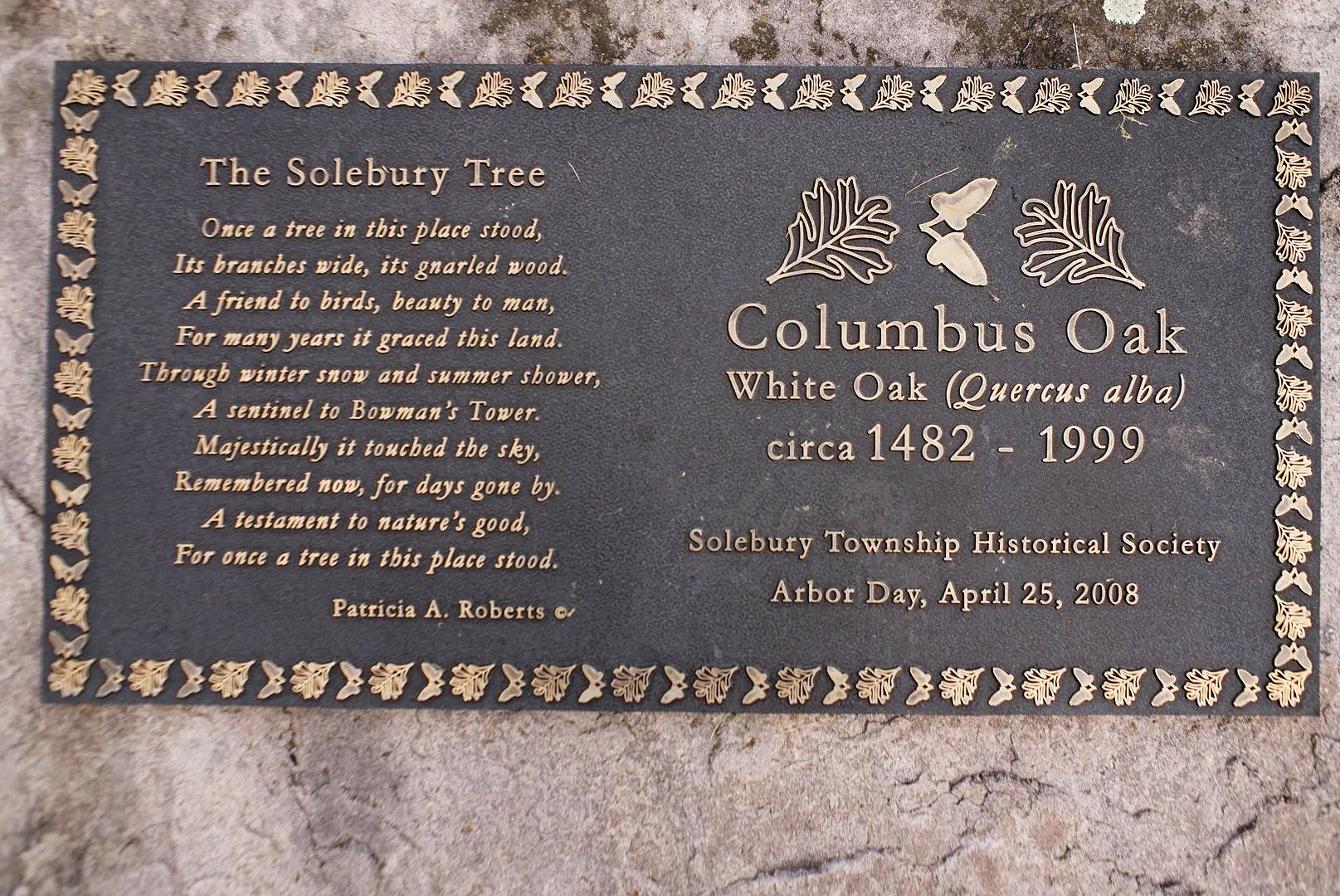
Before the oak is a massive stone, a 2½ ton Solebury sandstone monument that marks the site of the mother tree, the Columbus Oak. But there is no sign, no marker, nothing that reminds us of the remarkable young woman that this tree memorializes.
I realize that I came all this way to tell you that this tree is for Lori Piestewa.
Carolyn Herrera-Perez is a writer, a maker, and Contributing Editor of Material Intelligence. She is currently pursuing her MA in History of Design and Curatorial Studies at Parsons and Cooper Hewitt where she is a Curatorial Fellow. Herrera-Perez first studied art history and ceramics at suny Potsdam and has previously been a ceramist and studio-assistant at various ceramic studios.
Photography, Carolyn Herrera-Perez