The fibers of this place

E. Saffronia Downing
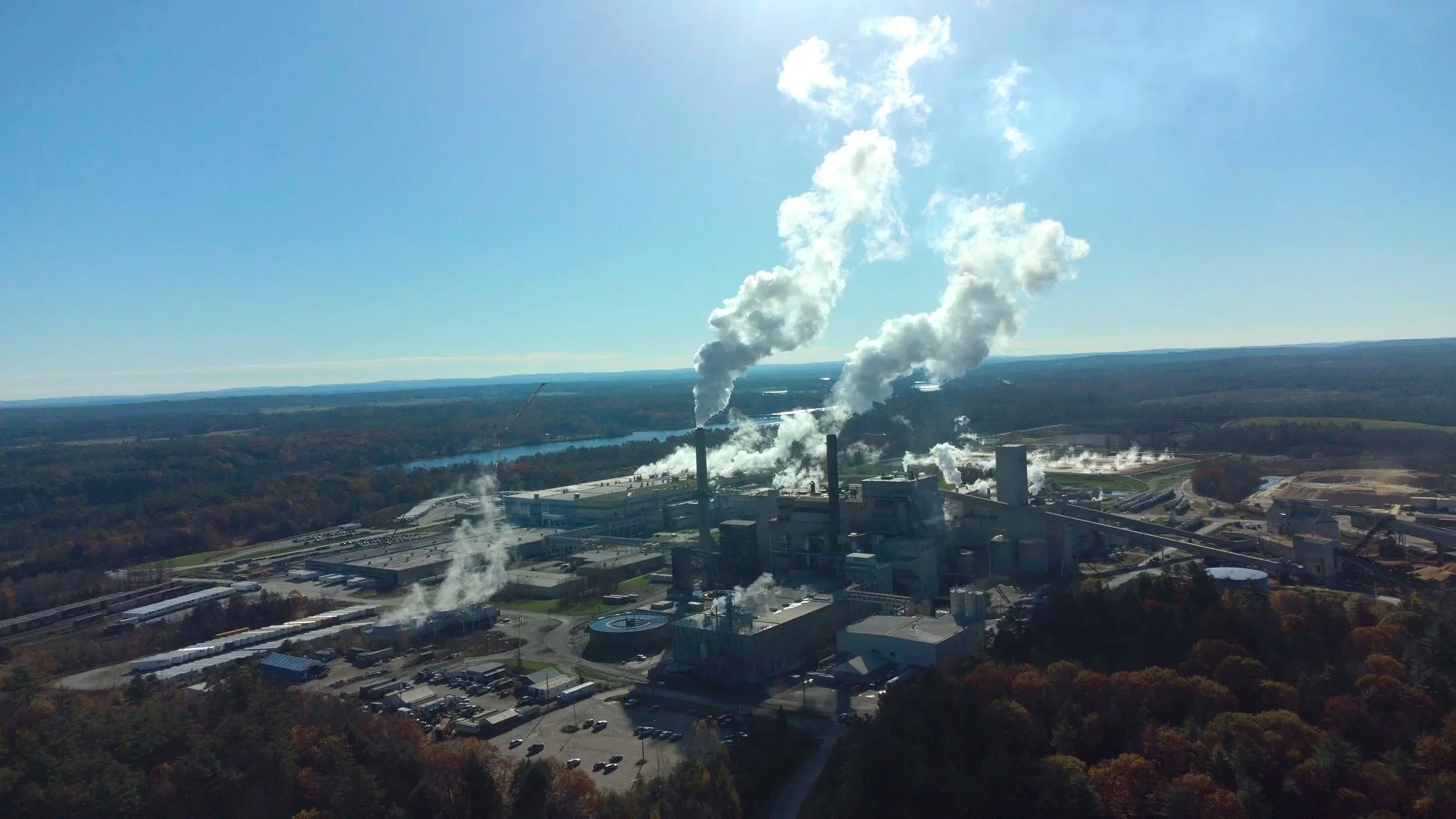
John Harlow (American, 1989– ), Drone Photo of SAPPI Mill, October 2023.

I stare out my studio window at the rushing Kennebec River. It’s early spring in Western Maine, and the river is starting to swell. Patches of yellow ice surge over a steel dam. Silent smokestacks stand against the cold sky. Not too long ago, this spring thaw was a sign that the log drives were soon to begin.
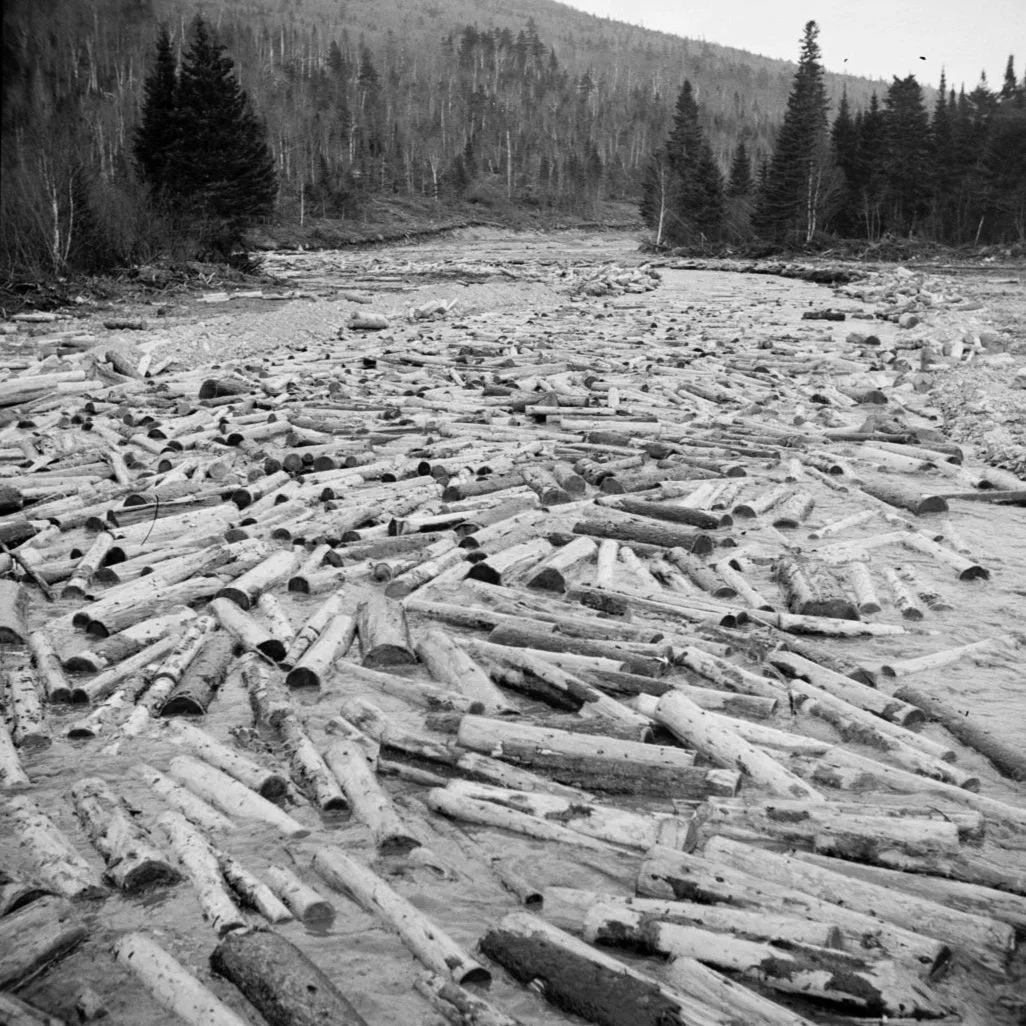
John Collier Jr. (American, 1913–1992), Spring pulpwood drive on the Brown Company timber holdings in Maine. A small “head” at the mouth of Dennison Bog Brook, Nitrate negative, May 1943, Library of Congress, lc-usw3- 030056-e [p&p] lot 761.

“I watched them log drives since I was a kid,” Bob Nadeau told me. Nadeau is a senior environmental engineer at Somerset Mill  SAPPI, one of the few papermills left in the state. When he was a child, Maine’s rivers were regularly obscured beneath a continuous blanket of floating wood. “You couldn’t see the water at all,” he says. “You’d throw rocks and just watch them bounce off the logs. You couldn't go fishing, because there was no open water, at least for a good part of the year.”
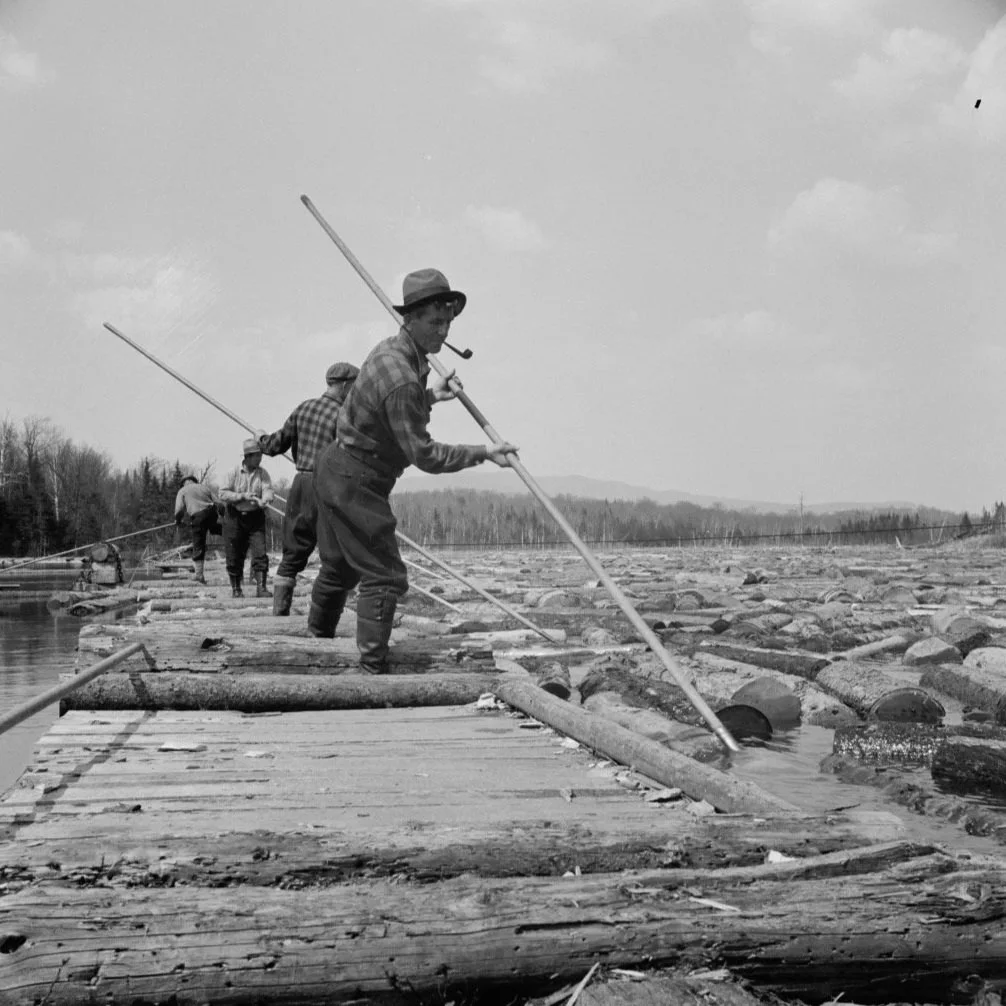
John Collier Jr. (American, 1913–1992), Spring pulpwood drive on the Brown Company timber holdings in Maine. Pikemen keep the logs moving down toward the sluiceway of the power dam, Nitrate negative, May 1943, Library of Congress, LC-USW3- 030115-E [P&P] LOT 761.

As Nadeau describes this memory, I imagine the river and forest, the water and the wood, fibers of this place materializing into an open page. From the early 19th century through the mid-20th century, millions of cords of spruce, fir, poplar, and pine were shepherded down river highways to Maine’s paper mills. The logs were pulled out of the river by workers, themselves floating on pontoons. The wood was then debarked, chipped, and cooked in chemical baths in massive digesters. The bleached pulp was sprayed onto a rotating wire screen where the pulp fibers knit together into a single long sheet. The sheet was spun through heated rollers that pressed and dried the paper before it was cut into pieces or wound into a massive roll.

For many Mainers, paper was the material on which life was written. From 1920 to 1960, Maine was the nation’s top producer, specializing in coated papers used in magazines such as National Geographic and LIFE. Whenever the wind blew south, sulfuric breeze drifted through mill towns such as Skowhegan, Rumford, and Millinocket. Locals called it the “smell of money.” The mill work was brutal, but it could ensure a lifetime of secure employment.

Even as workers churned out glossy pages for the nation’s most popular magazines, paper companies rewrote Maine’s political and environmental landscape. Companies such as Great Northern Paper and Oxford Paper came to own 10 million acres between them, an area the size of New England’s five other states combined. The paper industry rerouted rivers, altered forests, and left pollutants such as Dioxin and PFAS embedded in the sediment.

How did Maine, known for its vacationland image, become a place of paper? In 1800, American paper had been produced in small workshops, mostly in southern New England and Pennsylvania. It was a laborious craft, little changed in its 2000-year history. Used cloth rags were ground into a pulp by hand with a mortar and pestle. The pulp was then spread on wire screens to create individual sheets. An efficient operation might make five reams of paper a day.

Demand boomed in the mid-nineteenth century, as both the population and the publishing industry increased. Rags were becoming scarce, and inventors rushed to find a new resource. They experimented with various cellulose materials, including corn husks, straw, hemp, wasp’s nests, tobacco, and cattails. In the end, wood proved unmatched – both for the quality of the paper it produced, and the quantity of raw material available. With eighteen million acres of woods and a network of seven rushing rivers, Maine offered a bounty of resources unavailable in the already deforested states further south.

In the 1990s paper production shifted from a local industry to a global enterprise, and many Maine mills consolidated or closed completely. More recently, digital communications have resulted in declining magazine sales. The few paper mills that are still running have shifted from magazine papers to cardboard packaging and paperboard, produced in massive rolls and crafted to hold the endless products on the market, from Amazon shipping boxes to the containers for McDonald French fries.

By the time Bob Nadeau started working at Scott Paper Mill (now SAPPI) in 1979, the Maine Legislature had ended the practice of transporting wood by water; the state’s rivers were degraded from chemical discharge and wood debris. River-spawning fish such as Atlantic salmon, shad, and river herring, once with populations in the millions, were nearing extinction. “We don't put any logs in the river,” Nadeau says. “It’s all trucked to us now. We get about 400 trucks of tree-length logs delivered to the mill a day.” Maine’s few extant papermills now operate under a “flow loop system,” designed to treat chemicals at their source. Many jobs and skilled trades are gone for good, but the waterways are beginning to recover, and river spawning fish have started to return.

Fresh paper is akin to a heap of snow against the sidewalk– a conglomerate of complex patterns concealing its own intricate parts. A single sheet can contain fibers from hundreds of different trees, which may have traveled thousands of miles from their origins in the forest. A blank page may seem to be empty space, but it actually holds invisible marks of history, energy, and process. Even as I gaze into my notebook writing these words, it’s hard to see the stories teeming in the fibers.


E. Saffronia Downing is an artist and educator invested in craft processes, embodied research, and ecological thought. Downing forages local materials to create site-specific installations and sculptures. Through her work, she posits that the pursuit of foraging considers various points of correspondence between maker and matter. Downing received her mfa in ceramics from School of the Art Institute of Chicago. Her work has been exhibited nationally and internationally. She has received fellowships at College of the Atlantic, Lunder Institute of American Art, and Oxbow School of Art.

Brilliant Move

Brilliant Move is the Brooklyn-based creative studio of Marci Hunt LeBrun specializing in building websites on the Squarespace platform – among many other things.

I love working with small businesses, nonprofits, and other creatives to help them organize their ideas, hone their vision, and make their web presence the best it can be. And I'm committed to keeping the process as simple, transparent, and affordable as possible.

https://brilliantmove.nyc
Previous
Previous

Papier mâché, the chameleon material

Next
Next

When our fingers walked on paper