When our fingers walked on paper
Joana Albernaz Delgado

Illustrative image of the Yellow Pages, Medicimage Education / Alamy Stock Photo.
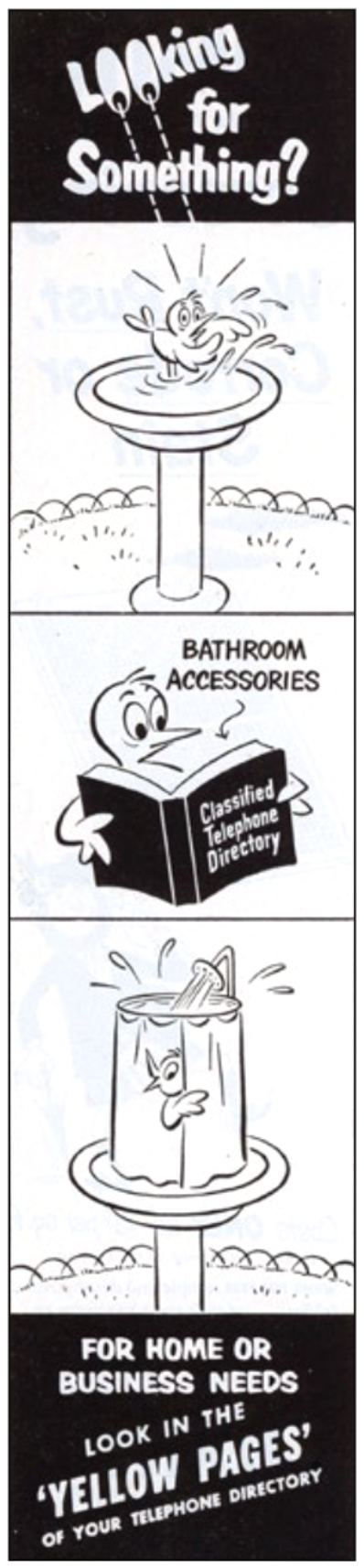
Yellow Pages advertisement, Good Housekeeping, April 1953, Patti McConville / Alamy.
I am a yellow book that no one reads. When people use me, they walk the whole city without leaving their houses. What am I?
This sounds like a children’s riddle, but few children today would get it right. Actually, you probably need to have lived before the internet to know that the answer is the Yellow Pages, a classified directory published worldwide in the twentieth century.
The history of the phonebook is inseparable from that of the telephone itself. The first directory, a one-page list with fifty telephone subscribers, was printed in the US in February 1878 – just two years after Bell patented the telephone. By November, it had seventeen pages and a ten-page business directory. A few years after that, the Yellow Pages were born: a new resource for universal consumerism. They were for everyone, everywhere, and everything: man or woman, home, office, train station or hotel, business or pleasure, necessity or desire. You just had to “let your fingers do the walking.”
Dennis Duncan has described his brilliantly titled book Index, A History of the, as “the story of our accelerating need to access information at speed.” This is certainly true of the Yellow Pages. It belongs to an extended family of indexes that permeated everyday life long before Google and Wikipedia, embodying a chapter in the history of our relationship with knowledge. Now, when a pipe burst, stressed fingers could flick right to the page for “Plumbers.”
Materially speaking, the Yellow Pages were at the lowest, most prosaic echelon of the index. Living by the telephone in the house’s entrance hall or on the secretary’s desk, they were made from thin, cheap paper, just durable enough to last a year. This put them well below the noble, indulgent paper of the modern encyclopedia, though perhaps just above the flimsy sheets of the daily newspaper, whose classified section used to be the most ephemeral of all directories.
In the USA, the shift from standard paper to newsprint happened in the 1920s, as the size of directories rapidly expanded: “some means of reducing bulk had to be discovered.” In 1941, directory paper was touted as meeting ‘exacting requirements as to color, cleanliness, thinness, opacity, and sturdiness,’ although manufacturers were still fine-tuning formulae as late as 2010.
While alphabetical directories typically use white paper, classified directories (printed sometimes in the same publication, in a separate section) have long adopted yellow, making the distinction clear for users. The origins of this yellowness are as obscure as many American tales of ingenuity. It is said that in 1883, a Wyoming printer ran out of regular paper and used yellow instead. Curiously, other yellow products such as post-its® or legal pads share a similar chromatic story, in which color is somehow an impromptu outcome.
Still, the yellowness of the Yellow Pages was chemically precise, obtained by adding dyes to the pulp during manufacturing. By the 2000s, however, most copies were no longer dyed. A former salesman’s account unveiled the “inside secret”: the pages were selectively printed with yellow ink. Advertisements generated million-dollar revenues, and using white paper allowed for full-color ad printing.
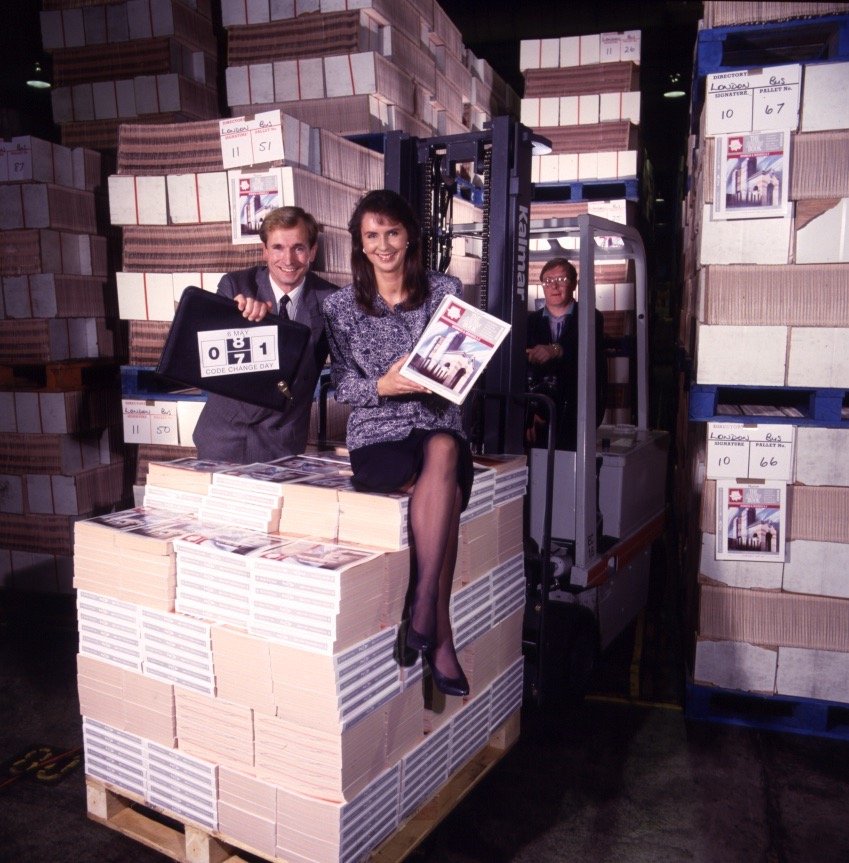
Warehouse of Ben Johnson’s printing factory in Gateshead, with the new London business directory featuring the 1990 code change, Photographic transparency, February 1990, BT Digital Archives, TCC 474/HF 33V.