Conchophilia: On shells and surrealism
Gavin Parkinson
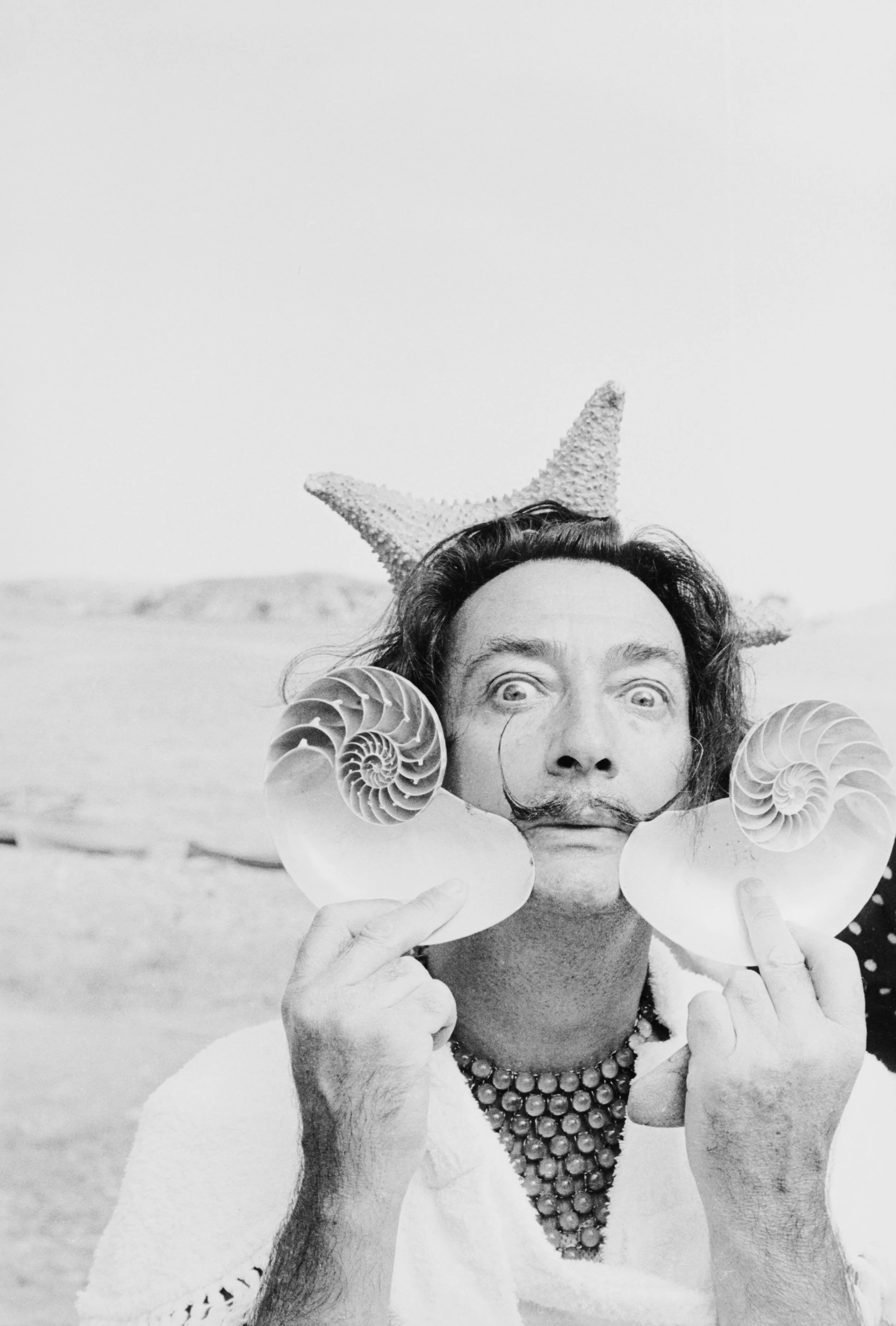
Charles Hewitt, Dali With Shells, 1955. Original Publication: Picture Post, 7465, "A Day With Salvador Dali," 1955. Photo by Charles Hewitt/Picture Post/Hulton Archive via Getty Images.
André Breton, the poet and main theorist of Surrealism, wrote in Magic Art (1957) that the ‘shellfish, snail, volute, spiral, vulva, diamond, pearl and cauldron, which combine embryological and reproductive analogies, belong to the same chain.’ He was just one of many artists, poets and filmmakers associated with the movement who were sensitive to shells’ metaphoric and metonymic potential. Consequently, the incidence of shell imagery has slowly accrued in one corner of the visual culture of Surrealism.
A highly abbreviated survey of Surrealist conchophilia could begin with the shell (or a jelly mould of one) in the Premonitory Portrait of Guillaume Apollinaire (1914) by Giorgio de Chirico, the most significant artist for the first generation of Surrealists. One of their number, Max Ernst, sought a dialectic of impermanence and durability in his Flower-Shell series of paintings (1927-9), which propose an imaginary natural history. The shell shares main billing in what some call the first Surrealist film, The Seashell and the Clergyman (dir. Germaine Dulac, 1928), in which scallop shells under various guises convey and conceal a hallucinatory imagery of containment, conduit, destruction and desire.
Shells, scattered on beaches or inserted into fissures, are found in many of Salvador Dalí’s early paintings, such as Accommodations of Desire (1929), The Great Masturbator (1929), and The Average Bureaucrat (1930). They evoke the beach of Port Ligat Bay in his childhood town of Cadaqués (where he was once memorably photographed holding a pair of nautilus shells). Later in the 1930s, Dalí’s drawing Portrait of Sigmund Freud (1938) presented the father of psychoanalysis as modelled after the artist’s intuition, while dining on snails, that ‘Freud’s brain is in the form of a spiral – to be extracted with a needle.’
Shells continued to motivate the art of the Surrealists in the postwar period. In René Magritte’s Olympia (1947), the artist’s wife idly contemplates a conch shell resting on her belly – perversely memorialising Édouard Manet’s iconic painting of 1863, while also alluding tenderly to her fertility. (The painting was stolen at gunpoint from the Magritte Museum in 2009, and later returned for a ransom.) Joan Miró’s coloured lithograph Les Coquillages (1969) imagines a pair of figures whose heads are composed of little shells – conchophilia on their minds. Some of the recent sculptures of Czech Surrealist Jan Švankmajer, too, are made largely from shells, inspired by Giuseppe Arcimboldo (principally his painting Water, of 1566).
The main period of Surrealist interest in shells, however, was the 1930s. This was the decade the movement came to international prominence, in part for intriguing assemblages that sometimes gave evidence of beachcombing. Mirό’s collecting activity in the coastal locations of Mont-Roig and Mallorca yielded finds such as the scallop shell in Object (1929); Eileen Agar, another beachcomber, constructed her signature object Ceremonial Hat for Eating Bouillabaisse (1936) by piling an upended cork bowl with coral bones, a sea urchin, bark and several varieties of shell (among them whelks, smooth clams, and grooved carpet shells), in a festive celebration of the loaded fish stew of the French Riviera.
André Masson’s art had always been given over to nature, so he was susceptible from the outset. His automatic drawing Woman with Shells (1929-30) conflates the female body with the ocean by depicting the figure with conch shells for feet, while The Bottom of the Sea (Homage to Botticelli) (1937), a spare composition in oil paint, sand and algae, incorporates scallop shells in playful reference to The Birth of Venus (1484-6). There is also the widely reproduced painting Gradiva (1937) where the pink interior of a conch shell is turned towards our gaze, hovering between the figure’s open legs as a displaced vulva. In Ithell Colquhoun’s painting Scylla (1937), too, abstracted shells embody a potentially sexualised, mythological theme.
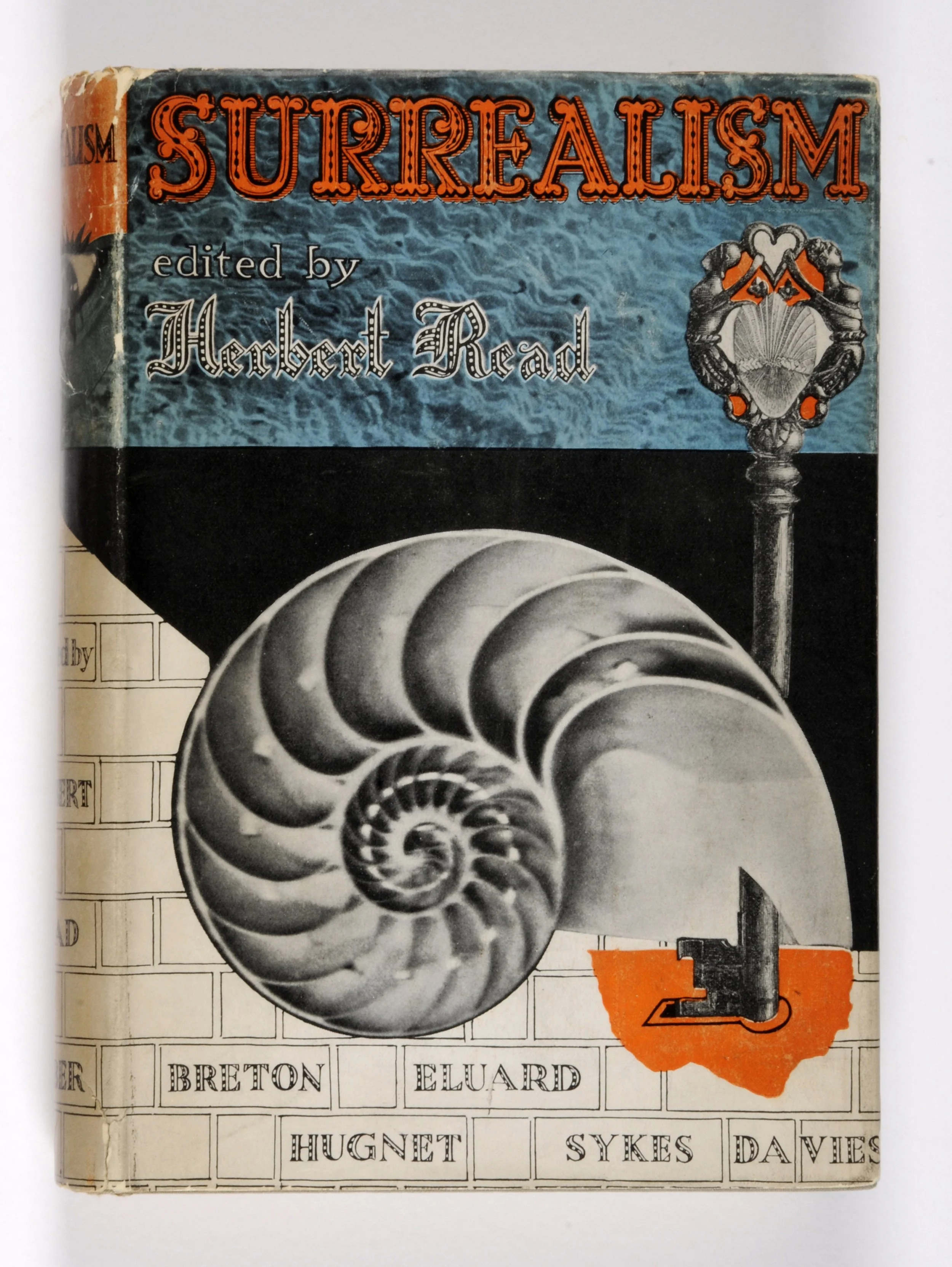
'Surrealism' edited by Herbert Read (1893-1968), 1936. Print. The Sherwin Collection, Leeds, UK. Photo credit: Bridgeman Images, JSC383817.