In touch with the land
Elena Carena, Nadia Caretti, Andrea Caretto Raffaella Spagna
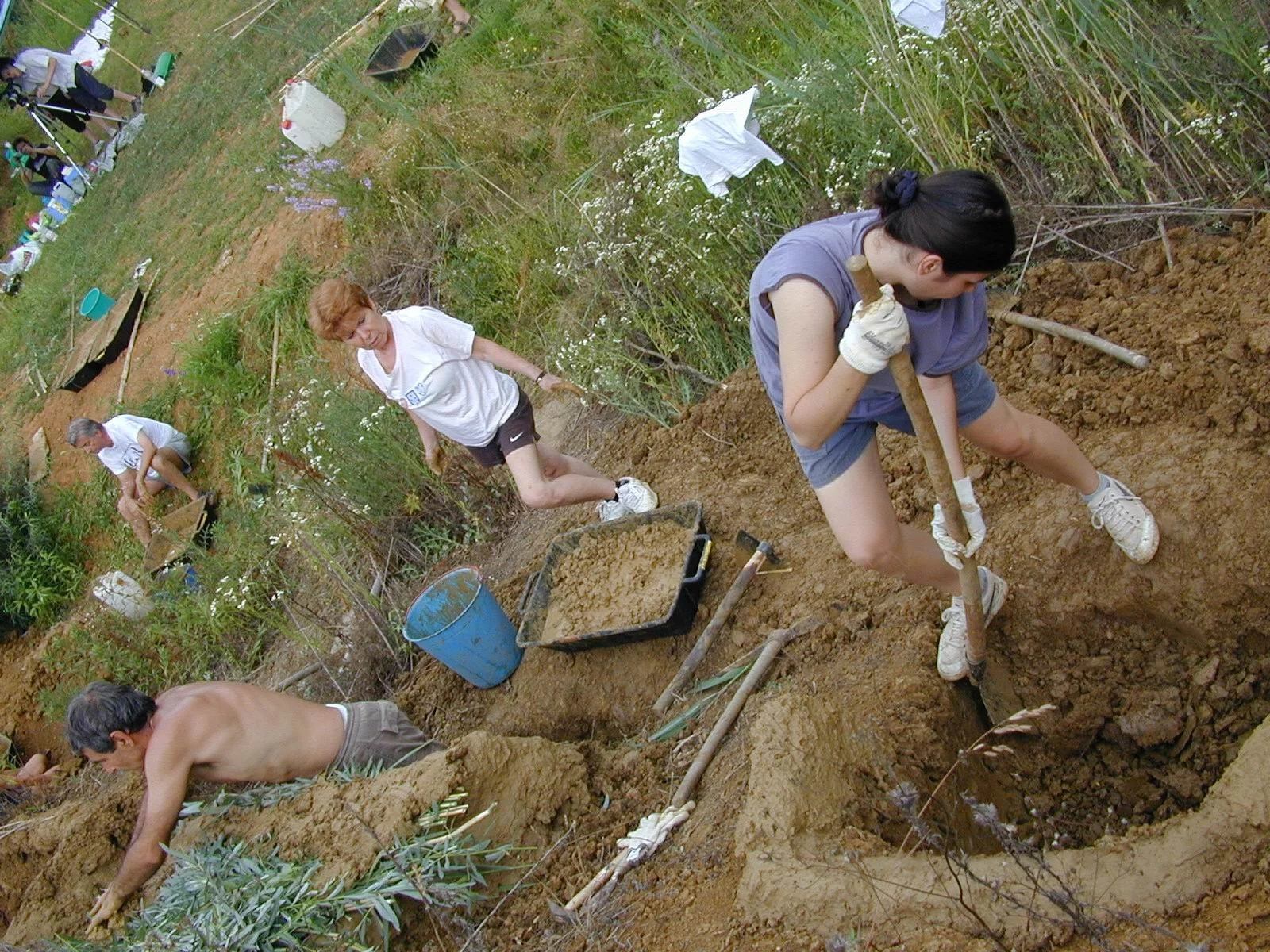
Andrea Caretto and Raffaella Spagna, “Anthill Village,” 2005. Participants of a raw clay workshop collectively dig out and process the clay. Photo courtesy of Andrea Caretto and Raffaella Spagna.
There is so much talk these days, and so much noise. Even our most crucial words, like “sustainability”, have been worn thin by overuse, stripping them of their radical meanings. Information is so abundant that it slides off us without leaving a mark: we know, yet knowledge fails to spur us to action.
There exists a place, however, that has dedicated itself to the art of sensing reality: Munlab Ecomuseo dell’Argilla. It is located in a special place, the Poirino plateau, spanning roughly 400 square kilometers in central Piedmont, northern Italy. Before tectonic shifts raised it above the surrounding plains, the area was traversed by a mighty river that deposited alluvial sediments over the course of millennia. Long ago those prehistoric waters changed their course due to significant tectonic movements and abandoned the plateau. Yet they left behind precious traces: subterranean deposits of alluvial clayey silt, that is to say, raw terracotta clay.
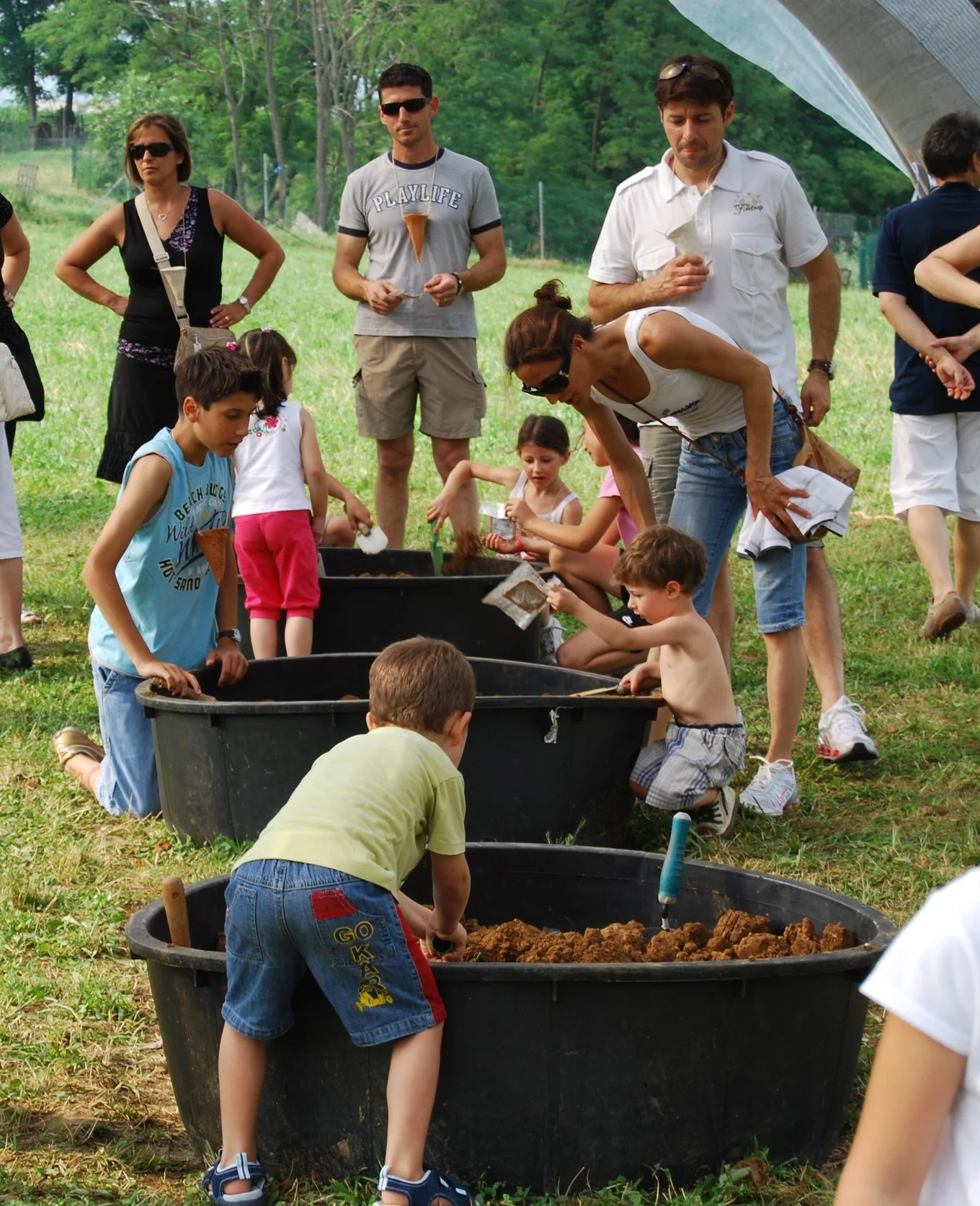
Munlab’s Clay Festival, 2008. An event organized with the participation of 40 residents (youth, families, seniors, teachers, etc.) from the town of Cambiano, where Munlab is located, to provide hands-on clay experiences through games and explorations in the quarry. Each station was designed, created, and managed by volunteers. Photo courtesy of Archivio Munlab.
Although hidden from view, this underground materiality has profoundly shaped the local ecosystem. The clay etches undulating lines on the horizon, marking the cycles of agricultural production. It has also determined the appearance of the region’s villages and cities, most of which are constructed from red bricks. The entire Pianalto manifests the clay’s presence, from redness of plowed fields to the extraction quarries, deep as open wounds.
It is industrial brick production, in fact, that has left the most visible marks. Over time, the clay used for brick-making has been extracted by digging deeper and deeper into the ground, creating voids across the landscape. Once these deposits were depleted, they were either abandoned or transformed into poplar groves, artificial lakes, and landfills.
In 1987, Cesario Carena, an architect, designer and artist, whose family had founded the brick manufactory Fornace Carena in 1907, decided that the secret of clay should be revealed, in a very different way from the brutal action of the excavators or the systematic turning of sod. He decided to narrate the peculiar ecology of the Pianalto, introducing a new connection to the landscape. Carena reclaimed abandoned areas of the company’s brick kilns, the depleted quarry, and other obsolete facilities. He dedicated himself to the deep essence of clay, showing its interdependence with all other elements of the territory and celebrating its boundless potential. Above all, he hoped that people would finally see the local clay through different eyes.
Slowly, artists, educators, ceramists, sociologists, and naturalists gathered around him, all taking part in his experiments with the material. A space open to the community gradually took shape: a place where anyone could experience firsthand what it means to be part of a territory. This is how Munlab was born. Today, it remains an open and diverse community where immersion in matter is proposed as a transformative experience. The goal is to position human beings within a system of relationships that encompasses quite literally everything around us.
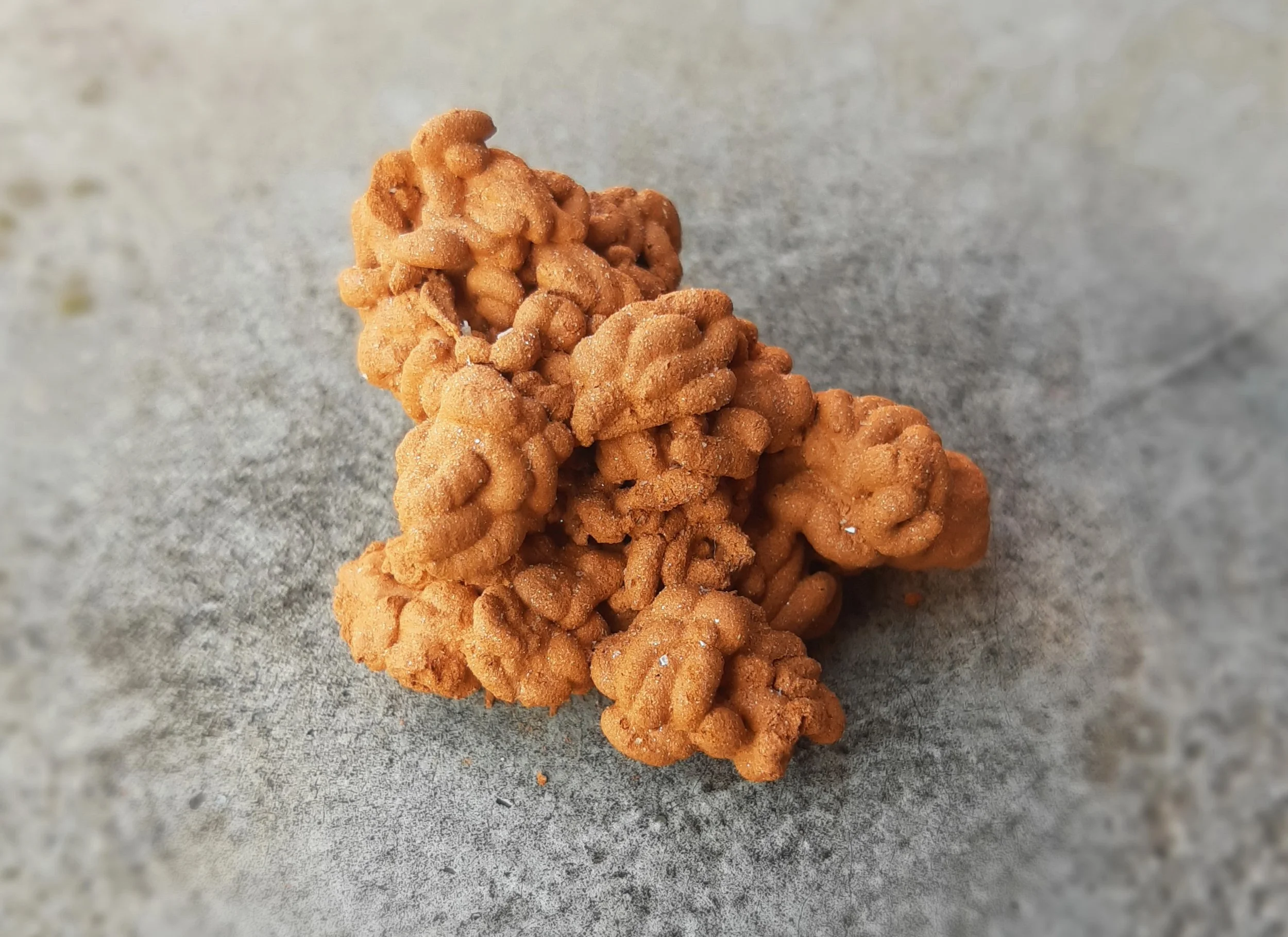
Andrea Caretto and Raffaella Spagna, “Monument to the Earthworms” or “Homage to Charles Darwin,” 2023, Terra cotta, Earthworm castings fired in the ceramic kiln.
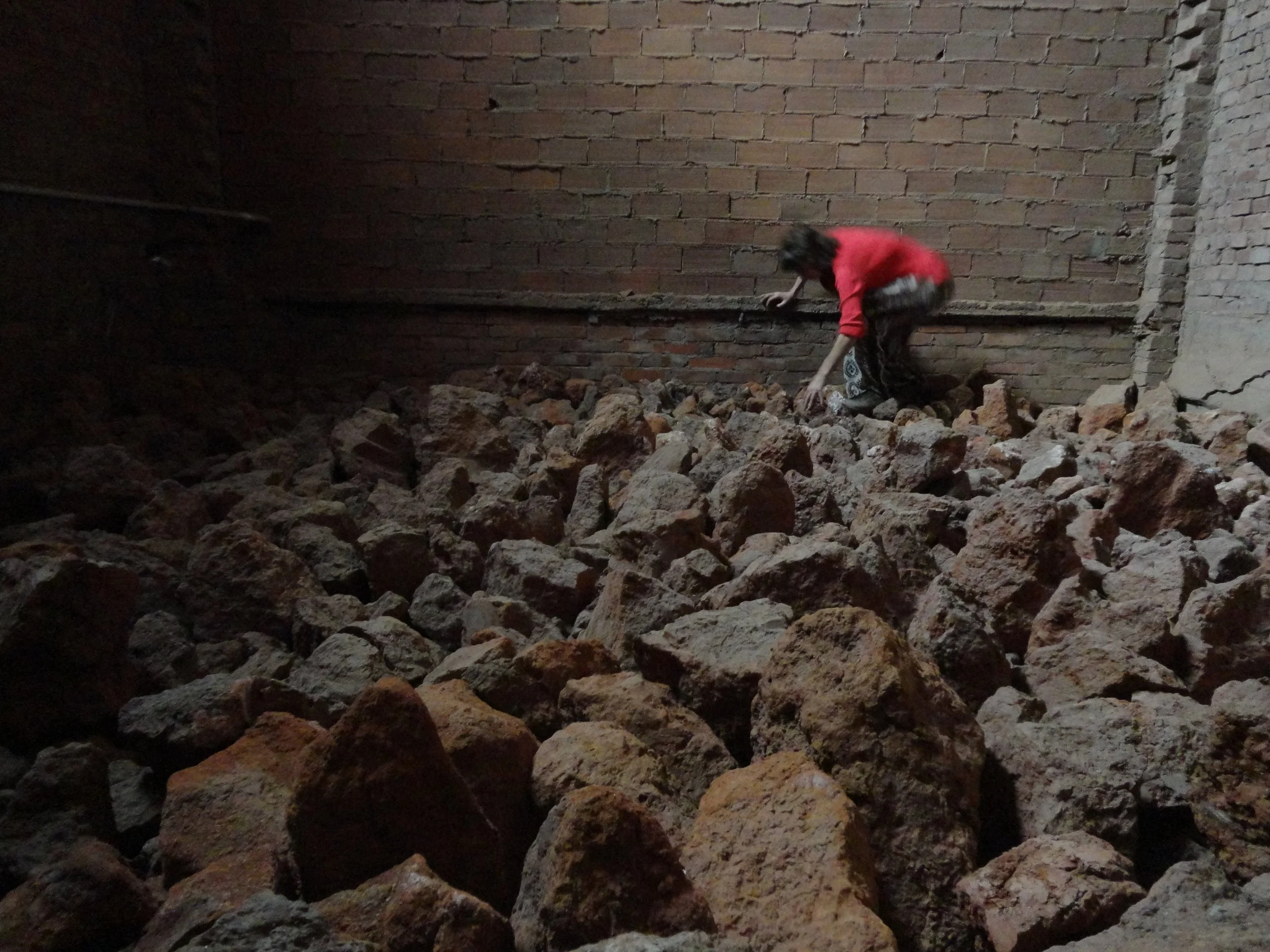
Cesario Carena, “Campo cotto a quota -4.80 m” (Baked Field at altitude -4.80 m), 1986. In October, in the countryside, farmers prepare their fields for planting by cutting into the soil with ploughs. The work is remarkable. But how can this ephemeral landscape be fixed in time? By baking it. But baking is diffcult: the clay of the field is rich in humus and the soil clods lose their cohesion as they dry. The kiln quarry, where the clods are buried deep in the ground, comes to the rescue: the excavator ploughs the surface of the quarry just as the plough would the field, but the sod, dug to a depth of -4.80m, is humus-free and compact. Campo cotto is made from quarry sod that is dried, baked and exposed at the same excavation depth of -4.80 m. Photo courtesy of Andrea Caretto and Raffaella Spagna.
Artists Andrea Caretto and Raffaella Spagna have their studio inside Munlab, and collaborate with its staff on an ongoing basis. They have been working together since 2002, and their approach is grounded in an attitude of experiential presence, in close contact with matter. Caretto and Spagna seek to establish - or reestablish - a relationship with the other inhabitants (mineral, vegetable, animal) of the world. Through the sharing of their artistic practice, they invite the public to perceive an interconnected web, and to experience reality as a composition of elements in continuous correspondence.
For an experimental workshop which took place in July 2005, Caretto and Spagna organized a collective endeavor in within the confines of the "Oasi" – a once-depleted quarry that had been re-naturalized by Munlab, and temporarily transformed into an open-air self-construction site. A group of local people was invited to come together and collectively explore the inherent human drive to reshape the environment and create habitable shelters. Equipped with rudimentary tools such as hoes, shovels, picks, and, of course, their own hands, the participants began digging clay and crafting it into habitable “dens.” These small spaces were either modeled on the surface or meticulously sunk into the subsoil. As their collective effort unfolded, interconnecting pathways between the small dwellings gradually wove together, unveiling a small community marked by a rich array of construction styles and forms. The artists dubbed this creation "Anthill Village."
The act of digging and constructing offered each participant an up-close encounter with the very essence of clay.
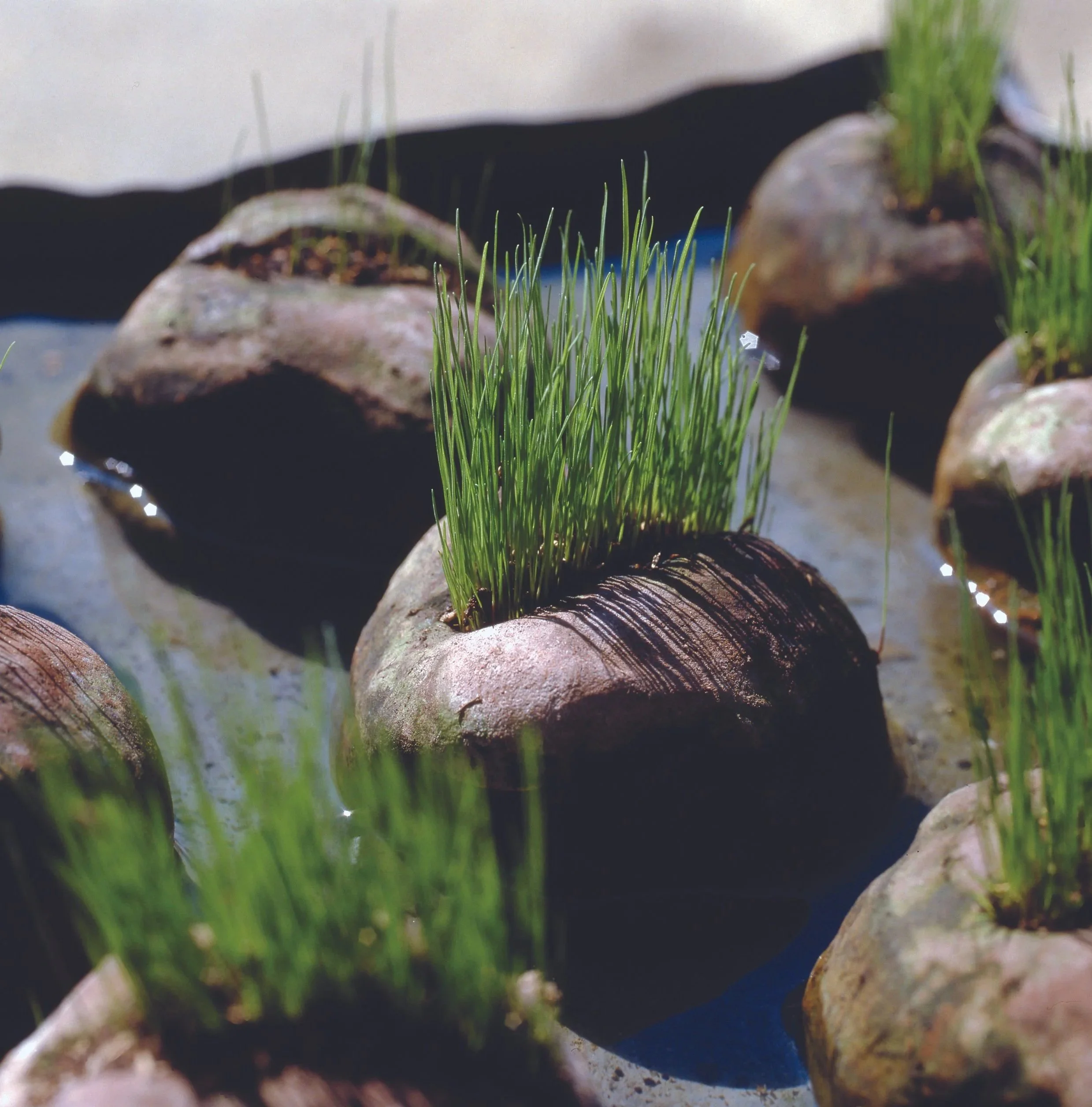
Cesario Carena, “Capillarità” (Capillarity), 2018. Simple shapes needle forms, pistils and spheres —are submerged in water, which slowly rises until it activates the germination of the sown humus. The result is a range of aesthetic ideas that take advantage of the natural properties of terra cotta. Photo courtesy of Paolo Robino.