Of earth and sky
Susan Tunick
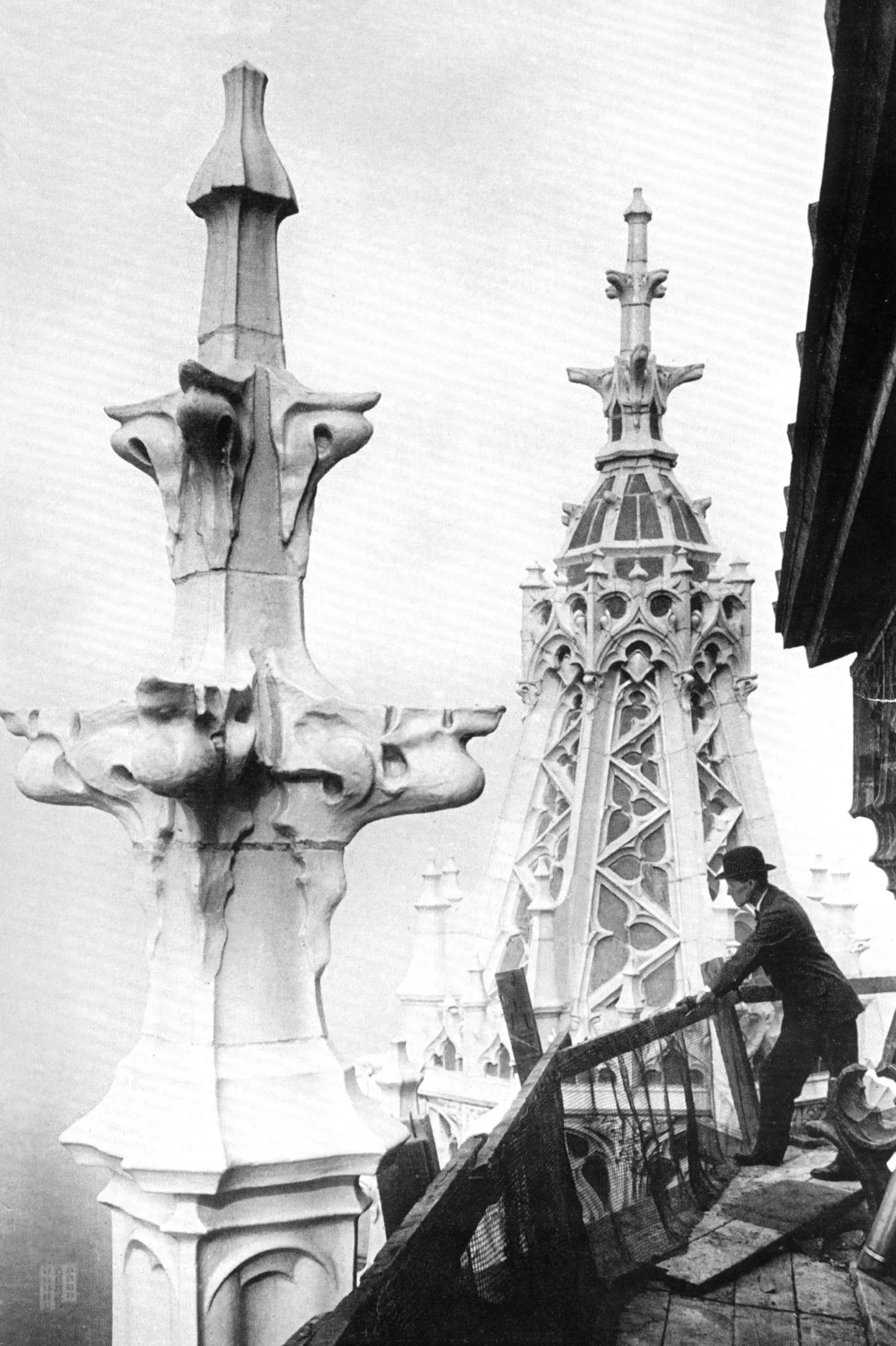
Atop the Woolworth Building, New York, New York. Courtesy of the Friends of Terra Cotta Collection.
The New York skyline… is more than half architectural terra cotta. And yet – not more than one lay mind in a thousand appreciates the fact, and even to some architects and builders, this truth will come as a surprise.
–The New York Times, May 14, 1911
What was true in 1911 remains true today. Many of the city’s historic structures are elaborately ornamented with terra cotta – façades and rooflines, natural or glazed, in matte or glossy finish – but they frequently go unnoticed. Terra cotta brought a new expressiveness to skylines across America, vivid yellows, greens, and cobalt blues, as well as metallic lusters of silver and gold, emphasizing lavish architectural detailing.
Terra cotta was first used in American architecture in the 1850s, and gained widespread popularity in the 1880s. Over the following half-century, it was used to embellish thousands of buildings nationwide. Then it hit a wall: with the halt of construction during the Great Depression, demand suddenly declined. When building resumed after World War Il, the modernist aesthetic made terra cotta unfashionable.
In its day, though, terra cotta was king. It was used for many Manhattan landmarks, including Carnegie Hall, the Flatiron Building, and the Woolworth Building – dubbed the “highest of the handmade buildings,” and completed in 1913. Frank Woolworth intended to build a structure that was not a purely a commercial venture, but a worthy ornament to the city. The challenge for its architect, Cass Gilbert, was “how to combine height with architectural distinction.”
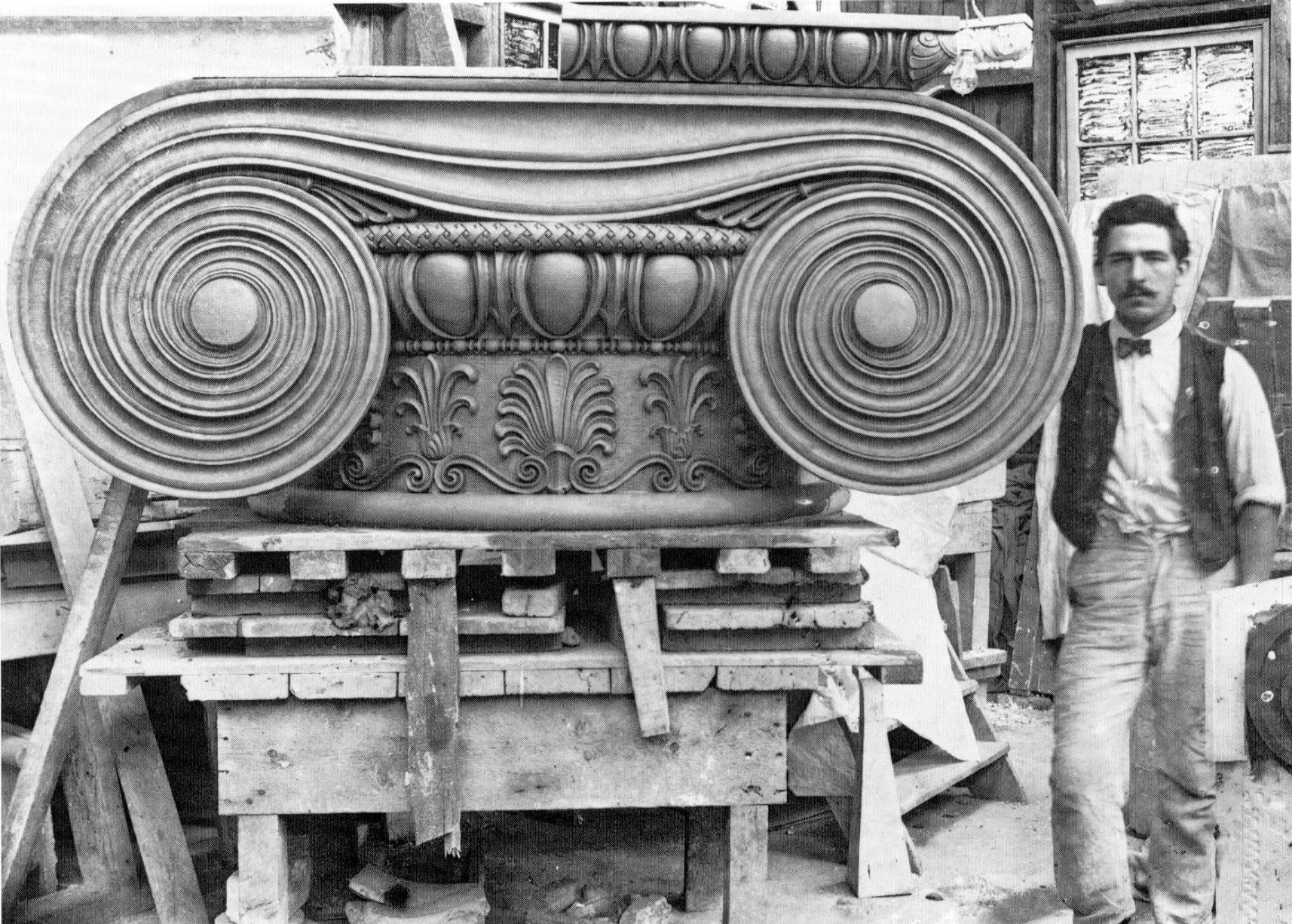
Worker in the Modeling Room of the Atlantic Terra Cotta Company, New Jersey. Courtesy of the Friends of Terra Cotta Collection.
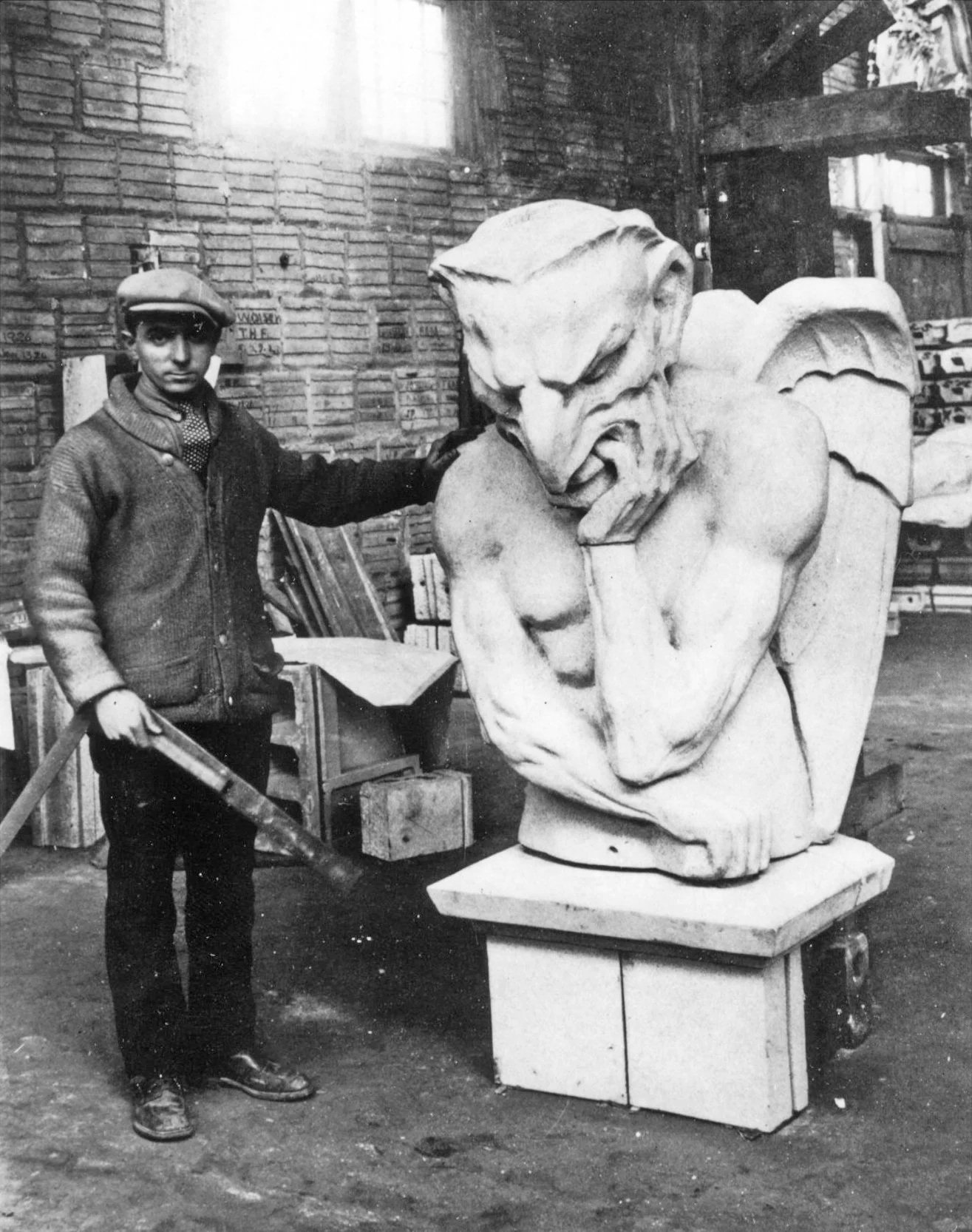
Stereo view of the O. W. Ketcham Terra Cotta Company, Pennsylvania. Courtesy of the Friends of Terra Cotta Collection.

Trifold postcard of the Woolworth Building, New York, New York. Courtesy of the Friends of Terra Cotta Collection.
Terra cotta cladding was the obvious solution. No less than 7,500 tons of it were produced for the project by the Atlantic Terra Cotta Company in Perth Amboy, New Jersey (which had become the largest terra-cotta company in the world following a merger with three other manufacturers, in 1907). On its completion, critics hailed the building as a feat of structural engineering. The critic Clarence Ward praised the poetry – indeed, the “Gothicness”—of its “lacelike and beautifully proportioned terra cotta detail.”
How were such feats of mass ornamentation achieved? The answer lies in the materiality of architectural terra cotta, a fine-grained product similar to brick, but made from a higher-grade blend of clays, with grog (pre-fired material, ground into tiny bits) and other additives. The molded elements applied to building exteriors were typically hollow blocks with open backs, small enough to reduce cracking and warpage, and facilitate handling.
The process of architectural terra-cotta production, from blueprint to final installation, is complex and fascinating. Each design passed through the hands of dozens of workmen, varying in skill and background, from the finest European immigrant sculptors to untrained day laborers. Terra cotta pieces were rarely signed by individuals, and only occasionally stamped by manufacturers. This has left us with a clay legacy produced largely by unknown craftsmen.
The process began with the architect, who (according to the Atlantic Terra Cotta Company)established “the architectural style and period to be used as a precedent, possibly supplemented by rough sketches of particular details.” Working from these general instructions, the modeling department created prototypes which were photographed for approval by the architect, then translated into plaster molds.
The next stop was the pressing department, where malleable clay – about the consistency of bread dough – was pressed by hand into the molds. (Today, it’s more common in new construction and restoration projects to use a ram press or an extruder, which forces the clay through a custom shaped die.) After the clay stiffened, the mold was removed, and any imperfections were carefully repaired in the finishing department. Each piece was coated with either a liquid clay (slip) or glaze, and fired to approximately 2000 degrees Fahrenheit. Finally, once un-stacked from the kiln, the units were sent to the Fitting Department, where they were measured for quality control, and numbered with black paint. These numbers appeared on the drawings sent along to the job site with the finished terra cotta, showing the exact location for each piece.
Few people realize it, but this artisanal process played a key role in the emergence of the skyscraper, along with the advent of metal skeleton frames and the passenger elevator. Terra cotta was relatively inexpensive (roughly one-tenth the cost of carved stone) and could be applied to a curtain wall in panels, horizontally from column to column, and vertically from girder to girder. As one commentator noted, “the problem was so radically solved that the masonry or clay walls could be built from the top story downward, if desired.” Terra cotta was also light, fire-resistant, and thanks to the molding process, could easily be used to create a repeat of motifs.
The combined technology of steel and terra cotta changed architectural engineering more than any development since the medieval flying buttress. America’s urban landscape was thoroughly re-shaped as a consequence. After decades of neglect, appreciation for these buildings – so strikingly modern in their time – has grown with the rise of a preservation movement. Next time you are walking down a city street, take a look up at the beautiful clay decoration, its details still crisp and clear all these years later. It used to be the future.
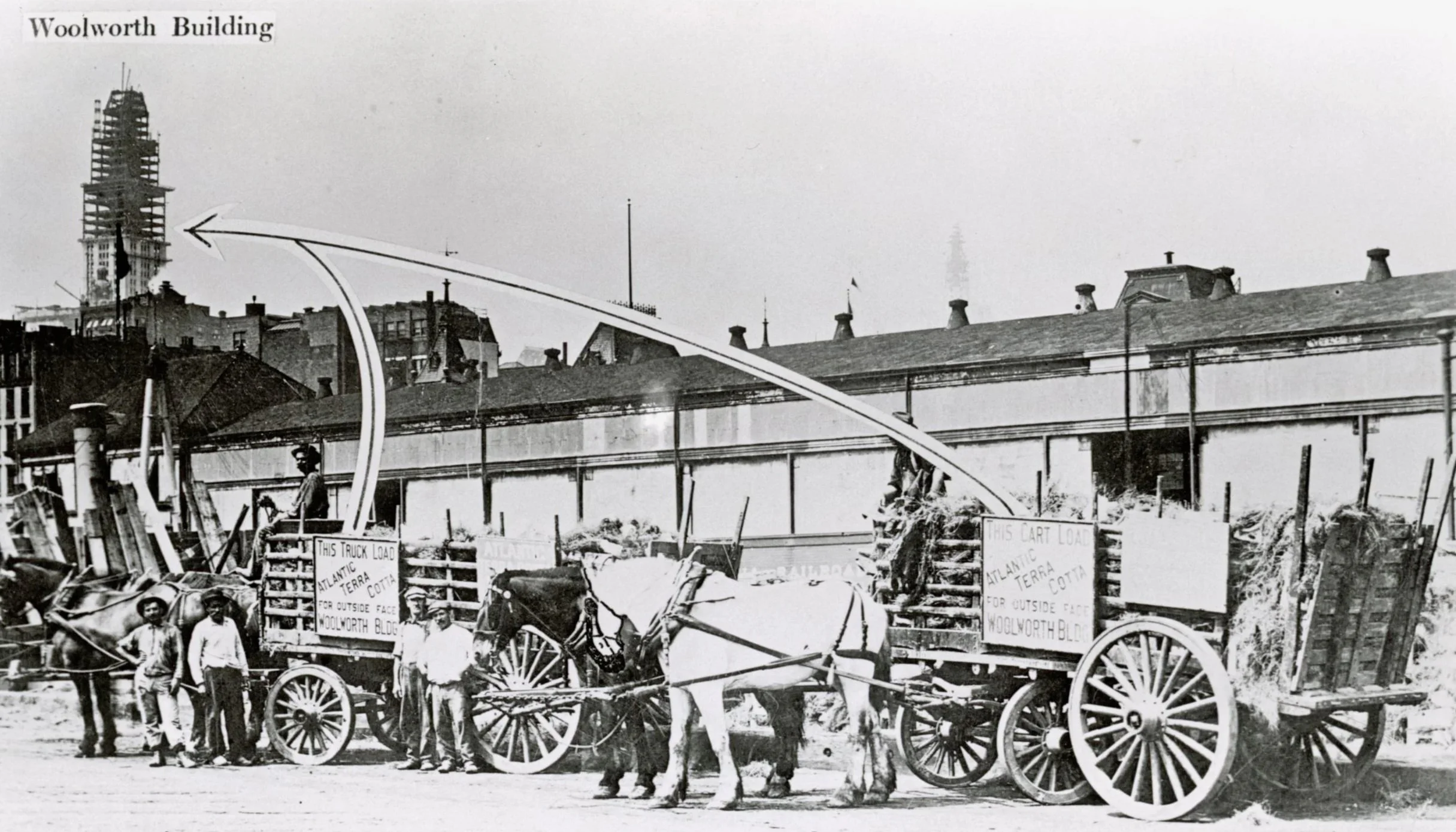
A terra cotta delivery to the site of the Woolworth Building, prior to 1913. Courtesy of the Friends of Terra Cotta Collection.