The day of the crayons
Joana Albernaz Delgado
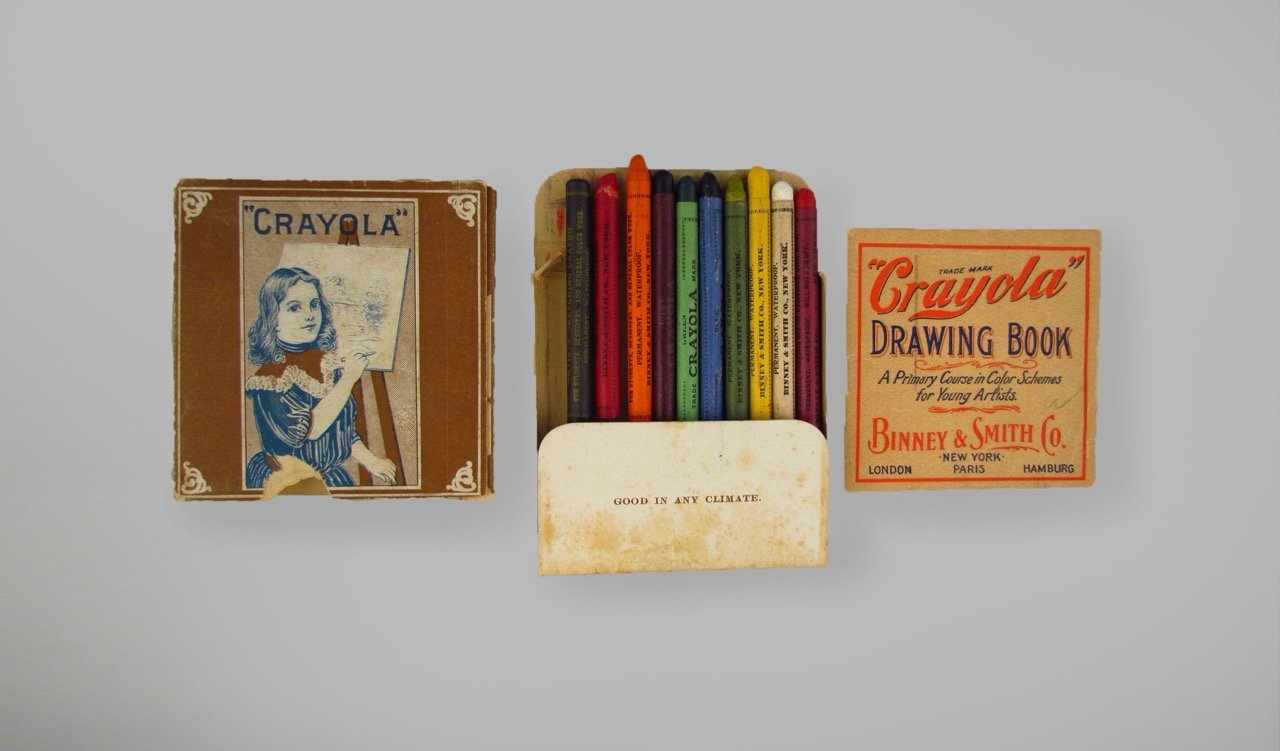
Binney and Smith, Box of Crayons (open), 1903–1909. Division of Home and Community Life, National Museum of American History, Smithsonian Institution, Washington, DC, 1998.0068.
The Day the Crayons Quit, published in 2013 with brilliant illustrations by Oliver Jeffers, was inspired by an actual old box of Crayolas. The author, Drew Daywalt, posted a photograph of them on his website. “I couldn’t for the life of me remember the last time I had colored,” he noted, “But here was a box I’d apparently kept with me, moving them with all my office stuff from apartment to apartment.” The photo is a bit blurry, but you can’t miss the distinctive green and yellow of the brand, familiar to children everywhere.
Binney & Smith, the American paint company that launched Crayola in 1903, was not the first to manufacture wax crayons for children. The name was suggested by Alice Binney, a former school teacher and the founder’s wife, who combined the French craie, chalk, with ola, from “oleaginous.” In 1900, Franklin Crayon Co. had advertised boxes of “Rainbow Crayons” for the young, later claiming to be “the first of the kind made in the U.S.” The American Crayon Company, in their 1902 catalog, offered “an attractive line of toy wax crayons and school marking crayons, in addition to the older, now well-known products.”
What was new? Not just the focus on younger demographic, but also modern paraffin wax, which made crayons that were (so the manufacturers claimed) “superior to oil or water colors and pastels,” which could “be blended and overworked,” which would “not blur nor rub off.” Tired mothers and busy educators were assured that these new crayons were “not injurious to the hands,” would not “soil the clothes,” were “cleaner and handler than water colors for children’s use,” required “no brushes to clean” and “no waiting for the colors to dry.” Crayola crayons were also advertised as “good in any climate,” ideal for outdoor drawing activities and sweaty little hands.

H. Armstrong Roberts, 1940s, Two Children Coloring in Book, 1945. Archival photograph. Photo: H. Armstrong Roberts / ClassicStock / Alamy.
Wax crayons for children thrived in the U.S. alongside Froebel’s Kindergarten movement, which fostered a Rousseau-inspired ideal of imaginative play, nurturing preschoolers’ good nature before stiffening them up for traditional schoolwork. Crayon advertisements appeared in education periodicals flanked by articles about crayon crafts for children. Crayola’s history unfolded close to the classroom: Binney & Smith’s eight-color sets were originally intended for in-school use. Crayons hovered somewhere between toys and school supplies; they were “not designed simply for a toy, but for good practical work.”
Preschool activities recommended in turn-of-the-century educational publications included “free drawing”—but not that free, as there was a list of what to draw ("people walking in the rain,” "trees with new leaves"). Larger Crayola boxes were marketed to “Young Artists,” and accompanied by educational booklets. Girls in bouncy curls and pretty dresses showed grownup landscape work, oddly mounted on easels to stress artistic intention. Colors were given historical names that all artists, young and old, should know, including Venetian Red, English Vermilion or Van Dyke Brown.
Today, crayons come in scented, glitter and jumbo versions, and new colors resonate with other aspects of children’s everyday lives: Macaroni-n-Cheese, Razzmatazz, Piggy Pink. Instead of instructing little Van Goghs, the focus has been on a growing, arguably unhinged, consumerist market fuelled by a supposed belief in freeing young minds. Wax remains crucial: as solid bodies of coloring material, crayons facilitate alternative drawing techniques that go beyond the tyranny of the pedagogically-approved pencil grip. Crayola shows how to hold crayons in different ways; teachers even confess to ripping the paper covers off to encourage creativity.

Inspecting Crayons At Binney & Smith (Crayola Crayons), Easton, Pennsylvania (Northampton County), USA. Photo: H. Mark Weidman Photography / Alamy.