Cold visions 

Vy Tsan

In the hot Summer of 1995, contemporary Chinese artist Yin Xiuzhen extracted gallons of water from the Funan River in Chengdu. By then, the river that had once been lauded in Tang poems had become a vessel for the city’s wastewater, accommodating the rapid industrial expansion happening inland. 

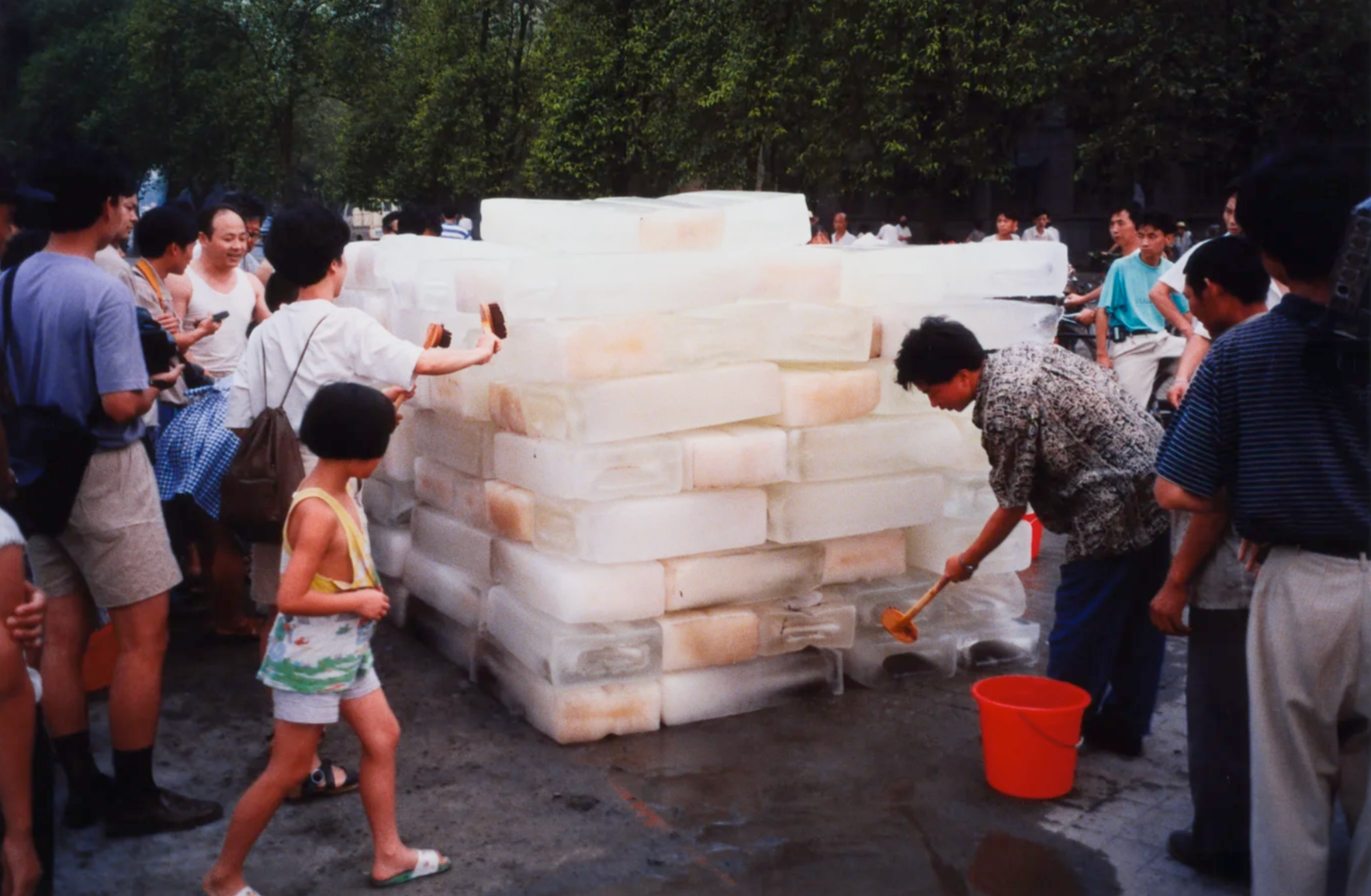
Yin cast this polluted river into a sculpture, freezing it into solid ice-bricks, white mottled with black and brown, which she then stacked them atop one another. She built something she could show to the people of Chengdu, exhibited on a concrete walkway along the riverbank with bright red, plastic buckets and brushes. For two days, she invited the public to clean the sculpture before it eventually melted and returned to the river. 

Yin’s gesture – entitled Washing River (1995) – was intentionally futile, a ritualistic purification akin to that of a Buddhist monk or shamanistic exorcist. Her local audiences, who call the Funan their “mother river,” were recruited into this quixotic act: they appear in her photographs wielding brushes of all kinds used to clean hard and soft surfaces. Ice, as a medium, played a central role in structuring this encounter. Transforming water into solid form, if only for a moment, rendered it a distinguishable object. Yin’s suspension of water from its system not only isolated it from the Funan River, but all the other bodies of water around the world to which it is ultimately connected. For a moment, she was asking the people of Chengdu to care for this water that flows through the world. 

In this sense, Washing River speaks to universal conditions while emphasizing the responsibility of the individual in global climate emergency. By encouraging people to touch her ice sculpture, Yin also reveals that material as active rather than passive. Unlike fixed but fragile mediums such as fired clay, which demand careful handling, ice’s ephemeral quality allows it to be engaged without restraint. The people cleaning the river with their bare hands felt the cold, saw the melting; the river responded to their touch. But ice cannot be held for long. 
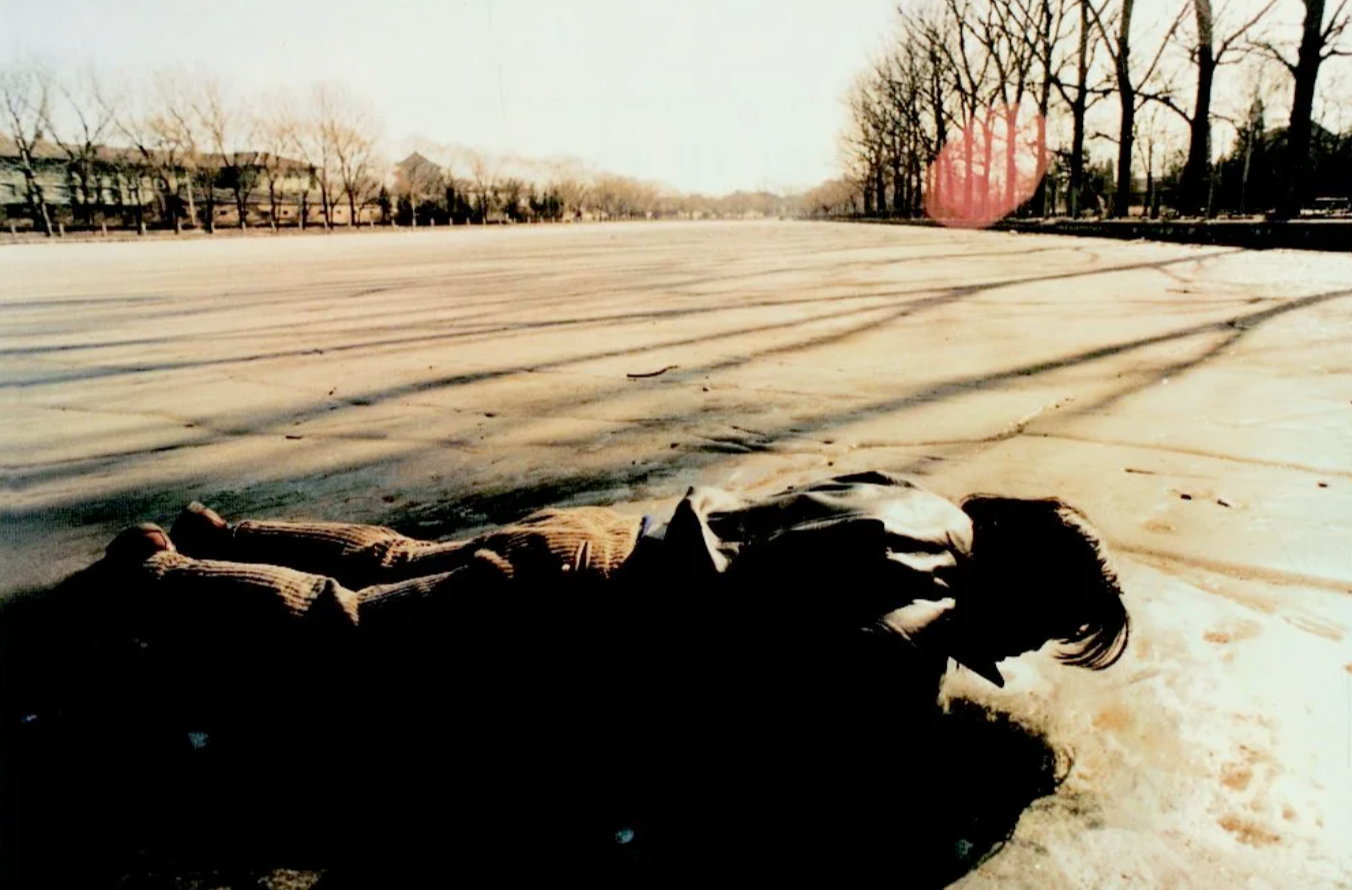
On the following New Year’s Eve, Yin Xiuzhen was the only intended audience member for another performance revealing the ephemeral, transformative qualities of ice. This was a work by the artist Song Dong (b. Beijing, 1966), whom she met at the Department of Fine Arts of Beijing Normal Academy, where they were both studying oil painting. That winter night, in sub-zero temperatures, wearing nothing but a thin leather jacket and corduroy trousers, Song laid prone on the pavement in Tiananmen Square for forty-minutes, face down, breathing in and out, until his warm breath condensed in the cold and dry city air and formed a sheet of ice beneath him. 

This image perhaps alludes to a warning in the Analects of Confucius: the teacher asked for men to tread lightly and cautiously in court politics, as if walking on “thin ice.” This is just what Song was doing in his oblique critique of the Tiananmen Square massacre, seven years after the event. Yin witnessed Song’s fleeting sculpture and documented it in a photograph. 

The next morning, they continued the performance at the manmade Houhai Lake, near Tiananmen Square and the Forbidden City. The lake was frozen, and Song laid down once more, trying to melt the ice in front of him with his hot breath for forty-minutes, to no avail. He set out to create two mirror images of ice, forming and melting in response to his body, but the frozen Houhai would not relent. Yin’s photos were printed as a diptych, which Song called Breathing (1996). 

The two artists had graduated from the academy in 1989, the year of the massacre; that same year, they stopped painting. It was also the year of several important exhibitions, both in China and abroad:   Robert Rauschenberg’s first exhibition in China at the National Art Museum; Gao Minglu’s China/Avant-Garde exhibition, which Yin has called “the closing act of the ‘85 Art New Wave’”; and the seminal ‘world’ exhibition Magiciens de la Terre, which included the first-generation Chinese avant-garde artists that Song and Yin had seen in Beijing: Huang Yong Ping, Gu Dexin and Yang Jiechang. During the Paris exhibition, Huang was granted political asylum in France due to the events of Tiananmen Square. 

1989 was thus a year of change in Chinese art history, haunted by political trauma and social upheaval, of which Tiananmen Square became an enduring symbol. Somewhere between that date and 1996, when Yin and Song created their cold visions, they were married. The Funan River and Houhai Lake, meanwhile, remained largely unchanged, seemingly indifferent to the emotional currents shaping people’s lives. 

Let’s return, now, to Yin’s photograph. Song appears in the left-corner, partially obscured by the long shadows of tree branches. Against the bright and expansive field of ice, he seems to meld with his own shadow. Yin captures him suspended between moments, breathing in the future even as his past self, breathing out, lingers as a dark echo. Song used ice as an equalizing image of nature, speaking to the impermanence of what humans can create on this earth. After he departed, the ice swallowed his trace, as if he had never been there. However, Breathing, like Washing River, suggests that futile acts are worth undertaking. The fragile warmth of Song’s body had no effect on the unyielding environment, yet he still marked a site of trauma, reimagining it as a place to begin again.


Vy Tsan is currently a Curatorial Fellow with New Curators, where she is co-curating Korean-American artist Kang Seung Lee’s solo exhibition at South London Gallery. She has previously held positions as Curatorial Assistant, International Art at the National Gallery of Australia; Content Coordinator at Craft + Design Canberra; and Curatorial Intern at Galeri Nasional Indonesia. In 2024, Vy was awarded the 2024/25 Dr Hettie Elwood Scholarship at SOAS University of London, where she is currently undertaking an MA dissertation on the collecting practices of Vietnamese-Danish artist Danh Vo.

Brilliant Move

Brilliant Move is the Brooklyn-based creative studio of Marci Hunt LeBrun specializing in building websites on the Squarespace platform – among many other things.

I love working with small businesses, nonprofits, and other creatives to help them organize their ideas, hone their vision, and make their web presence the best it can be. And I'm committed to keeping the process as simple, transparent, and affordable as possible.

https://brilliantmove.nyc
Previous
Previous

Something leads to nothing

Next
Next

Icegiving